My interview with Eugene Peterson

(Originally posted on my substack)

Back in 2006 I was working for St Andrews Bookshop and in the early stages of my Old Testament PhD. One of the most significant writers for me up to that point was Eugene Peterson. His books like Working the Angles and Under the Unpredictable Plant had been transformative, particularly at moments where I was feeling tired and cynical towards ministry.
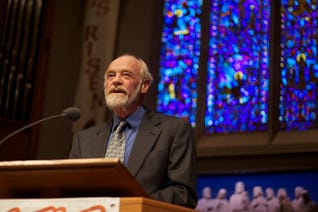
Every now and then I would do an interview with an author for St Andrews website or magazine and a colleague asked if I wanted to go up to the Christian Booksellers Convention where Peterson was doing the Bible readings. His UK publisher Hodder & Stoughton had brought him over from the States to promote Eat this Book: The Art of Spiritual Reading, the second volume in his Spiritual Theology series.

The following is the transcript of the interview that came out of it. I still have the recording on a micro-cassette (remember those?). Maybe one day I’ll figure out how to digitise it, clean up the background hiss, and post the audio too.

I hope you enjoy reading it. Peterson died in 2018 aged 85. I still go back to his books, and remember that day fondly; it was a warm conversation that feels just as relevant 18 years on.

Tim Davy: Firstly, tell us a bit about yourself and what you are doing in the UK at the moment.

Eugene Peterson: Well, I’m in the UK at the moment at the Christian Booksellers Convention at the invitation of Hodder & Stoughton, who are the publishers of a new series of books I’m writing on spiritual theology. The second one is just published and is called Eat This Book. It’s on the art of reading Scripture, ‘spiritual reading’.

I grew up in a small town in Montana. I grew up in a Pentecostal church and ended up as a Presbyterian. I thought I’d be a professor; I was preparing to be a professor and actually did start out being a professor of Hebrew and Greek in a seminary. But then I had what I call a conversion; it was a vocational conversion. I realised what pastors did and I just thought, ‘That’s what I’ve always wanted to do’. I’d just never realised what was involved, but circumstances converged to put me in a place where I realised, ‘That’s my identity’.

So while I’ve taught a good bit through the years in different places (I ended up for 6 years at Regent College as a professor), I’ve always had this self-identity as a pastor, and in fact I still do: that’s who I am.

TD: Do you think that your pastoral identity was particularly crucial when you were writing The Message, which I suppose you are most well-known for?

EP: Oh yes, definitely. I could never have done The Message without being a Pastor. The Message distils years and years and years of preaching, teaching and praying. But central to all that was attempting to get the message of the Bible, the message written in Hebrew and Greek, translated into the language these people I was working with were living.

So all through The Message pastoral work was kind of the catalyst that formed those phrases, those images, the colloquialisms. And I wasn’t doing it for America or the UK; I was doing it for my congregation. So it was very local; I had three or four hundred people that I was doing that with, although I didn’t know what I was doing at the time. I never had any idea it would become The Message.

TD: Do you see the role of pastor, theologian and biblical interpreter as all being one vocation?

EP: They have been for me. But the catalyst that pulled those things together was the congregation: local, personal, involved with all the mess of community, sin, salvation. For me, I never felt I quit being a theologian when I became a pastor, and I never felt I quit being a biblical exegete when I became a pastor; they were just incorporated into something more personal and local and present.

TD: You mentioned the word, ‘mess’. One of the things I’ve got from your writing is this idea of the pastor recognising God in the mess and how life is untidy and people’s spiritual experiences are untidy. Is that a common view in the world of church leadership?

EP: You know I don’t think so! Many pastors have the self-defined role of ‘tidying up’ the congregation; making it presentable and dressing them up, washing their face, making sure their noses are blown. And of course, in so much of our culture today, churches advertise themselves or present themselves as these glamorous, glorious places where everybody has their problems solved, everybody sings and praises the Lord. I think it’s all a lie; it’s hypocrisy. I’ve never known any congregation like that and I think a good number of people stay away because they are presented like that. Other people join because they think it’s going to be like that but I think the most accurate description of a Christian congregation is the Hebrew phrase tohu v bohu (formless and void – from Genesis 1:2). But what happens in that tohu v bohu is that the Spirit of God moves over the face of the waters and that’s where the creativity takes place. God says, ‘Let there be light’, ‘Let there be Tim’, ‘Let there be salvation’, ‘Let there be this healed body’. But it takes time; I don’t think it happens in six days!

TD: I was flicking through Christ Plays in Ten Thousand Places this morning, where you say that “Sunday is no longer a rehearsal of escape… it is an exposition of the week”. So, that’s the same kind of thing?

EP: Yes, exactly.

TD: I can remember exactly where I was when I read the first two pages of Working the Angles. I know you’re a fan of Dostoevsky; they reminded me of Notes from the Underground in which the first page slaps you in the face and grabs your attention!
You say in
Working the Angles that you are an angry pastor; that you felt abandoned. Are you still angry?

EP: I don’t think I’m still angry but I still get angry. I don’t think anger is a prominent part of my life, but I do get angry, Tim. I get angry that so many pastors and leaders take this with so little seriousness. I mean, we’re dealing with really important things and they play games, they devise silly programmes, they fool around trying to find a way to get more people into their church.

I don’t know what it’s like here but in America there is a huge trivialisation of the Church, and that makes me angry. When you see what is precious and valuable and eternal being treated like a piece of commerce it makes you angry.

But for me the anger is momentary and it ignites something (usually a book!) and I work it out, trying to go back again and start at the beginning, and work out all the implications of this. I try to show people how everything is interrelated in this; it’s all interrelated by the Spirit of God – the operations of the Trinity.

But I think anger is a good triggering emotion for me; it doesn’t sustain me but it pulls the trigger. Richard Hugo, a good poet from Montana, has a poem called The Triggering Town. It’s about towns he goes through and something in that town triggers something – an image, a metaphor – and then he writes this poem. There’s always a triggering thing that gets the poem going. Well, that’s true for me with books, sermons, lectures. If there was no mess, I wouldn’t have anything to do!

TD: This new series, Spiritual Theology; is this your magnum opus? Is this what you’ve been building up to say over your ministry?

EP: Well, magnum opus seems a little bit pretentious, but yes it does feel that way. I feel like I’m getting everything together that I’ve been doing all my life and I hope I can fit it together well.

In some ways, when I did The Message, I had the feeling that it was a kind of a culmination of things. This is my whole pastoral life redrawn into the Scriptures and expressed in a way that was part of my congregation.

If I had to visualise these five volumes of Spiritual Theology, this is the underground of The Message, the background. This is all the thinking and the exegesis and observation that produced The Message.

TD: So, ‘the man behind the message’?

EP: Right.
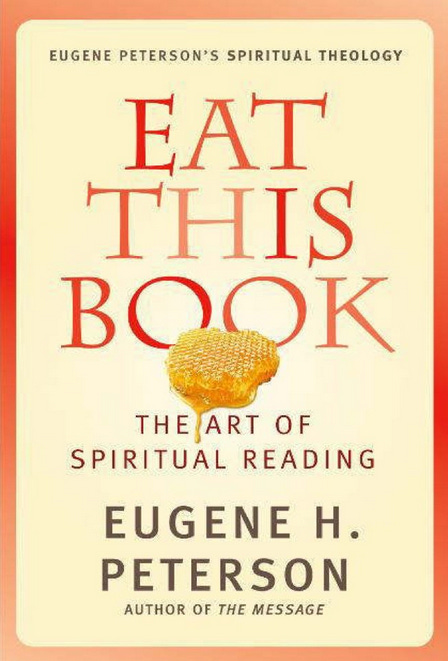
TD: Your new book, Eat This Book, is about ‘spiritual reading’. What precisely do you mean by spiritual reading?

EP: It’s a way of reading. It isn’t confined to Scripture; it’s a way of reading anything. I guess I would contrast it with informational reading (like when you read a mathematical textbook or a history book – you’re trying to get the facts), or functional reading (reading to know how to do something, like a manual for reworking your carburettor). And then there’s another kind of reading I guess I would call inspirational reading, where you read to feel better, to clarify your thoughts. And of course there are other kinds of reading, like entertainment, mystery stories.

But there is a reading in which you let the author, let the book change you. Now, this is not my stuff, this is not new; it’s ancient. You are not going to the book to get something that you want; you are going to receive something that the writer wants to do. Revelation is what it is. It can be in a poem – we read most poetry this way: not to get a meaning but to let it shape a way of insight in us. We are not in control; that’s the key thing. We’re letting the author be in control. So we don’t keep asking questions like, ‘What does this mean?’ or ‘How did he get that?’. We are submitting to the mind of the maker (to use Dorothy Sayers’ phrase) and letting something be made in us. So this is what spiritual reading has always been.

The interesting thing (and in some ways the disconcerting thing) is that for a thousand years at least this was the major work of the Church. This is what pastors did. This is what theologians did. They taught people how to read receptively, rather than as a consumer. And then with the rise of the universities in the 12th century things shifted and we looked at a book now as something to be mastered or gotten something out of or explained. And this predominant way of reading, that was developed for a thousand years at least, kind of got pushed to the periphery. Monks did that; pious people did that. But if you’re really on the cutting edge of things you figure it out, explain it, use it.

TD: It reminds me of my own field of Old Testament Studies, with the changes in the last few decades with canonical criticism, ‘confessional readings’ as some would put it, accepting the final form of the text rather than dissecting and atomising it, which I think you touch on in another book.

EP: In Working the Angles I do that. I’m not sure I use the term ‘canonical’ but Brevard Childs influenced me a lot. William Albright was my professor.

It’s interesting to me, and maybe this is just a prejudice and probably wouldn’t hold up to any examination, but Old Testament scholars have been the pioneers in this, for me. They are the ones who discovered Scripture as narrative. They got fed up with this whole source criticism as a way to approach Scripture, and began discovering the world in which it was done, rather than trying to sort out the fragments and take them apart and show them.

TD: Is that because there is more about creation in the Old Testament, or is the Old Testament messier?

EP: I think it’s messier.

TD: I think that’s why I like it!

EP: Me too! Yeah, it’s messier; it’s just not the sum of its parts. It’s like somebody took apart an engine and started to put it back together again and then they have these parts around that don’t fit. But they do fit. Yeah, I like the mess too…

Liberating Scripture: An Invitation to Missional Hermeneutics

One of my aims for the site is to raise awareness of relevant publications. I may post subsequently with a review of a book or article but often I will just give a notification of something that has been published.

Liberating Scripture: An Invitation to Missional Hermeneutics written by Michael Barram and John R. Franke (with a foreword by Drew G. I. Hart and an afterword by Lisa M. Bowens). It was published in March 2024 by Cascade, an imprint of Wipf & Stock.

Here is the blurb and table of contents from the publisher’s website:

‘Rooted in and advocating for a postmodern and postcolonial understanding of mission, Liberating Scripture is the first book-length study designed specifically to introduce readers to the emerging subfield of biblical interpretation known as missional hermeneutics. The authors provide a thoroughgoing overview of the background and development, rationale, terminology, and methodology of missional hermeneutics, doing for biblical interpretation what Missional Church (edited by Darrell Guder et al., 1998) did for reimagining the church in light of the missio Dei. As the initial volume in the new Studies in Missional Hermeneutics, Theology, and Praxis series, Liberating Scripture is a critical resource for study and practical application, and its accessibility will make it a go-to text for classrooms and congregations.’

Table of Contents
Foreword
Introduction
Part One: Missional Hermeneutics
Chapter 1: Why Missional Interpretation?
Chapter 2: Missional Hermeneutics and Biblical Interpretation
Part Two: Toward a Missional Hermeneutic of Liberating Love
Introduction to Part Two
Chapter 3: How We Shackle Scripture
Chapter 4: Toward a Vision of the Missio Dei
Chapter 5: The Liberating Word
Chapter 6: Missional Hermeneutics and Theological Interpretation
Chapter 7: The Practice of Missional Hermeneutics
Afterword
The Forum on Missional Hermeneutics: Session History
Discussion Questions

Five reasons why pastors need to study a missional interpretation of the Bible

I’ve been teaching students how to understand and read the Bible missionally for about a decade. This was my favourite piece of student feedback.

In the class was a student who had agreed to preach at his home church after term had finished. At the end of the module he said that the way he approached the sermon changed as a result of his studies. That’s how I knew the teaching had ‘landed’. Yes, there were good essays submitted. Yes, we had rich conversations. But here was someone whose learning had made the transition from classroom to pulpit. Some days you just have to punch the air and give thanks to God that you get to do this stuff for a living!

This July (23-27th) Rosalee Velloso Ewell and I will be teaching ‘Reading the Bible Missionally’ as part of Redcliffe College’s UK Summer School. It can be taken as part of our MA in Contemporary Missiology or as a standalone, non-validated week of teaching for personal and vocational development.

But why should you, a church leader, invest time immersed in a missional reading of the Bible? Here are five reasons why I think you’d love it and your ministry would be enriched by it.

Grasping more of the Bible
In my experience, a missional approach to reading the Bible grows our understanding and love for God’s Word. It deepens our appreciation of why we have the Bible, what God is saying through it, and how he uses it to shape us for his purposes in the world. I find my view of Scripture is enlarged and my sense of wonder deepened: ‘I can’t believe I’m in on this!’

Fresh ways to approach familiar texts
What biblical texts do you most associate with mission? Matt. 28? Luke 4? John 20? Gen. 12? Isa. 49? All vital passages for understanding God’s mission, of course. But have you ever found yourself wondering if there is more to say on these Scriptures? A missional reading of the Bible helps us to articulate questions we may not have considered before. In so doing it helps us to revisit familiar texts in fresh ways. To see this at work in the context of Bible study, see my previous post, Making Bible Studies Missional.

New approaches to neglected texts
One of the really exciting things about a missional reading of the Bible is the way this approach breaks open new possibilities for connecting ANY biblical text with God’s mission. This is not to downplay the complexity of reading certain texts missionally; indeed a good missional reading will probe those complexities. I’ve seen the benefit of a missional approach through students working fruitfully on Nahum, Ecclesiastes, Song of Songs, and Esther, as well as the Beatitudes, and women in Luke’s Gospel. And if you need further proof that a missional approach enables us to be attentive to an unlikely source of biblical reflection on mission, consider that my own PhD was on a missional reading of Job!

A more connected congregation
A missional reading makes us more attentive to mission in the Bible and the Bible in mission. It heightens our awareness of our identity as God’s people and our role together in God’s mission. At its best a missional reading of Scripture makes us all more attuned to the call to follow Jesus and make disciples. It challenges the whole congregation with a whole-Bible call to engage in God’s mission. It critiques the notion that there are those that ‘do mission’ and those that don’t. It confronts our simplistic divisions between ‘local’ and ‘global’. It comforts us in our pain and says that even in our brokenness (perhaps especially in our brokenness) we have a part to play in God’s purposes.
A missional approach to the Bible can be a way of encouraging a congregation to turn our disposition to God’s mission as a central part of who we are, rather than relegating it to the periphery. Because a missional reading breaks open multiple layers of possibility for thinking biblically about the Church’s participation in God’s mission, there will be no member of the congregation for whom it won’t apply.

Refreshment for your own life and ministry
Maybe you need to immerse yourself in a missional reading of Scripture just because it will do you good! Maybe you are tired, or feeling battered by the pressures of ministry. Maybe you feel like you’ve been running on empty or that you’re looking for a fresh approach to your preaching. Maybe you’re curious about what a missional reading might mean for your own Bible reading, prayer, preaching and leadership. Maybe you love studying but need the discipline of a structured programme.

Whatever the reason, maybe spending a week immersed in a missional reading will do you good! For more information on joining Rosalee and me this Summer, visit: UK Summer School, MA in Contemporary Missiology, or drop me line. For details of costs and how to apply to ‘audit’ the module click here. See you in July!

Tim speaking at Forming a Christian Mind conference 2017

Next month I’ll be one of the speaker’s at the 2017 Forming a Christian Mind conference, which has as its theme, ‘Redeeming our Days: academia and a Christian view of time’. My session is focused on ‘Locating ourselves in redemptive history’. Here’s some information from the Jubilee Centre website if you’d like to find out more and book a place:

Forming a Christian Mind (FACM) explores how the Christian faith interacts with personal and academic development. It aims to help postgraduates and post-docs to develop their capacity to think biblically about their discipline and address the tensions between secular and Christian perspectives on their subject, both in the university and in wider society.

FACM is an annual conference in Cambridge, organised by Jubilee Centre together with Christian Heritage, Cambridge Papers, Christian Graduate Society, KLICE and The Faraday Institute.

The event is primarily for postgraduates, post-docs and junior academics; however anyone who is pursuing an academic career in other ways is welcome.

Dates: The 2017 conference takes place over two days: Friday evening 10th November, and Saturday 11th November

Venue: St Johns Old Divinity School, St John’s Lane, Cambridge

Theme: Redeeming our days: academia and a Christian view of time

Speakers: Os Guinness (on Friday only); John Coffey (University of Leicester), Rhoda Hawkins (Sheffield University); Tim Davy (Redcliffe College)

Five scholarships up for grabs for CSBM’s Bible and Mission MA

Firstly, thank you! It’s been wonderful to receive such enthusiasm and encouragement following our announcement on Tuesday that Redcliffe and Trinity are now working together on the Centre for the Study of Bible and Mission. We are truly excited about what is ahead and hope you will journey with us.

Over the coming weeks we’ll be posting content on this blog to show more of what this partnership will involve. Today I want to highlight an exciting opportunity for those considering Master’s level study in Bible and Mission.

Recently Redcliffe announced the availability of 25 scholarships over the coming year for new students on its blended MA programmes. Five of these scholarships have been set aside specifically for our Bible and Mission MA. This is a big deal, as in real-terms these scholarships could mean 25% off your tuition fees for the full course – definitely worth exploring, and once they’re gone – they’re gone!

You can find out more about the content of the MA programme here. It is studied part-time over two- to four years and is designed to fit alongside (and even integrate) work and other ministry commitments.

Typically a student will come to two Summer School intensives (held in July), or combine this with long weekend mode for two of the modules. These are the modules:

  • Research Methods and Approaches for Missiological Study;
  • Global Missiological Issues in Intercultural Contexts;
  • Reading the Bible Missionally;
  • Scripture Engagement: Approaches and Issues;
  • Dissertation

Naturally, I’m a big fan of this course! Sinking deep roots into a missional reading of Scripture can be a life-transforming experience, impacting how we read, study, preach and teach the Bible. I love seeing students’ excitement over the whole-Bible approach to mission, and love hearing how it is fuelling their passion and decision-making in mission. It’s been wonderful to see students engaging deeply with Scripture while also wrestling with issues very particular to their roles and contexts.

To give you a flavour, these are some of the dissertation topics that have been done over the last few years:

Power at Work: Assessing the opportunity for UK Christians to be missional disciples through the stewardship of their personal power in the workplace

An Evaluation of the Effectiveness of the Simply The Story (STS) Workshops for Oral Learners in Ethiopia

The Impact of Vernacular Scriptures: Assessing the benefit of local language Scriptures among the bilingual Malila and Nyiha communities of Tanzania

A Missional Reading of 2 Corinthians 1-7

Umuhimu wa Biblia: An investigation into how Tanzanian Christians perceive and engage with God’s Word

Nahum and the Nations: A Missional Reading

The Missional Function of the Levitical Priesthood

A Better Way: Leading a Bible Study for Oral-Preferenced Learners

A Missional Reading of ‘The Beatitudes’

Y Alpha? An Evaluation of the Adaptation of the Alpha Course for a Generation Y Audience

What’s So Missional About Meaninglessness?: A Missional Reading of Ecclesiastes

What is your particular passion when it comes to Bible and Mission? Have these dissertation titles whetted your appetite for what you’d love to research, given the chance? I’d love to hear from you in the comments section below, and hear about exactly where you’d love to explore mission in the Scriptures – or perhaps which Scriptures you’d love to use more effectively in mission!

Drop me a line if you’d like to explore more about the course, and to find out more about the scholarships.

All Together for Justice Lent resource


screen-shot-2017-03-01-at-16-49-25Are you reading anything in particular over the Lent period? I’ve chosen a couple of things to work through between now and Easter. The first is a new book by Lynn Japinga on Preaching the Women of the Old Testament. It has 40 chapters covering 40 women and, according to the blurb, the author ‘demonstrates how the character’s story has been read in Christian tradition and offers sermon ideas that connect contemporary issues to each story.’
The other thing I’ll be reading through is a resource produced by All We Can called All Together for Justice. I have contributed one reflection on ‘Made in God’s Image’ and it was put together by Claire Welch, a current student on the ‘Bible and Mission’ stream of Redcliffe’s MA in Contemporary Missiology. I asked Claire to say something about it for this blog:

I work for a Christian international development charity called All We Can. As part of my role, I have the privilege of helping Christians engage their faith with issues of poverty and injustice. To do this I write resources that pull together biblical reflection with current world issues. The most recent resource I have launched is called, All Together for Justice, which benefits from the contributions of theologians and leading Christian figures. All Together for Justice is a book of reflections, activities and prayers that can be followed over Lent (or any other 40-day period). It is designed to be used daily by individuals or weekly by small groups. This resource is free for you to order and enjoy. Just visit www.allwecan.org.uk/justice

In a recent news item, All We Can talk about the enthusiastic uptake of the resource. Indeed, they have now developed an email version that you can access here: http://allwecan.eu

Well done Claire, we’re all proud of you!


If you want to wrestle with issues of Bible, mission, justice, advocacy and reconciliation why not sign up for a Redcliffe MA programme in Contemporary Missiology? Join with others from around the world at this year’s 3-week MA intensive in July. Find out more

‘that’s not a Bible issue’ – Evoking the Bible in the public sphere

16298761_10154024580726266_841722606016648056_n

I spend a lot of my time thinking about what the Bible says and what the Church does with what the Bible says. How you and I involve the Bible in justifying our actions or those of others should be held up to rigorous scrutiny.

The importance of this simple observation is evident in the current debate over Franklin Graham’s support of President Trump’s executive order temporarily banning refugees and immigrants from several countries. In an article on the HuffPost website, Graham used the phrase, ‘That’s not a Bible issue’ and it is this wording (and what it implies) that I’d like to explore. I’m not claiming this to be an analysis of the whole debate, or that I am able to offer an authoritative voice on all the issues. I do, however, want to attempt to bring some clarity to this one particular aspect of how the Bible has been used.

To begin with let’s quote the relevant passage in the HuffPost article (posted 25.1.2017):

The Huffington Post spoke with Graham on Wednesday, and asked whether it’s possible to reconcile Trump’s temporary ban on refugees with the Christian commandment to welcome, clothe and feed the stranger, and to be a Good Samaritan to those in need.

Graham said he doesn’t believe those two things need to be reconciled.

“It’s not a biblical command for the country to let everyone in who wants to come, that’s not a Bible issue,” Graham told HuffPost. “We want to love people, we want to be kind to people, we want to be considerate, but we have a country and a country should have order and there are laws that relate to immigration and I think we should follow those laws. Because of the dangers we see today in this world, we need to be very careful.”

A former colleague of mine here at Redcliffe used to give students three questions to ask when reading something, to which I have added my own annotations. There are many other questions we could ask, of course, but let’s stick with these three.

‘What are you saying?’  This is a question of clarity. Have I taken the time to be clear on what the author/speaker is (and is not) actually claiming? This matters in terms of accuracy but is also a matter of principle and respect to the person writing/speaking.

‘How do you know?’  This is a question of methodology. How has the author arrived at their claim? What assumptions have they made to get there? What logical steps have led them to this conclusion?

‘So what?’  This is a question of significance. What are the implications of what the speaker has said? This could be significance in terms of what it reflects about the author’s context and role (especially when in a position of influence). It also has to do with the practical consequences of what they are saying, or the effect their words may have beyond their own immediate action. We might say, if people take this word seriously, how might this change their behaviour and what would be the consequences of this?

So let’s apply these questions to Graham’s statement, or at least the sound bite that people have focused on, ‘that’s not a Bible issue’.

What is he saying?  The ‘that’, which Graham considers ‘not a Bible issue’ is the idea of a government policy that would ‘let everyone in who wants to come’. There is no biblical command, says Graham, requiring a country to do this.

A response to Graham’s comment that simply lists the multitude of biblical injunctions to welcome the stranger and care for the alien doesn’t directly address what he is saying. It is not the biblical requirement for caring for the vulnerable he is questioning; it is how that requirement should, or should not be adopted as government policy. The problem is, of course, that Graham has set up a ‘straw man’ by arguing against an extreme idea of uncontrolled, completely free immigration.

How does he know?  How does Graham arrive at his view? What assumptions are at play? The logic seems to be this:

  1. Something counts as a ‘Bible issue’ if there is a specific commandment about it;
  2. The opposite of the policy is the uncontrolled letting ‘everyone in who wants to come’;
  3. The Bible does not command a country to do this;
  4. Therefore this policy is not a ‘Bible issue’ and is allowable

The logic doesn’t work on a couple of fronts. Defining a ‘Bible issue’ this way is a very narrow way of understanding biblical ethics. It is essentially requiring proof-texts for behaviour and policy rather than the construction of biblically informed frameworks with which we can think ethically.

The argument is also advocating against a form of immigration policy that isn’t (to my knowledge) being debated. He is not arguing against a representative view of critics of the policy, but a straw man. In this way the opposing view is dismissed by association with the extreme form.

So what?  What’s more important: the way an argument is made, or the effect that it has?

Graham’s statement has been used to give credence to the current government policy. It implies that the policy is not incompatible with biblical teaching and, therefore, provides a biblically satisfying way of supporting the policy.

In my view it is a way of deflecting the debate because it has the effect of undercutting the biblical teaching on caring for the vulnerable. It places biblical objections to the policy (i.e., the views of those within the Church opposed to the policy) to the sidelines. It basically says that because the Bible does not have an explicit commandment requiring an extreme form of a specific government policy, the Bible is therefore irrelevant to this matter. Hence, it is not a Bible issue.

I have written previously on the Bible’s call to care for refugees and asylum seekers. In my view Graham’s way of justifying his support for the policy is based on an argument that does not stand up to scrutiny. It seems to me that in this case the Bible has been used inappropriately and unjustifiably, but that it has the effect of giving the perception of biblical credence to the policy, and this needs to be challenged.

As I said at the start, this post does not attempt to tackle all the issues in the debate. I do not believe the Bible can be used legitimately to justify the policy under debate and I am deeply concerned with the way it has been used. The focus of this post has been about the latter.

My main point is this: if we are going to evoke the Bible when discussing controversial issues (whether ‘within the Church’ or in the ‘public sphere’) let’s do so rigorously. And that applies to me too.


If you want to develop rigorous thinking about the Bible, faith and society, why not sign up for a Redcliffe MA programme in Contemporary Missiology? Join with others from around the world at this year’s 3-week MA intensive in July. Find out more