Mission and the downward movement of solidarity

Here’s a thought-provoking quote from Richard Bauckham’s 2003 book, Bible and Mission (Paternoster Press):

The gospel does not come to each person only in terms of some abstracted generality of human nature, but in the realities and differences of their social and economic situations. It engages with the injustices of the world on its way to the kingdom of God. This means that as well as the outward movement of the church’s mission in geographical extension and numerical increase, there must also be this (in the Bible’s imagery) downward movement of solidarity with the people at the bottom of the social scale of importance and wealth. It is to these – the poorest, those with no power or influence, the wretched, the neglected – to whom God has given priority in the kingdom, not only for their own sake, but also for all the rest of us who can enter the kingdom only alongside them. (pp.53-54)

What do you think?

Teaching Isaiah in a coffee shop

This morning my final year Isaiah class went on an outing to a local coffee shop. I wanted to see if meeting in that kind of environment helps or hinders learning and discussion. We were due to cover material on chs. 36-39 as well as talk about spirituality in Isaiah, using a chapter from Eugene Peterson’s book, The Jesus Way (London: Hodder & Stoughton, 2007, ch.6 ‘Isaiah of Jerusalem: “The Holy”‘). The way the course works is that students come prepared to discuss a passage by reading John Goldingay’s NIBC commentary plus one other (Motyer, Brueggemann, Childs, Oswalt, Watts, etc.).

We managed to get a table all together (there were about a dozen of us) and started discussing some of the historical and literary issues surrounding the Hezekiah narratives. We also talked about the characterisation of Hezekiah and the rather ambiguous way the section finishes.

About half way through we had a break and discussed how we would live our lives if we were told we only had 15 years left to live.

Then we moved on to Peterson’s stuff on spirituality. Here are some quotes we found useful:

“Holy” is the best word we have for the all-encompassing, all-embracing life of God that transforms us into a uniquely formed and set-apart people. Holy is never pious abstraction. It is never a quality that can be understood apart from the bodies that we inhabit or the neighborhoods in which we live or apart from the God who made, saves, and blesses us. It is something lived. It is the life of God breathed into and invigorating our lives. (p.127)

the living God, is what we men and women hunger and thirst for most deeply, and The Holy, seeping (bursting!) through the containers in which we habitually confine and then label life, whets our appetite. (p.138)

Isaiah is the greatest preacher to be represented in our Scriptures. He is also our most conspicuous failure. For forty years he preached powerful, eloquent, bold sermons. Nobody listened. He preached repentance and the salvation of Jerusalem and Judah. The people did not repent and were taken into exile. (p.140)

We are after something – more life than we can get simply by eating three meals a day, getting a little exercise, and having a decent job. We’re after the God-originated and God-shaped life: a holy life. (p.147)

I’m glad we decided to go to the coffee shop the week we discussed spirituality and holiness; the more we talked, the more appropriate it seemed. I had envisaged us having a quiet, ‘civilised’ discussion, but instead the coffee machine was whirring and gurgling, other customers were coming and going, and a child behind me fell out of their chair – they were fine but very upset. So the session was messy and distracting. Sometimes it was difficult to hear each other. We were not in our tidy, quiet classroom; we were in the midst of the mess and noise of real life. What a perfect environment in which to discuss holiness, which is something we are called to live out amidst the chaos and mess of life.

So I wouldn’t hold my lectures in a coffee shop every week, but for this particular session, it was the messy ideal!
Zondervan Illustrated Bible Background Commentary series

Just a quick one today to let you know that Zondervan have put the Genesis entry in their new and very plush looking Illustrated Bible Background Commentary series on the web until the end of October. Here’s a link to John Walton on Genesis

And here’s some publisher blurb from Zondervan’s website:

This series brings to life the world of the Old Testament through informative entries and full-color photos and graphics. Here readers find the premier commentary set for connecting with the historical and cultural context of the Old Testament.

Many today find the Old Testament a closed book. The cultural issues seem insurmountable and we are easily baffled by that which seems obscure. Furthermore, without knowledge of the ancient culture we can easily impose our own culture on the text, potentially distorting it. This series invites you to enter the Old Testament with a company of guides, experts that will give new insights into these cherished writings. Features include • Over 2000 photographs, drawings, maps, diagrams and charts provide a visual feast that breathes fresh life into the text. • Passage-by-passage commentary presents archaeological findings, historical explanations, geographic insights, notes on manners and customs, and more. • Analysis into the literature of the ancient Near East will open your eyes to new depths of understanding both familiar and unfamiliar passages. • Written by an international team of 30 specialists, all top scholars in background studies.

Biblical Basis of Mission course – week five

In session five of our Biblical Basis of Mission course we looked at mission, the Gospels and the book of Acts. Throughout the course I’ve had to make choices about what to focus on – such a vast subject! – and this week was no exception. As so often, I took my cues for this lecture from Chris Wright’s excellent book, The Mission of God (Nottingham: IVP, 2006). At one point he outlines the train of thought he imagines an early Christian might have considered:

1.  if the God of Israel is the God of the whole earth
2.  if all the nations (including Israel) stood under his wrath and judgment
3.  if it is nevertheless God’s will that all nations on earth should come to know and worship him
4.  if he had chosen Israel to be the means of bringing such blessing to all nations
5.  if the Messiah is to be the one who would embody and fulfill that mission of Israel
6.  if Jesus of Nazareth, crucified and risen, is that Messiah
7.  then it is time for the nations to hear the good news

‘It was time for the repeated summons of Psalms that the news of YHWH’s salvation should be proclaimed and sung among the nations, and for the vision of the prophets that YHWH’s salvation should reach the ends of the earth, to move from the imagination of faith into the arena of historical fulfillment.’ (p.501)

Given than Jesus’ ministry was focused on his fellow Jews, I was particularly keen for students to reflect upon the encounters Jesus had with Gentiles – pre-echoes if you like of the Early Church’s Gentile mission. For example, The Roman centurion’s servant (Matt. 8:5-13; cf. Ps. 107:3; Isa. 49:12); The Gadarene demoniac and the deaf-mute in Decapolis (Matt. 8:28-34; Mark 7:31-35); The Syro-Phoenician woman (Mark 7:24-31).

We also considered the missional way in which the Gospel writers themselves constructed their books. Take Luke, for example, who starts his 2-volume work in universal scope which narrows down as his Gospel progresses until we are in Jerusalem. Acts then opens in Jerusalem and then explodes back out into the international realm with wider and wider reach. Craig Blomberg’s illustration of the structure of Luke-Acts as an hour glass is helpful (see his excellent book, Jesus and the Gospels). You can see what I mean in this blog post by North West Church of Christ.

So, one more week to go. The final session is on mission, the Epistles and the book of Revelation.

Mission and Wisdom

On my previous post about week four of Redcliffe’s Biblical Basis of Mission course I spent all my time refecting on some missional aspects of the Psalms. However, we also look briefly at the Wisdom Literature in that session. Chris Wright’s The Mission of God (pp.441-453) was our major source on this. Although he only spends a few pages focused on the Wisdom Literature he has some excellent things to say. Here are some bullet points:

  • 1. Wisdom as international bridge
    Wisdom thinking and writing was a widespread occupation in the Ancient Near East. Israel’s sages were aware of wisdom from other cultures, and even borrowed from them, recognising that there was often truth in what they said. However, they were careful to exclude and modify different aspects in order to fit them in with Yahweh faith.
    Missional implications: a. common human concerns; b. welcoming the wisdom of the nations; c. critiquing the wisdom of the nations; d. this wisdom bridge is not itself redemptive
  • 2. Wisdom focuses on creation rather than ‘salvation-history’
    Unlike the Torah and Prophets, the Wisdom Literature tends to appeal to creation (e.g., why should we act with justice? Compare: Exod. 23:9; Lev. 19:33-36; Deut. 15:12-15; Prov. 14:31; 17:5; Job 31:13-15).
    Missiological implications: we share a common humanity and a common creator God (though this may not be recognised); lots of areas of commonality we can start with; hopefully this will lead to more specific engagement with the message of the gospel.
  • 3. Wisdom often uses a ‘struggling voice’, which acknowledges uncertainty and promotes honesty
    The Wisdom Literature acknowledges the tension between life as it should be and life as we experience it. Missiological implications – If the faith we are seeking to share is truly a faith for all peoples, surely it must then enable people to deal with all of their questions, including the uncomfortable ones.

 Wright is also eminently quotable:

‘Israel had no monopoly on all things wise and good and true. Neither, of course, have Christians. Nothing is to be gained from denying, and much missional benefit accrues from affirming, those aspects of any human cultural tradition that are compatible with biblical truth and moral standards.’ (p.446)

‘A constant missiological task, which is not a modern one but goes back to the Bible itself, is identifying the criteria that determine the fine lines between cultural relevance and theological syncretism. If Israel sought to do this through the revelation contained in the Torah, how much more is it incumbent on us to make use of the whole Bible in this mission task of cultural discernment and critique.’ (p.447)

‘The biblical wisdom tradition shows us that there is a certain universality about biblical ethics simply because we live among people made in the image of God, we inhabit the earth of God’s creation, and however distorted these truths become in fallen human cultures, they will yet find an echo in human hearts.’ (p.450)

‘For the sake of the world, then, we must take this [struggling] tone of voice in the Wisdom literature seriously, with its awkward questions, its probing observations, its acceptance of the limitations of our finitude. It is part of our missional responsibility to do so.’ (p.452)

‘Such biblical wisdom calls loudly to us that our mission endeavour should be marked by
 – critical openness to God’s world
 – respect for God’s image in humanity
 – humility before him and modesty in the claims and answers we offer to others’ (p.453)

‘some missiologists and cross-cultural practitioners suggest that the Wisdom literature provides one of the best bridges for biblical faith to establish meaningful contact and engagement with widely different human cultures around the world.’ (p.445)

Biblical Basis of Mission course – week four

The book of Psalms is an immensely significant part of the Scriptures. There are many reasons for this but one struck me in particular this week as we looked at the subject of mission in the Psalms and Wisdom Literature.

My daughter is learning to talk at the moment. I could write a whole stream of posts on what I am learning about language from her (in fact – I think I will; watch this space!). One of the things that shapes her language development is what she hears and sees repeated again and again. She is immersed in certain words and phrases (‘daddy’, ‘mummy’, ‘bye-bye’, ‘dog’, etc.) and it is this repetition that informs her view of the world.

It’s the same with the songs we sing on a Sunday morning, isn’t it? We may not realise it but worship songs are remarkably influential in shaping our theology and experience as disciples of Jesus.

And so it is with the Psalms. These prayers and songs that the Israelites would have prayed and sung over and over and over again were fundamental to how they conceptualised and experienced God in the world. So when we consider the missional significance of the Psalms we must ask, ‘How is this text that was repeated again and again shaping the person or community that prays or sings it?’ The basic point of this is not new to me but I’d never really considered the power of repetition in this context.

As a class we went for a wander around Redcliffe’s grounds and read aloud to each other from the Psalter. These are some snippets from what we read together:

O LORD, our Lord, how majestic is your name in all the earth!
You have set your glory above the heavens. (Psalm 8:1, ESV)

The earth is the LORD’s and the fullness thereof,
the world and those who dwell therein (Psalm 24:1)

May God be gracious to us and bless us
and make his face to shine upon us, Selah
that your way may be known on earth,
your saving power among all nations.
Let the peoples praise you, O God;
let all the peoples praise you!
Let the nations be glad and sing for joy,
for you judge the peoples with equity
and guide the nations upon earth. Selah
Let the peoples praise you, O God;
let all the peoples praise you! (Psalm 67:1-5)

Oh sing to the LORD a new song;
sing to the LORD, all the earth!
Sing to the LORD, bless his name;
tell of his salvation from day to day.
Declare his glory among the nations,
his marvelous works among all the peoples! (Psalm 96:1-3)

Praise the LORD, all nations!
Extol him, all peoples!
For great is his steadfast love toward us,
and the faithfulness of the LORD endures forever.
Praise the LORD! (Psalm 117)

These are some of the ways in which the nations feature in the Psalms. How would they (or should they) have shaped Israel’s attitudes and theology? And what about C21 believers? How do the songs we sing and the prayers we pray develop the missional shape of our lives?

I’ll leave it there for now and do a separate post on the Wisdom Literature before my post of week five. If you are around at 11am to 1pm come and join the conversation at www.twitter.com/redcliffeuk . My thanks to Brian Russell for doing so on Monday. Check out his excellent blog, which this week featured a post on a missional reading of Psalm 2.

Biblical Basis of Mission course – week three

Having looked at the missional call/creation, role and shape of God’s people we turned this week to mission in the Prophets (that is, the former prophets of Joshua, Judges, Samuel and Kings, and the latter prophets of Isaiah, Jeremiah, and so on).

We focused on Isaiah as a case study of the ways in which the nations function in the prophets. But today I want to concentrate on our exploration of the historical books. Although these books are mostly about the failure of God’s people to live up to their missional calling as set out in the Torah, there are still signs of hope. A few times, for example, we read about a Gentile embracing the covenant life before God (like Rahab in Josh. 2, or Ruth). For me the most exciting and poignant account is that of the healing and conversion of Naaman.

I’d like to write further about the story in 2 Kings 5:1-19a as it has immense missional significance. For now, though, I’ll say this: the anonymous slave girl in Naaman’s household is one of the great missionaries of the Old Testament. As we discussed her circumstances and her role in the story we were both inspired and humbled. Here was a young girl who had been captured by a foreign army, stolen from here land, and put to work as a servant in an alien household. Yet, despite all this, she remained faithful and showed extraordinary compassion to her suffering master.

Here we have a faithful believer in hard circumstances remaining faithful and being a blessing to the nations. We took some time to pray for those in similar situations to this unnamed girl, that God would give them the courage, protection and faith to persevere. And we prayed that he would use them in similarly extraordinary ways. Perhaps you could take a moment to pray these things too?

If you want to read more about the missional implications of the Naaman story have a look at chapter 3 of Walter Kaiser’s Mission in the Old Testament (Grand Rapids: Baker Academic, 2000). By his own admission Kaiser gained many insights from a 1997 article by Walter Maier, which is available in its entirety online: The Healing of Naaman in Missiological Perspective

Biblical Basis of Mission course – week two

Following on from last week’s introduction to a missional reading of the whole of Scripture, session two of this Biblical Basis of Mission module looked at mission and the Torah.

After a brief overview of Gen. 1-11 we focused on a few key passages:

  • Gen. 12:1-3 – The call/creation of God’s missional people
  • Exod. 19:4-6 – The role of God’s missional people
  • Deut. 10:12-22 – The shape of God’s missional people

I like to mix up-front teaching with small group work so we used some quotations from J. Okoye’s Israel and the Nations: A Mission Theology of the Old Testament (Maryknoll: Orbis Books, 2006) to stimulate discussion. Here are a couple of examples:

“Mission must be experienced by the peoples as blessing” (p.54)

“Exodus 19:5-6 helps us perceive that the life of a people is a vehicle for mission. The effort to be true to the character of God as the Holy One of Israel also manifests God to the world.” (p.66)

We also watched this MTV/Radiohead video on child labour to remind us why these ancient texts still breathe life into the integral missionary task we are called to as the people of God (see my previous post Human trafficking and mission for more on this).

For next week students have two tasks. The first is to read the Encounters journal article, A Kiss of Heaven: Abraham, Global Blessing, and Civil Society, which considers Abraham’s life as a model for mission. The second is to reflect on the story of Naaman in 2 Kings 5:1-19a and think about any mission connections.

If you want to join in the conversation, I’ll be tweeting as redcliffeuk at certain points during the lecture using the tag #biblicalbasis.  It will be from 11.10 to 13.00 GMT on Monday. Maybe see you then!

The multicultural presence of God

We are half way through the first week of term at Redcliffe. Wednesday mornings see the College community coming together for a corporate time of devotions.

Today our new Principal, Rob Hay, delivered part two of his introductory preach. Part one, on Sunday, focused on the foretaste of heaven we see reflected in our community, which is comprised of around 30 different nationalities. Rob read from Rev. 7:9-12 which describes the multiethnic, multilingual multitude assembled and worshipping before the thrown of God.

It reminded me of something I read recently in an article by James Brownson (‘Speaking the Truth in Love’, International Review of Mission, Vol 83, No. 330 (1994), pp.479-504):

“All of humanity is called to glorify God, not by suppressing diversity and particularity, but by sanctifying it. The universal bond of humanity appears not so much in its set of common responses to its creator and sustainer, but rather by humanity’s diverse responses to the singular vision of God disclosed in the story of the life, death and resurrection of Jesus Christ.” (p.485)

Brownson then suggests that, “a missional hermeneutic begins with the assumption that the mode in which God is present among the faithful is irreducibly multi-cultural.” (p.485) So, he says, no single culture has a monopoly on understanding or describing God. We, the multiethnic Church must try to understand and worship God together, embracing our cultural diversity rather than constantly seeking our common denominators.

So, yes, it is and exciting and extraordinary privilege to be part of this multicultural community called Redcliffe College. But, yes, we are also a gathering of sinners still in need of God’s grace every day. Which is why Rob’s text for today’s talk was Eph. 5:15-21. We need to walk with integrity, forgiving and being forgiven, cultivating thankfulness and seeing God at work in the nitty-gritty of life. This will be the true test of our spirituality this year: will we seek to love one another when the going gets tough?

Biblical Basis of Mission course – week one

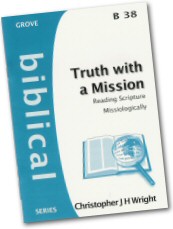
Truth with a MissionToday was the first day of lectures at Redcliffe and I began a six-week course with the first years called, The Biblical Basis of Mission, which is coupled with a six-week course next term on Issues and Trends in Contemporary Mission.

This morning we looked at some foundational stuff using Chris Wright’s introductory material on missional hermeneutics. It’s found in a few different places – Fanning the Flame: Bible, Cross and Mission (edited by P. Gardner et al, Grand Rapids: Zondervan, 2003); Out of Egypt: Biblical Theology and Biblical Interpretation (edited by C. Bartholomew et al, Carlisle: Paternoster, 2004); Text and Task: Scripture and Mission (edited by M. Parsons, Carlisle: Paternoster Press, 2006); and expanded in Wright’s The Mission of God: Unlocking the Bible’s Grand Narrative (Nottingham: Inter-Varsity Press, 2006) – but the most accessible format is his 2005 Grove booklet, Truth with a Mission: Reading Scripture Missiologically (Cambridge: Grove Books).

The issues we discussed included: the Bible as the story of God’s mission; the Bible’s call to mission; the Bible as the product of mission; the Bible as a tool of mission; mission as the theme of the Bible; the messianic and missional nature of the Bible; the difference between evangelism and mission; mission as first-and-foremost God’s activity; and more!

I love this quote in particular:

It is not so much, as someone has said, that God has a mission for his church in the world, as that God has a church for his mission in the world. Mission is not just something we do (though it certainly includes that). Mission, from the point of view of our human endeavour, means the committed participation of God’s people in the purposes of God for the redemption of the whole creation. (in Truth with a Mission, p. 14)

Next week, Mission and the Torah…