Chris Wright on Noah and the mission of God

In our journey through Genesis 1-11 on Redcliffe’s Applied Theology in Intercultural Contexts degree programme we have reached the account of Noah.

Here is what Chris Wright in The Mission of God says about the covenant God makes with Noah in Gen. 9

The narrative of the covenant that God made with Noah in Genesis 8:15-9:17 is the first explicit reference to covenant-making in the biblical text… The Noachic covenant establishes at least two foundational points that are relevant to the rest of the biblical concept of mission.

God’s commitment to all life on earth. In the context of God’s radical judgment on the comprehensive nature of human sin (repeatedly portrayed as “violence and corruptions”), God still commits himself to the created order itself and the preservation of life on the planet. Although we live on a cursed earth, we also live on a covenanted earth. There is an unambiguous universality about God’s covenantal self-commitment here: His promise is not only with humanity but also with “every living creature on earth” (Gen 9:10). This Noachic covenant provides the platform for the ongoing mission of God throughout the rest of human and natural history, and thereby also, of course, the platform for our own mission in participation with his. Whatever God does, or whatever God calls us to do, there is a basic stability to the cotnext of all our history.

This does not of course mean that God would never again use his natural creation as the agent of his judgment as well as his blessing (as the rest of the Old Testament amply testifies). But it does set limits to such actions within history. Apart from the final judgment of God that will bring an end to fallen human history as we presently know and experience it on this sinful planet, the curse will never again be expressed in an act of comprehensive destruction as the flood. This is God’s earth, and God is also covenantally committed to its survival, just as later revelation will show us that God is also covenantally committed to its ultimate redemption. Even the final judgment will not mean the end of the earth as God’s creation but the end of the sinful condition that has subjected the whole of creation to its present frustration. Our mission then takes place within the framework of God’s universal promise to the created order. This is a framework that gives security and scope to all our mission: security because we operate within the parameters of God’s commitment to our planet, and scope because there is nothing and no place on earth that lies outside the writ of God’s covenant with Noah. The rainbow promise spans whatever horizon we can ever see.

The ecological dimension of mission. The language with which God addresses Noah at the end of the flood clearly echoes Genesis 1. In a sense this is a fresh start for all creation. So Noah and his family are blessed and instructed to fill the earth and (although not with the same phrase) to have dominion over it. The creation mandate is renewed. The human task remains the same-to exercise authority over the rest of the creation, but to do so with care and respect for life, symbolized in the prohibition on eating animal blood (Gen. 9:4). So there is a human mission built into our origins in God’s creation and God’s purpose for creation. To care for creation is in fact the first purposive statement that is made about the human species; it is our primary mission on the planet. The covenant with Noah effectively renews this mission, within the context of God’s own commitment to creation. (pp326-327, his italics)

Here are a few questions to get you thinking.

  • Is our reading of the Bible so focused on humanity that we miss what it says about God’s purposes for the wider creation?
  • What do you make of God making a covenant with all of creation, and not just humans?
  • What do you think of Wright’s point that, ‘there is nothing and no place on earth that lies outside the writ of God’s covenant with Noah’? How does it rebuke or encourage you as you engage in God’s mission?
  • How does Wright’s section on ecology inform discussions on creation care? To what extent do we treat creation care as peripheral to mission?

What do you think? Leave a question or comment below…
The Bible, justice, advocacy and reconciliation

jusTice initiative at Redcliffe CollegeOne of the many exciting things going on at Redcliffe is the new jusTice initiative.

Part of the initiative is the development of a new MA in Justice, Advocacy and Reconciliation in Intercultural Contexts.

Some info about the course is available below. First, though, here is what Joel Edwards says about it:

Justice is still the ugly sister in theological education. This is an awful tragedy because it remains one of the most pervasive ideas and convictions in the Bible. Our reluctance to go beyond acts of kindness to explore and respond to systemic injustices has a great deal to do with a distinct lack of theological reflection. This new MA, and the jusTice Initiative is attempting to put that right and deserves our support. A more robust biblical reflection on this critical issue will produce a generation of men and women who are truly able to show the whole council of God, make a substantial difference to our biblical advocacy and in turn, make a material difference to the 1.4 billion people who still live in abject poverty. (Joel Edwards, International Director of Micah Challenge)

Justice, advocacy and reconciliation are key biblical themes which frame our Christian witness and contribute to creating a world where people and the environment can flourish and become all that God wants them to be.

In an increasingly complex and globalised world, there is a critical need for us to identify and understand how the structures of society can facilitate or obstruct the flow of justice and how the Church can act in ways which promote justice, advocacy and reconciliation.

Redcliffe’s exciting new MA in Justice, Advocacy and Reconciliation in Intercultural Contexts seeks to equip the rapidly-growing number of people involved in justice and mission-related activity. Students will explore Biblical frameworks, mission thinking and practice and explore a number of key issues in areas of socio-political, economic and environmental (in)justice.

The course is being developed in consultation with Christian Aid, International Justice Mission, Micah Challenge, CARE and Coventry Cathedral’s Reconciliation ministry, along with others who will be involved in the ongoing development and delivery of the course. It is subject to validation by the University of Gloucestershire and the planned start date is September 2012

Who is the course for?

  • Mission agencies who require their members to develop biblical, theological and missiological frameworks in preparation for justice, advocacy or reconciliation-related work
  • Partner agencies with members who wish to develop theological and missiological perspectives to undergird their justice-related expertise
  • Those already engaged in mission who want to reflect biblically and missiologically on their role and activity
  • Members of para-church agencies and non-governmental organisations working in related areas who wish to develop biblical and theological frameworks for reflective critique
  • Missionaries on home leave, looking to reflect and engage with such issues, relevant to their mission context
  • Church leaders and the wider Christian community engaged in justice-related ministry and who wish to add a theological/missiological framework

Course structure
Subject to validation, students complete three compulsory modules* and choose one further module from the options below.

  • Method and content in missiological study*
  • Just Mission – justice issues in intercultural contexts*
  • Advocacy, Reconciliation and Peace-building in intercultural contexts*
  • The mission of the Church in the context of post-colonialism and globalisation
  • Theology of religions
  • The Greening of mission
  • Crucial issues in Asian mission and theology
  • Crucial Issues in European mission and theology
  • An introduction to global leadership
  • Independent study module

The MA is available in full-time, part-time and flexible learning modes. 

2012 lecture in Bible and Mission – Steve Walton on the book of Acts as the mission of God

Each year we host an Annual Lecture in Bible and Mission at Redcliffe. Following previous lectures by Chris Wright, Gordon Wenham and Eddie Arthur, Prof Steve Walton from LST will be speaking on Tuesday 15 May on ‘The Book of Acts as the Mission of God’.

Here are some further details taken from the main Redcliffe website:

The Acts of the Apostles as the Mission of God

Tuesday 15 May 2012  7.30pm-9.30pm

Delivered by Prof Steve Walton, Professor of New Testament at London School of Theology

Steve WaltonAction plans for mission are widely used today: but are they right? Who really drives mission? In the Acts of the Apostles, the church is frequently slow to recognise and get on board with what God is doing. Mission among the Gentiles happens slowly and is a result of God’s initiative, not the church’s plans – and this reflects the wider point that it is God who drives the story of Acts forward, not the believing community. This challenges some modern emphases on the role of the church in mission.In this lecture, Steve Walton will explore the work of God in Acts, and reflect on this key feature of Acts in the light of the emphasis on missio Dei (the ‘mission of God’) in contemporary missiological thinking.

Prof. Walton has taught at LST since 1999 and has a special interest in Luke-Acts, Paul and New Testament Greek. Among other publications, he is the co-author of a popular textbook on the Gospels and Acts (in SPCK’s Exploring the New Testamentseries) and is currently working on the Acts volume in the Word Biblical Commentary series.  He is a retired international volleyball referee and now works in training and developing other referees, which takes him around the world from time to time.
The Lecture is free but pre-booking is required. Please visit Redcliffe’s website for more details on the 2012 lecture in Bible and Mission
For more details on previous annual lectures, visit the Public Lecture page.

Chris Wright on dancing the gospel

In his 2003 essay, ‘Future Trends in Mission’ Chris Wright opens with a nice, illustrative story. (the essay can be found in Bartholomew et al, The Futures of Evangelicalism)

‘The people who prefer to dance’ – a very short story

There is a tribe in northern Nigeria known as the Gwandara-wara. During the early part of the twentieth century, two attempts were made by Christian missionaries to reach and evangelize this tribe. Both attempts failed. The gospel was not communicated. Nobody came to faith in Christ. No church was planted. In the mid 1980s, a third group of missionaries tried again. This time they were more successful. They were allowed to live among the tribe and cultivate some land. They discovered that the tribe’s name means, ‘The people who prefer to dance’. From the tribal elders and story-tellers – the guardians of the tribe’s identity and history – the missionaries established that the name went right back to the tribe’s rejection of Islam in the nineteenth century when, in response to the attempt to covert them to Islam, the tribe had insisted, ‘we prefer to dance’ – that is, we will not give up our culture of music and dance for a religion which wants to prohibit them.

Reflecting on this new information, the third group of missionaries came up with a new strategy of evangelism: they would dance the gospel to the ‘people who prefer to dance’. So they devised a means of telling the Bible story, including the story of Jesus and the cross, through the medium of African music and dance. The communication gap was bridged. There was a breakthrough of understanding; some believed the gospel and there is now a church of Jesus Christ among the Gwandara-wara.

Who were this third group of missionaries who succeeded where others had failed. They were not white nor Western, neither American nor European. They were in fact Africans, members of the Evangelical Missionary Society of ECWA – the Evangelical Church of West Africa, one of the largest churches in Nigeria and throughout West Africa. The EMS is a fully indigenous Nigerian mission agency, with some 1,000 missionaries serving cross-culturally throughout western Africa.

This is a story which could be repeated myriad times in many other parts of the world. It illustrates at least three things about mission today and in the future. First, God is still keeping his promise to Abraham. Second, mission, like the church itself, is multinational and multidirectional. Third, God is calling for adaptation, creativity, flexibility and hard thinking in mission.

Reflecting on this story in relation to how we communicate the Bible, it seems to me that Wright’s final points are particularly helpful. We look back and see in Scripture the assured promises of God – we are encouraged. We look around and see the many and varied ways that the global church can join together to understand and communicate the Bible more fully – we are rebuked of the narrowness of how we have done this in the past, but inspired by what might be possible in the future. As we partner together we look ahead to see the ways we as a global church can develop the creativity and appropriateness with which we will strive to communicate God’s Word together.

And I like his final statement. These changing dynamics lead to innovation in practice, but also some hard thinking. The realities of mission should be reckoned with in biblical, theological and missiological thinking, as well as in our practice.

And a brief piece of self-critique to round things off: is it significant that I reflected on Wright’s summary/explanation rather than the story itself? Read up on the differences between oral and non-oral communicators to see why this might have been the case: Bible and orality resources.

Mission in Context: Explorations Inspired by J. Andrew Kirk

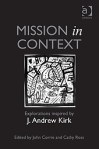
Mission in ContextMission in Context is a new book edited by John Corrie and Cathy Ross and features a number of notable articles that will be worth checking out. In particular, I’m intrigued by the article by Peter Penner on ‘Practising Community in the early Church: A Missional reading of the summary texts in Acts’. My former Redcliffe colleague Darrell Jackson also has an article on the European context. Darrell is now teaching at Morling College in Australia.

Anyway, here’s the blurb and contents for the book:

Stimulated by Andrew Kirk’s mission theology, this book brings fresh theological reflection to a wide range of mission issues. A formidable group of international missiologists are drawn together to explore current reflections on a wide range of issues including: poverty and injustice, environmentalism, secularism, the place of scripture in a pluralist culture, science and faith, liberation theology, oppression and reconciliation, and much more. Kirk’s influence and reputation is international, and extends to South America, USA, Eastern Europe, Africa and SE Asia. Latin American mission has been especially enriched by Kirk’s innovative thinking on revolutionary politics, contextualisation and holistic mission. This is an indispensable resource of up-to-date missiological reflections for all involved in mission at every level.

 ‘Andrew Kirk has through his own life and scholarship in mission studies embodied a union of evangelical faithfulness, passionate regard for social justice, and deep theological reflection. This union – sadly all too rare in the field – is exemplified by this rich collection of essays in his honour.’
Brian Stanley, University of Edinburgh, UK

‘The richness, freshness, and depth of the essays in this book provide a fine tribute to J. Andrew Kirk as one of the most significant missiologists of our time. This collection will enrich any library – academic or personal.’
Steve Bevans, Catholic Theological Union, Chicago, USA

Contents

Foreword by Christopher J.H. Wright

Introduction – John Corrie and Cathy Ross

Part I: J. Andrew Kirk: His Life and Work
1 Missiologist and theologian – Cathy Ross
2 A Life in Mission – Daniel Kirk
3 Doing evangelical theology at a time of turmoil: A retrospective survey of Andrew’s Latin American experience – J. Samuel Escobar

Part II: What Is Mission?
4 Global Partnership and integral Mission – C. René Padilla
5 Evangelicals and Liberation theology – John Corrie
6 Practising Community in the early Church: A Missional reading of the summary texts in Acts – Peter Penner
7 The Gospel and nation-Building in emergent nations: An evangelical Agenda – Hwa Yung

Part III: Truth in a Pluralistic World
8 Convictional Perspectivism: A Constructive Proposal for a theological response to Postmodern Conditions – Parush R. Parushev
9 Truth and Pluralism – Vinoth Ramachandra
10 Intercultural and inter-religious Dialogue in europe: Are the EU and the Council of europe Participants or Arbiters of the Dialogue? – Darrell Jackson
11 Worldviews and Christian Conversion – Andrew F. Walls

Part IV: Culture, Education and Religion
12 A Missiology of Western Culture: Background and Development of a Project – Wilbert R. Shenk
13 Christian Faith, Freedom and Illiberal Liberalism: Leads from Lesslie Newbigin – David Kettle
14 Mission and Violence: inculturation in the Fourth Century – Basil and Ambrose – Alan Kreider
15 Dilemmas and Challenges for Theology in Post-Communist Eastern Europe – Peter Kuzmic
16 The Significance of Pentecostalism to Mission – Allan Anderson

The Lord is my Blackberry – contextualising metaphors in the Psalms

As part of our Psalms course at Redcliffe we were looking at Psalms of trust and lament today. One of the preparation tasks was to rewrite Psalm 23 using contemporary imagery. This is a really hard thing to do as metaphors are so vibrant, complex and loaded. What would be a contemporary way of expressing all that the psalmist wanted to convey when he said, ‘The Lord is my shepherd’? In a pure sense it can’t be done; no other term will employ the same language organism of emphasis, downplaying, and evocation.

Still, at least if we try we might dig deeper into what the psalmist was trying to get across. Metaphors get to the guts of the matter in a way that connects with the hearer-in-the-know in a way that ‘mere’ description cannot do (and by the way, try to describe something without using any metaphors – it’s harder than you would think!).

Here is what 2nd year degree student Emma-Louise brought this morning (she kindly gave me permission to use it here):

The Lord is my Blackberry, I lack nothing,
He makes me listen to easy listening music,
He helps me communicate with family,
and read my daily Bible…

 
Metaphors arrest us and sometimes shock us. They place alongside each other things that normally have no business being seen together. After the initial surprise, they force us to resolve the tension that has been lodged in our minds: ‘how can A be like B’? They open us up to imagine old, precious truths in fresh ways.

Is this a new metaphor for the digital generation? What do you think?

Praying the Psalms

The Day is Yours by Ian StackhouseHave you tried praying through the whole Psalter in a month? In our Missional Texts: Psalms and Genesis 1-11 class we spent some time discussing this ancient practice of the people of God, and are trying to practice it through the week as well.

As a catalyst for discussion we read a chapter from Ian Stackhouse’s The Day is Yours: Slow Spirituality in a Fast-Moving World (Paternoster, 2008), which was also reproduced, with permission, in the June 2010 issue of Encounters Mission Journal: Praying the Psalms

Here are some quotes I found particularly helpful:

The journey from Psalm 1 to Psalm 150 is the original odyssey: from the safety of a world where the righteous flourish and the wicked perish,  [5] to a world where the wicked prosper and the righteous suffer, [6] and all the way through to a world where, whatever our experience of life, however unjust life has been, all ends in praise. [7] To pray the Psalms over a month is to embrace the whole gamut of human experience.

Waking up to whatever five psalms are before me is like waking up to greet old friends. I have been here before. I have heard these words already. Their familiarity is a comfort to my soul, and a relief from having to find the right words.

As Peterson continues: ‘Liturgy pulls us out of the tiresome business of looking after ourselves and into the exhilarating enterprise of seeing and participating in what God is doing.’

That we don’t identify with the particular mood of the psalm for that day, as is often the case, is not a problem according to this tradition of praying. Prayer is not in the first instance about my feelings anyway. I may identify with it, I may not. It doesn’t matter. The point of liturgy, as Heschel reportedly said to his congregation on one occasion, was not to express what they felt; rather it was to learn what the liturgy expressed.

In a strange and paradoxical way, this liturgical rhythm of prayer, far from supressing the emotions, in fact liberates them. As Kathleen Norris remarks… ‘To your surprise you find that the Psalms do not deny your feelings, but allow you to reflect on them, right in front of God and everyone.’

‘God behaves in the Psalms in ways that he is not allowed to behave in systematic theology.’ [11] Our emotions are allowed to run wild. For those of us reared in the language of sentimental niceness on the one hand, and theological correctness on the other, the Psalms tutor us in a language that is far more daring. Without betraying the core ofIsrael’s faith, the Psalms say it straight.

It is no surprise to me, therefore, that people instinctively turn to the Psalms when they are suffering. How many times have I been aware as a pastor of how critical the Psalms have become for someone going through treatment for a cancer, another facing a bereavement, another off work with stress, still another waiting for an unfaithful spouse to return? Each one of them testifies to the relevance of these ancient words; for what the Psalms do is transfer us from the flatness, ishonesty and inadequacy of so much of our modern speech and into the ancient and extreme world of praise and lament, with all the ambiguity that living at the extreme implies.

When I pray the Psalms the whole company of saints is there with me: those who have gone before and those who are going now. Furthermore, even if I don’t feel what the Psalmist is going through, you can bet that someone else in the community of faith is. Even if I wake up joyful, for a change, and can’t hack why the Psalmist is so downcast – ‘why are so you downcast, I my soul?’ [16] – the simple act of praying the Psalm reminds me that I am part of a community in which at any one time there are people grieving even as I am rejoicing. Conversely, while I am grieving, there are others who are rejoicing. Praying the Psalms tutors us in this community awareness.

Sometimes when I am praying a psalm a face will appear; someone for whom this Psalm describes actual experience. Other times the words of the Psalm sound for all the world like the latest news bulletin from Kosovo, or theCongo, and so, in a strange way, the ancient liturgy helps me to be more up-to-date than I would otherwise be. Precisely because the world hasn’t changed much, and human experience is awful a lot of the time, praying the Psalms, far from representing a retreat into private interiority, is an advance onto the concourse of life.

Reading Psalm 139 at the graveside of a person who died by suicide convinced me long ago that what the church needs in its public ministry, not to mention its public worship, is the gravitas of these ancient prayers: prayers where the words are weighty enough to hold us, cavernous enough for us to hide in.

Making a Biblical Studies programme missional, part 3

This is the third in a series of posts exploring the Biblical Studies side of the new curriculum at Redcliffe College. Specifically, I’m aiming to inform and excite you about the way we are trying to make our teaching of Biblical Studies a thoroughly missional activity. Check out part 1 and part 2 of the series for an overview and introduction.

Having established a missional approach to the Bible and a foundational survey of the books of the Old and New Testaments in the first year, we then focus on some key texts in year two. By this stage we want students to be deepening their understanding of the content, interpretation and application of biblical texts.

As well as a biblical language, students have the option to take the following modules:

Missional texts: Psalms and Genesis 1-11

The module aims to enable students to analyse important aspects of these two key Old Testament texts and consider how they relate to the thinking and practice of the church’s involvement in the mission of God.

This module covers:

  1. The function of the book of Psalms and Genesis 1-11 as part of a missional reading of the Bible;
  2. Key issues in understanding and interpreting Psalms and Genesis 1-11, including historical and cultural contexts, genre, structure, literary features and theological themes;
  3. Case-studies in exegeting Psalms and passages from Genesis 1-11;
  4. The contemporary application of Psalms and Genesis 1-11, especially in relation to the thinking and practice of mission.
For me, it is so important that students leave Redcliffe equipped with the Psalms. More than any other part of Scripture, the Psalms articulate life and give us a liturgy for all the experiences we may go through. We encourage the students to pray through the Psalms – a habit I hope they will adopt, enjoy and be shaped by. There are also some important and intriguing missiological questions in the Psalms, not least the role of the nations and the great eschatological visions of nations gladly worshipping the LORD.
Genesis 1-11 has often been treated as the background to God’s mission. In this module we explore the content of the text in depth and try to see how it can function missionally.

Missional Texts: Luke and Acts

The module aims to enable students to analyse important aspects of Luke’s contribution to the New Testament and consider how it relates to the thinking and practice of the church’s involvement in the mission of God.

This module covers:

1. The function of Luke-Acts as part of a missional reading of the Bible;

2. Key issues in understanding and interpreting Luke-Acts, including historical and cultural contexts, genre, structure, literary features and theological themes;

3. Case-studies in exegeting passages from Luke-Acts;

4. The contemporary application of Luke-Acts, especially in relation to the thinking and practice of mission.
The language of the descriptor is clearly very similar to the Psalms and Genesis 1-11 module. Luke and Acts was an obvious choice in that it spans at least two different genre, and is often referred to in the literature on mission.
Finally, in addition to these book-specific modules, we offer a hermeneutics module:
Interpreting the Bible in Intercultural Contexts

The module aims to enable students to analyse important aspects of historical and contemporary interpretation of the Bible, and consider biblical hermeneutics in relation to a variety of Western and non-Western cultural contexts.

This module covers:

1. Key periods and events in the history of Biblical interpretation (e.g. Jewish, early Christian, and Medieval exegesis; the hermeneutical impact of the Reformation and of the Enlightenment;

2. Major topics in contemporary hermeneutics (e.g. literary approaches and  the role of the reader;

3. Biblical interpretation in different cultural contexts (e.g. Latin American, Asian and African);

This is an opportunity for students to look at the bigger picture of biblical interpretation, but also explore issues of intercultural reading and contextualisation.

So, by the end of the second of their three-year bachelor’s degree in Applied Theology in Intercultural Contexts, students are delving deeply into some crucial biblical texts and becoming more sensitive and globally aware interpreters. Stay tuned for the final year…

The Bible and European mission

Redcliffe has just hosted the annual European Consultation, organised jointly by ourselves, Global Connections and ECM.

This year the focus of the 24-hour event was on three trends in Europe, which were covered in three sessions yesterday: Islam, Migration, and Urbanisation. This morning then comprised of three responses: one from a church perspective, one from a mission agency perspective, and finally, a biblical reflection, which I was asked to do.

I won’t replicate the talk here just yet as it will be available soon on the Global Connections website as an audio file.

My brief was to reflect biblically on the conversations that had gone on throughout the event. I chose three parts of the Bible to do this. To whet your appetite, here is the basic structure. I’ll post again when all the talks are available.

2012 European Consultation

Biblical Reflections on Encountering the Other

Whether it has been in the context of talking about Islam, Migration or Urbanisation, a recurring theme over the course of this consultation has been an exploration of encountering those unlike ourselves. In the case of those of other faiths or none, how do we engage with them, love them, and reach them with the good news of Jesus? In the case of those who already share our faith, how do we join together with them in fruitful ways?


A migrant’s story (2 Kings 5)

Here is someone who has migrated but not of her will. We can only imagine the trauma of her situation. Yet still she seeks shalom for her captor; she still trusted in the power of Yahweh, as well as his ability and willingness to heal this pagan enemy.

I think the story here in 2 Kings 5 can move us to remember that God’s people are often the disempowered in every worldy sense, yet even here (especially here?) God can and does do some extraordinary things to further his purposes.


Applying Wisdom to a European context (Proverbs, Job, Ecclesiastes)

One rather neglected part of the Bible when it comes to mission thinking and practice is the Wisdom Literature of the Old Testament: Proverbs, Job and Ecclesiastes.

In his book, The Mission of God Chris Wright addresses the WL in several ways which I would like to draw on here:

1. Wisdom as ‘international bridge’.

Israel’s WL is part of an international body of WL, the type of which was common across the ANE. Israel was aware of this and was often complimentary of the wisdom of other nations. So, lots of contact between Israel’s wisdom thinkers and those of other cultures.

Wright, p.443: ‘The Wisdom literature is undoubtedly the most overtly international of all materials in the Bible’

This is seen in 2 ways: deals with issues common elsewhere; 2. but Israel did not absorb the nations’ wisdom uncritically

Wright: ‘some missiologists and cross-cultural practitioners suggest that the Wisdom literature provides one of the best bridges for biblical faith to establish meaningful contact and engagement with widely different human cultures around the world.’

‘Israel had no monopoly on all things wise and good and true. Neither, of course, have Christians. Nothing is to be gained from denying, and much missional benefit accrues from affirming, those aspects of any human cultural tradition that are compatible with biblical truth and moral standards.’

‘Missional engagement then may well build a bridge with other cultures through the common international quality of biblical Wisdom, but the bridge in itself is not salvific. Eventually, something must cross the bridge. And that can only be the message of the biblical gospel, of the identity of YHWH and the fill biblical story of his redemption of the world through Jesus Christ.’

2. Wisdom often uses a ‘struggling voice’, which acknowledges uncertainty and promotes honesty.

‘not a safe intramural exercise for Israel. They are issues with which Israel struggles or the sake of the world.’ (Brueggemann, quoted in Wright)


From, ‘I embrace you’ to, ‘I need you’ (Rev. 7)

The heart language you speak will reflect and shape the way you see the world around you, in a way that only that language can do. So, there will be ways of understanding and praising God through Swahili that English just can’t do. And vice versa. There are aspects of God that a French or Hungarian speaker might more readily or fully understand that wouldn’t come so easily to an Albanian. And so it goes on.

‘Christianity seems unique in being the only world religion that is transmitted without the language or originating culture of its founder.’ Lamin Sanneh

That is to say, the Christian faith cannot be contained within one language or culture. It is too big, too wonderful and too gloriously complex to be fully contained and expressed through one language or one cultural expression.

This is not just an issue of how benevolent, accommodating or curious a host culture church should be in relation to the migrant individuals, communities or churches. The very nature of the Gospel, of the incarnation, and of passages like Rev. 7 teach us that we need each other to more fully understand and express our worship to God.

Free access to IJFM journal issue on Bible translation

Thanks to Scripture Engagement for the heads up. The July-September 2011 issue of the free-to-access and tremendously helpful International Journal of Frontier Missions focused on some crucial issues in Bible and mission.

Here’s an outline of the content:

28:3 – The Terms of Translation
From the Editor’s Desk by Brad Gill
A New Look at Translating Familial Biblical Terms by Rick Brown, Leith Gray and Andrea Gray
A Brief Analysis of Filial and Paternal Terms in the Bible by Rick Brown, Leith Gray, and Andrea Gray
When “Literal” is Inaccurate: A Multi-Dimensional Approach to Translating Scripture Meaningfully by Donna Toulmin
Ideological Challenges for Bible Translators by Roy E. Ciampa
Basic Principles and Procedures for Bible Translation, Forum of Bible Agencies International

Click on the link to access all the articles: IJFM issue 28:3 on The Terms of Translation