You are God’s shop window

mission-net is a pan-European mission congress for young people taking place at the end of 2011 in Germany.

I recently contributed a short article called You are God’s shop window! on the mission-net website, which aimed to encourage readers to live out the missional life that God requires of us. Here’s an extract:

Israel were to be a kingdom of priests and a holy nation. They were supposed to show the rest of the world what it was like to live in covenant relationship with God.

Israel’s lifestyle was missional – it was like a shop window for the world to look through. The nations were supposed to look at the quality of Israel’s life together and think, ‘Wow! Look at them; we want to know their God!’ (see, for example, Isaiah 2:1-5).

What about you and your Christian community? What is your ‘window’ like? When people see your life or your life together to they think, ‘Wow! I really want to get to know Jesus!’?

mission-net is a fantastic gathering. It was at a previous incarnation of mission-net (a TEMA confress) that I came to faith.

If you live in Europe, why not take your youth group along?

Defining missional

A Light to the Nations by Michael Goheen

‘Mission’, ‘missionary’, ‘missional’. I can imagine that if I taught at an art college I’d spend a lot of time asking students, ‘what is art?’. Well, teaching at Redcliffe College, one of only two specifically mission-training colleges in the UK, causes me to ask the ‘mission’ question of myself and students on a regular basis.

I’ve been reading Michael Goheen‘s new book, A Light to the Nations: The Missional Church and the Biblical Story. Here’s how he

approaches the term ‘missional’:

The employment of the term “missional” includes the superficial along with the profound, the culturally captive alongside the richly biblical. But the popularity of “missional” language suggests that something has struck a chord with many Christians…

At its best, “missional” describes not a special activity of the church but the very essence and identity of the church as it takes up its role in God’s story in the context of its culture and participates in God’s mission to the world. This book is an attempt to describe “mission” as the role and identity of the church in the context of the biblical story.

So, Goheen is saying that whatever activities we may label as ‘missional’ are all secondary and subsidiary to the missional identity of the church in our participation in God’s mission.

Bible Engagement and Oral Culture part 2

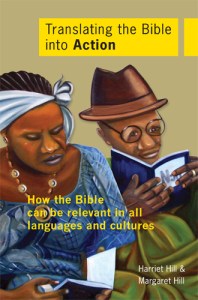
Translating the Bible into ActionThe theme of orality is one I return to again and again, especially over the summer with our MA module in ‘Bible Engagement in Intercultural Contexts’ and a forthcoming new undergraduate module called, ‘Story, Song and Social Networks: Bible Engagement and Oral Culture’.

We are also developing the Resources section of this microsite to include a whole section on the Bible and orality. There you will find links to websites, journal articles, books, etc. on the subject. Let us know if you find anything we’ve missed!

In the meantime, here is a quote from Hill and Hill in their book, Translating the Bible into Action: How the Bible can be Relevant in All Languages and Cultures

(for context, this is part of a section entitles ‘General barriers to engaging with Scripture’)

A. Literacy barrier

Printed Scriptures are effective when people know how to read and like to do so. But many people prefer to communicate using oral rather than written means, or they don’t know how to read. Even if literacy classes were available, people may not be interested in attending them. In some cases, those who do learn to read may still prefer oral means of communication, and soon lose their new skills. In other cases, people may want to learn to read but they are hindered by poor eyesight or other problems. If Scripture is only presented in written form to people who do not know how to read or like to read, this is a serious barrier. (pp. 3-4)

They then refer to five chapters in the book that deal particularly with this topic:

ch. 2  Using appropriate Scripture Products
ch. 16  Bible Storying
ch. 22  Engaging People with Scripture through Music
ch. 23  Engaging People with Scripture through Drama
ch. 24  Engaging People with Scripture through the Visual Arts

Mission and Genesis 1-11

The first part of Genesis (indeed, of the Bible!) is often neglected in Bible and mission writings. Is Gen. 1-11 merely a backdrop or prelude to Abraham’s call which is when the story of God’s mission really gets going in Gen. 12?

There are writers who do reflect on Gen. 1-11 missiologically (e.g., Ida Glaser in her book The Bible and Other Faiths or Brian Russell in his blog, to name just two). While taking a look at the website for Review and Expositor journal today I came across an issue from 2006 on Genesis 1-11 which features a couple of interesting looking articles, which will provoke thought, sympathy and disagreement: Bible and Mission MA students take note!

Missiological Thoughts Prompted by Genesis 10 by Isam Ballenger
Abstract:
The table of nations, Genesis 10, represents the post-history of Noah and his family with the fulfillment of the command given to be fruitful and multiply and the prehistory of Abraham and his family who are to bless all peoples on earth. Fulfillment, rather than a culmination, appears to be preparatory for what is yet to come; history appears to be prologue, attesting to the sovereignty and love of God and claiming time as an integral factor for mission. The peoples of this chapter are not without a relationship to God, raising the question about the relationship of all nonchosen peoples to God. Assuming God initiates relationships, i.e., mission occurs first in God, relationship assumes new dimensions, becomes more inclusive, less individualistic, and thus more demanding of the disciple of Jesus Christ.

God Came Down . . . and God Scattered: Acts of Punishment and Acts of Grace? by Nancy deClaissé-Walford
Abstract:
Throughout the stories in Genesis’ primeval prologue, humankind’s persistent sinfulness is met with punishment but also with acts of grace on the part of God. The last story, the Tower of Babel is usually understood as the ultimate act of disobedience on the part of humanity. In this interpretation, God punishes the people by scattering them over the face of the earth. There is no act of grace. Thus the primeval prologue ends in darkness; God moves to “Plan B” and decides to reveal Godself to humanity through a single family, that of Abram ben Terah. But what if we understood the scattering at the Tower as an act, not of punishment, but of grace on the part of God—an act that allowed humankind to fulfill the creation command to “be fruitful and multiply and fill the earth” (Gen 1:28)? How might that inform and affect our reading of the primeval prologue and the ancestral stories?

Myth

In the much disputed creation – evolution debate the word myth is usually attributed to the Genesis account of creation by one particular side. In using the words myth or mythological, for the creation narrative naturally communicates that it belongs in the realm of misconception, fairy tale and fantasy.  This understanding of myth has been perpetuated due to the fact that most great stories about gods or creation are in the guise of great epic stories based in an unscientific and non-rational age.  On account of this perception (especially in the Western world) it has enabled them to then become massive cinematographic blockbusters, such as Thor, Clash of the Titans and Evan Almighty to name but a few, providing viewing pleasure of millions of people. But what is mythology? John Walton in The Lost World of Genesis One writes,

Mythology by its nature seeks to explain how the world works and how it came to work that way, and therefore includes a culture’s “theory of origins”.  We sometimes label certain literature as “myth” because we do not believe that we the world works that way.  The label is a way of holding it at arm’s length so as to clarify that we do not share that belief – particularly as it refers to involvement and activities of the god’s…. Their “mythology” expressed their beliefs concerning what made the world what it was; it expressed their theories of origins and how their world worked.

By definition, our modern mythology is represented by science – our own theories of origins and operations. Science provides what is generally viewed as the consensus concerning what the world is, how it works and how it came to be.  Today, science makes no room for deity (though neither does it disprove deity), in contrast to the ancient explanations, which are filled with deity.

So how is this relevant missionally? What do we do with these two great mythologies?  Firstly, we must recognise that each culture and people group has their own interpretation of the origins of the cosmos, whether this is in the local pub, university or the other side of the world. Secondly, we should endeavour to find affirmations, similarities and critiques, between world views with the aim of finding a model that enables authentically contextualised missional engagement.

What do you think?

A Re-reading of Acts 10-11

Mission After Christendom by David Smith is a fantastic book that highlights some key challenges facing the modern missionary movement in an ever increasing globalised world.  He seeks to address each challenge using astutely discerned biblical passages as a model to motivate the Church to engage missionally with its surrounding culture effectively.

Looking at the challenge of pluralisation, he uses the narrative found in Acts 10-11 of Peter and Cornelius.   The following is an abstract from his book.

The literary structure of the first two scenes is similar; in both the prayer of the central character leads on to a vision, which is then followed by a special divine revelation.  However, there is also a contrast between Cornelius, who is open, responsive and obedient to the divine word, and Peter, whose reaction is characterised by confusion, resistance and rebellion.  The contrast is striking and disturbing; the man without the Bible is humbly obedient to the light given to him, while the one with all the privileges, who in this case has actually walked with the incarnate Word of God, resists further light and will not budge from an inherited theological position.

It is important to consider carefully the nature of the obstacles that initially prevented Peter from following the call of the missionary Christ.  He has a vision in which a sheet comes down from heaven containing both clean and unclean animals, which he is then commanded to ‘Kill and eat’.  His reaction is a very strong one, something like the ringing statement: ‘Never Lord! For not once in my life have I ever eaten anything unclean’ (10:14). Peter has always understood dietary behaviour to reflect the divine will since it was based on what seemed to be special revelation.  The dietary laws were not a merely human construction designed to provide ethnic distinctiveness to the Jewish people, but were an expression of holiness.  It is this perspective which explains the strength of Peter’s reaction and his seeming irreverence in resisting the voice from heaven.  He is, we might say, arguing for God against God.  Peter’s resistance to the divine command is long and vigorous, so that even after the instruction has been issued and declined three times he is still left ‘wondering about the meaning of the vision’ (10:17).

What is in fact happening here is that the apostle is making the painful discovery that things he has always regarded as unchanging absolutes were in fact, in the light of Jesus Christ, culturally relative. In a missionary context the church will always find itself involved in the struggle to distinguish biblical absolutes from culturally conditioned beliefs as practices.  The great Puritan preacher Richard Sibbes once accused his contemporaries of ‘making more sins than God has made’ and long-established theological traditions are always in danger of limiting Christian freedom by an unwarranted expansion of beliefs and practices classified as absolutes.  Put another way, mission involves the discovery that our faith and theology have been conditioned by culture to a far greater extent that we had ever realised.  Cultural conditioning is not something that happens only to other people, we too carry cultural baggage which needs to be declared ‘excess’ and left behind when we seek to share Christ with others.

It is incredibly difficult to perceive our own cultural baggage, especially as we are immersed within our own culture.  How can we take a step back and survey what are timeless unchanging truths and what is culturally relative baggage and in need of being left behind?

Eddie Arthur on The Radical Result of Bible Translation

Words for Life - Summer 2011 issueWords for Life is Wycliffe Bible Translators’ regular magazine. In the Summer 2011 issue Eddie Arthur tackles the subject of  ‘The Radical Result of Bible Translation’. In a short but insightful article he somehow manages to address a whole range of issues, including: the scary nature of giving someone a Bible; mission and coercion; the Bible and politics; language development and dignity; marginalisation, empowerment and identity.

Here’s some of the text of the article to give you a flavour. You can view the whole thing here: Words for Life – Summer 2011

Far from destroying dignity and oppressing them, Bible translation and language development work helps to give people a new sense of their value before God and amongst the nations. Bilingual education programmes give people a sense of value for their own languages and culture while providing them with a bridge to the wider world through the use of national and international languages. For many marginalised groups, who may well be ignored by their national governments, a language and translation programme may represent the only hope for education and development in their area. The work of Wycliffe Bible Translators and its partner organisations isn’t some sort of luxury; it is a vital part of bringing education, development and a sense of identity to some of the world’s poorest and most marginalised people.

It is hard for English speakers to understand what it is like to belong to a people group whose language is continually ignored or discriminated against, or to have a language so obscure that even God doesn’t seem to speak it.

Eddie has much more to say on these and other important topics, as our MA in Bible and Mission students discover when he comes to Redcliffe to teach half of the module, ‘Bible Engagement in Intercultural Contexts’.

Check out his blog as well.

The Mission of God Study Bible

Just a heads up about a forthcoming publication (due out in 2012) from Broadman and Holman.

Ed Stetzer has tweeted that he is currently editing essays for a Mission of God Study Bible.  I’m looking forward to finding out more about this project. Andreas Köstenberger notes that he is contributing an essay on ‘The Mission of God in the Old Testament’. I don’t know anything else about the content other than that, though it could go in a number of directions I suppose.

I’ll post every now and then when I find out more. In the meantime, check out Ed Stetzer’s twitter account @edstetzer, which has lots of mission-related stuff.

Listen free to A Passion for Mission talks

A Passion for MissionGlobal Connections hold an annual event for UK churches and mission agencies called A Passion for Mission. This year’s event was held in London last month and it focused on the Cape Town Commitment, thinking through what it means for the UK church. Chris Wright was the main speaker, along with responses from Rob Hay (Principal at Redcliffe), Rita Rimkiene and Peter Oyugi (both Redcliffe graduates). Rene Padilla also shared his own inspiring perspective.

Global Connections have made the talks from this and previous years available online, listed below. To listen to or download the talks visit Global Connections’ website

A Passion for Mission 2011 – Chris Wright – Ears to Hear (23740kb)
A Passion for Mission 2011 – Peter Oyugi – Ears to Hear (3185kb)
A Passion for Mission 2011 – Rita Rimkiene – Ears to Hear (8187kb)
A Passion for Mission 2011 – Rob Hay – Ears to Hear (7085kb)
A Passion for Mission 2011 – Rene Padilla – Ears to Hear (812kb)
A Passion for Mission 2010 – Joel Edwards – Just Mission (13719kb)
A Passion for Mission 2009 – Kenneth Brockley – Understanding Contextualisation (125kb)
A Passion for Mission 2009 – Ram Gidoomal – Credible Conversion (20541kb)
A Passion for Mission 2009 – Bryan Knell – Credible Conversion (6660kb)
A Passion for Mission 2009 – Ray Porter – Credible Conversion (11131kb)
A Passion for Mission 2009 – Kumar Rajagopalan – Credible Conversion (12489kb)
A Passion for Mission 2009 – Panel Discussion – Credible Conversion (8343kb)
A Passion for Mission 2009 – Howard Norrish – Credible Conversion (18624kb)
A Passion for Mission 2009 – Testimonies – Credible Conversion (9323kb)
A Passion for Mission 2008 – Lindsay Brown – Shining Like Stars (11425kb)
A Passion for Mission 2008 – Dave Bookless 1 – Mission and the Environment (4631kb)
A Passion for Mission 2008 – Ruth Valerio – Mission and the Environment (5422kb)
A Passion for Mission 2008 – Ruth Valerio handouts (204kb)
A Passion for Mission 2008 – Sian Hawkins – Mission and the Environment (4730kb)
A Passion for Mission 2008 – Dave Bookless 2 – Mission and the Environment (3899kb)
A Passion for Mission 2007 – Chris Neal – Partnership in Mission (8220kb)
A Passion for Mission 2006 – John Piper – Let the Nations be Glad (8154kb)

Bible Engagement and Oral Culture

International Orality NetworkIn a previous post I highlighted the Cape Town Commitment’s inclusion of the key issue of communicating the Bible in oral cultures.

The Bible and orality is a theme I will be returning to with more frequency, not least because over the Summer we will be preparing a new final year module as part of Redcliffe’s BA Degree in Applied Theology in Intercultural Contexts on ‘Story, Song and Social Networks: Bible Engagement and Oral Culture’.

As a helpful orientation here are a couple of excerpts from the website of the International Orality Network. The first gives a definition of their understanding of ‘oral learners’ or ‘oral communicators’. The second gives some statistics and facts.

Those of us who have tended to learn through literate means simply must get to grips with what this stuff means. Not only will it make our efforts to communicate the Bible more effective. I would argue it would also enrich our appreciation and understanding of the Bible immeasurably.

Definitions 

An oral learner or oral communicator is:

1. Someone who cannot read or write.

2. Someone whose most effective communication and learning format, style, or method is in accordance with oral formats, as contrasted to literate formats.

3. Someone who prefers to learn or process information by oral rather than written means. (These are literate people whose preferred communication style is oral rather than literate, even though they can read.)


Statistics and Facts

1. Over 4 Billion people in the world do not read as their primary method of learning – either they cannot read; they do not read; or they will not read.

2. The vast majority of missions work has been done for a literate audience. Unfortunately the vast majority of the true audience is therefore not able to connect with the Gospel.

3. Oral cultures are very relational – they share their lives with one another.

4. Most oral cultures will communicate with one another in narratives, dialogues and dramas, proverbs, songs, chants, and poetry. When asked what he thought about a new village school headmaster, a Central African replied “Let’s watch how he dances”

This leaves us with some serious questions to answer: how different would our missionary efforts look if we truly took the phenomenon of orality seriously? What could we learn that would apply to a (if I can use this term) ‘post-literate’ society? How much to I base my efforts to communicate on how I would understand something, as if my preferred learning style is objective?

Lots to chew over in the coming months. In the meantime, check out ION’s website