Isaiah, Eugene Peterson and turning down Bono

Eugene Peterson on Bono

If Bono asked you to come and spend a couple of days with him, what would you say?

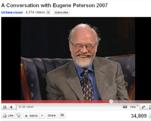
Eugene Peterson is the author of The Message version of the Bible, as well as numerous brilliant books on spirituality, theology and ministry. In an interview at Point Loma Nazarene University he is asked about politely turning down an invitation to hang out with U2’s lead singer, who is a big fan of The Message.

His reason for saying, ‘no’?

EP: “I was pushing a deadline on The Message. I was finishing up the Old Testament at the time… I really couldn’t do it.”

Interviewer (Dean Nelson): “You may be the only person alive who would turn down the opportunity just to make a deadline. I mean, come on, it’s Bono for crying out loud!”

EP: “Dean, it was Isaiah!”

Peterson, of course, gets a rapturous round of applause, which betrays a few things. Our delight that someone like that would turn down a chance most of us would grab at, because he is unfazed by celebrity, for one. But I love the way he implicitly critiques how casually I take my Bible reading. When we engage with the Scriptures we are in the company of remarkable, momentous events and talk, about and of God, that draw us into something bigger than ourselves.

You can see the exchange at about 12:00 mins into the video. It’s worth watching the whole thing for various insights into pastoral ministry and Peterson’s life. But following the Bono conversation they also talk about the whole idea of Bible translation. Well worth a listen.

Here’s a the video and a link if it doesn’t come through on your browser.

A Conversation with Eugene Peterson 2007

Lausanne Theology Working Group papers

Some papers from the working groups leading up to last year’s Lausanne congress were made available through the Evangelical Review of Theology. They are also freely available on Lausanne’s website, along with a whole host of other valuable documents: Lausanne documents

The four issues of ERT are:

ERT volume 31:4 October 2007 on Following Jesus in Our Broken World

Following Jesus as Unique Lord and Saviour in a Broken Pluralistic World – John Azumah
Following Jesus as the Truth: Postmodernity and Challenges of Relativism – Mark L.Y. Chan
Following Jesus in the Globalized Marketplace – Chris Wright
Following Jesus as his Community in the Broken World of Ethnic Identity – Dewi Hughes
Following Jesus in Contexts of Power and Violence – Jonathan Bonk
Following Jesus in a World of Suffering and Violence – Isaiah M. Dau
Case-Study: Overseas Filipino Workers – Athena E. Gorosp

ERT volume 33:1 January 2009 on The Whole Gospel

Editorial: ‘The Whole Gospel’: Lausanne reflects on its own vision
‘According to the Scriptures’: The Whole Gospel in Biblical Revelation
– Chris Wright
The Gospel and the Achievement of the Cross – Mark L. Y. Chan
Signs, Wonders, and Ministry: the Gospel in the Power of the Spirit – J. Kwabena Asamoah-Gyadu
The Gospel and Ethics – Jonathan Bonk
‘Unexpected’ Guests at God’s Banquet Table: Gospel in Mission and Culture – Ruth Padilla deBors
The Gospel in Historical Reception – Timothy C. Tennent
Case Study: How will we know when the Holy Spirit comes? The question of discernment – Kirsteen Kim

ERT volume 34:1 January 2010 on The Whole Church

‘The Whole Church’ A Statement of the Lausanne Theology Working Group
‘The Whole Church’ — Brief Biblical Survey – Chris Wright
Biblical Perspectives on the Role of Immigrants in God’s Mission – Charles (Chuck) An Engen
The Whole Church as a Transformed and Transforming Society – Dewi Hughes
Ethnicity and the People of God – Milton Acosta
Case study: ‘Unwanted Sectarians’: Spirit, Migration and Mission in an Case study: African-led Mega-Size Church in Eastern Europe – J. Kwabena Asamoah-Gyadu
Case study: New Faces of the Church: An Indian Case Study – Paul Joshua Bhakiaraj
Case study: Lessons from My Daughter: Reflections of Church and Ethics – J. Daniel Salinas
Case study: Way of Hope in Cambodia – Stephan J. Bauman
Case study: A Neopentecostal Experience of Aimara People – Marcel Vargas

ERT volume 34:3 July 2010 on The Whole World

‘The Whole World’ – Statement of the Lausanne Theology Working Group, Beirut 2010
The World in the Bible – Christopher J.H. Wright
Towards a Missiology of Caring for Creation – Peter Harris
The Global Public Square – Vinoth Ramachandra
Can Christians Belong to More than one Religious Tradition? – Tan Kang-San
Case study: Peacemaking amidst urban violence in Brazil – C. Rosalee Velloso Ewell (Brazil)
Case study: The gospel amidst ethnic violence in Burundi – Emmanuel Ndikumana (Burundi)
Case study: The world threat of nuclear weapons, and the church’s role – Tyler Wigg-Stevenson
Case study: eVangelism: The gospel and the world of the internet – Rob Haskell (USA)
Case study: The separation of beliefs and religion in Europe – Birger Nygaard (Denmark)

IBMR July 2011 issue on mission and the care of the environment

IBMR July 2011 cover

The latest issue of the International Bulletin of Missionary Research is now out. The theme is ‘Mission and the Care of the Environment’ and features a number of articles on the subject (see contents below).

As well as those, the issue also has two articles on missional hermeneutics and orality. Here are some details:

‘The Biblical Narrative of the Missio Dei: Analysis of the Interpretive Framework of David Bosch’s Missional Hermeneutic’ by Girma Bekele

Intro/abstract:

This article examines David Bosch’s missional hermeneutic, using it as an entry point into his understanding of the biblical foundation of mission. Until his tragic death in 1992 in a car accident, Bosch was chair of the Department of Missiology at the University of South Africa. He studied New Testament under Oscar Cullman at the University of Basel. The development of his theological thought was also shaped by his experience as an Afrikaner, as an ordained minister of the Dutch Reformed Church (DRC), and as a missionary in the Transkei. The sociopolitical and theological setting of South Africa during apartheid was, as it were, the anvil against which he hammered out his ideas of the vocation of the church within the world. His vision of missionary self-understanding and of the church as the “alternative community” is rooted in a strong conviction that the New Testament must be read as a missionary document.

Bosch follows the same general outline in both Witness to the World (1980) and Transforming Mission (1991): first, a discussion of mission crisis (this section is brief in the latter work), followed by a scriptural foundation of mission, an overview of historical perspectives on mission, a presentation of the emerging missionary paradigm, and development of a relevant theology of mission. A certain understanding, interpretation, and application of the Scriptures characterize each paradigm of Christian missionary history as it engages with its own particular context. Bosch is convinced that the task of each generation is to unlock, as if with its own time-conditioned key, the biblical foundation of mission and the biblical narrative of the missio Dei. He insists that, since the New Testament is “essentially a missionary document . . . it is incumbent upon us to reclaim it as such.”

‘Orality: The Not-So-Silent Issue in Mission Theology’ by Randall Prior

Intro/abstract:

I recently had a student from Indonesia in my class. He had completed theological studies and was an ordained minister before migrating to Melbourne with his family. He had settled into a newly formed ethnic Indonesian congregation and accepted the role as their leader. His task was to build up the congregation and to help immigrant relatives of the members to find their feet on Australian soil. Limited financial resources in the congregation meant that he was paid only a small amount of money for this ministry, and so he supplemented his income by driving a school bus in the mornings and afternoons. His love for the Gospel, his dedication to his community over a period of time, and the quality of his leadership all led to his church congregation growing impressively. As a result, he sought to become formally recognized as an ordained minister within the Australian church context, which meant that he needed to complete further studies.

From the very first day of class he impressed me as a man devoted to the Christian faith, with a strong sense of vocation to a ministry of leadership. It soon became clear, however, that if I were to impose upon him the same requirements as for the remainder of the class—namely, written pieces of critical and analytic discourse—then he would fail the course. While he was perfectly capable of handling the work, had a zeal for the class material, and impressed his class colleagues, his cultural background was oral. After some consultation with a faculty colleague, an arrangement was made for him to do his assignments orally. As a consequence, he gained a “credit” grade for the course. Soon afterward he was formally inducted as the minister of the Indonesian congregation and continues to give inspiring leadership to his people.

This anecdote raises issues and questions beyond the field of the delivery of formal theological education. With the relative decline of the church within the Western world and the rapid increase in the membership of the church in areas of the world where oral cultures dominate, a question is raised about the very shape of theology itself. Let me illustrate what I mean by way of experience and observation over a generation of involvement in the South Pacific.

IBMR are to be commended for making their journal available for free (though a log-in is required). It is a tremendous resource.

The Dispersion at Babel as Divine Cultural Enrichment

Throughout modern history there has been a tendency to view the dispersion or the confusion of language at Babel as a Divine judgment on the whole of humanity for their arrogance at trying to make a name for themselves.  Gordon Wenham highlights this perfectly when he writes, ‘The tower of Babylon stands as a monument to man’s importance before his creator, and the multiplicity of human languages is a reminder of divine retribution on human pride’ (Word Biblical Commentary on Genesis 1-15, p244).  This understanding seems to shed a negative light on the diversity of language, placing it in the same category of judgement as the ‘Flood’, the ‘killing of Abel’ and the ‘Fall’.  However, what if there is a positive understanding of this story rather than its primary function being judgment?

The increased accessibility of travel, and the awareness of becoming ‘multicultural’ in our society, has increased the ease at which we are experiencing multiple cultures in very short spaces of time.  It is here that postmodernist studies have helped us grasp the depth of diversity in other cultures. They highlight the layers of cultural lenses found within different peoples and nations, celebrating the vast range of resources, creativities, interpretations and expressions, that can only be gained through experiencing multiple cultures.  What if the Babel story found in Genesis 11:1-9 is more about creation and enriching the peoples of the world by gently nudging them to fulfill God’s mandate to ‘be fruitful and multiply, teem on the earth and multiply in it’ (ESV), giving them a head start in ‘mixing up their languages’.  This enrichment was the creation of a world that is varied in how it lives out its existence, varied in how it understands itself and creation, and varied in how it worships God.  The narrative of creation found in Genesis shows explicitly how God loves variety throughout His creation. Further, Revelation 7:9-10 gives us a picture of the variety of people worshiping God (people from every tribe, tongue and nation).  Is variety the full realization of the story of Babel, and its thrust, God urging us to explore our creativity in all things, and through this enrichment process giving a greater glory to God?

What do you think?

If you want to read more check out Eddie Arthur’s blog

Babel, Pentecost and the Blessing of Diversity http://www.kouya.net/?p=2734

What would a missional approach to the Bible look like in your life?

We use the Bible in a variety of ways for a number of different purposes (read Eugene Peterson’s excellent Eat This Book for more on this idea). So how would a specifically missional approach to the Bible impact different areas of the life of the people of God?

I’ve blogged a lot on how a missional approach to the Bible impacts interpreting the Bible in general. But what about when it comes down to the activities you and I are involved in on a day to day basis?

How might a missional approach to the Bible impact how we preach on a Sunday morning?

How might a missional approach to the Bible impact how we study the Bible together at a mid-week home group?

How might a missional approach to the Bible impact how we do evangelism?

How might a missional approach to the Bible impact how we read the Bible devotionally?

How might a missional approach to the Bible impact how and when we go to the Bible when we are wrestling with the frustrations and pain of living in this broken world?

So, what would all this look like? How do you see this approach working its way into your own contexts? Would it make a difference?

James and Justice

In Howard Marshall excellent book New Testament Theology: Many witnesses, one gospel, he writes

Of all the books of the New Testament the letter of James is the one that may appear at first sight to be the least theological. But at least it mentions Jesus, which is more than can be said of 3 John! (p269)

Recently when preparing an introduction to the book of James I came across this quote which pricked my interest.  His statement surprised me until I discovered how Martin Luther wanted to remove the book of James from the canon of scripture calling it ‘the epistle of straw’, and citing the fact that Jesus is only mentioned sporadically throughout the entire book.  However, delving a little deeper into the text we begin to see that the author’s thinking is so engrained with the teaching of Jesus that he ‘neglects’ to mention his references.  Nevertheless, if we cross reference James with Jesus’ ‘Sermon on the Mount’ found in Matthew 5-7 we begin to see remarkable parallels, the most compelling being the theme of Justice.  In noting this we must first recognize that the book of James fits neatly into the literary category ‘Wisdom’, (like, Proverbs, Ecclesiastes, Eccesiasticus and the Wisdom of Solomon) which was extremely familiar to first and second century Jews.  Therefore, it is from within this perspective that we should understand the author of James as advocating a ‘hard hitting and reality-orientated attitude’ (Peter Davids, 1989), offering us a realistic benchmark for how to live out a life filled with justice and integrity.

From cover to cover the Bible is a missionary book

The Bible Basis of Mission - Robert Hall GloverThe title of the blog post is a quote from by Robert Hall Glover in his 1946 book, The Bible Basis of Missions.

He was not content to rely on proof-texts to justify or encourage an involvement in mission. Rather, he saw the whole Bible as a missionary book.

I include a long quote here but have highlighted particular interesting statements. Having noted Michael Goheen’s new Bible and mission book this week it is good to look back and draw on what previous generations have said about the subject.

The language is obviously of its time (as is ours), but there’s plenty to chew over here.

It is not sufficient to be able to say that we are “interested in missions,” nor even that we are taking some part in the promotion of missions. A good deal of missionary interest and effort falls short of being satisfactory, because it rests upon an altogether inadequate conception of what the missionary enterprise really is. Mere pity for the people of mission lands, called forth by some heart-moving tale of dire need or some instance of cruel suffering, is not enough, commendable though this may be. Something deeper and broader is needed to constitute a solid foundation for worthy and enduring missionary effort.

The missionary enterprise is no human conception or undertaking, no modern scheme or invention, no mere philanthropy even of the finest kind. It did not originate in the brain or heart of any man, not even William Carey, or the apostle Paul. Its source was in the heart of God Himself. And Jesus Christ, God’s great Missionary to a lost world, was the supreme revelation of His heart and expression of His love.

The one great fact in which all true thoughts of God must find their root is the fact of John 3:16, that “God so loved the world, that he gave his only begotten Son, that whosoever believeth in him should not perish, but have everlasting life.” This verse is commonly regarded as the central text of the New Testament, the very heart of the Gospel. For this reason it is also the central missionary text. Along with it several other texts naturally associate themselves: [John 3:17; 2 Cor. 5:19; 1 John 2:2; John 1:29].

The texts just quoted, and many others like them, make clear the fact that the redemption of the whole world was God’s great purpose from the beginning. [Acts 17:26]. Nay, more, He came Himself, in the person of His Son, “to seek and save that which was lost.” The Gospel was intended for, and is adapted to, every race and clime and condition of mankind. The enterprise known as world-wide missions, then, is simply the carrying into effect of the divine purpose and project from the foundation of the world. Its accomplishment is the one sublime event toward which the whole creation moves forward, and which will constitute the consummation and crown of all God’s dealings with the human race.

If all this be true, we should expect to find much about it in the Holy Scriptures, and this is precisely the case. Throughout the Bible God’s thought and plan for the world’s evangelization are everywhere in evidence. From cover to cover the Bible is a missionary book, so much so that, as someone has expressed it, one cannot cut out its missionary significance without completely destroying the book. For, let it be understood, Scriptural authority for world-wide missions rests not merely upon a group of proof texts, but upon the entire design and spirit of the Bible as it reveals God in His relation to men and nations, and as it traces the unfolding of His purposes down through the ages.

One writer aptly sets forth the essential missionary character of the Bible by describing it as the story of God’s search for man, in contrast with all other sacred books, which are the story of man’s search for God. Then follow these words: “This divine search of the Creator for His child begins with the first chapter of Genesis, and does not end until the closing words of Revelation. God Himself is thus seen as the first and greatest Missionary, and the whole Bible as the revelation of His successive outreaches into the soul of man.”

Michael Goheen on Bible and Mission – lots of resources and a new book

A Light to the Nations by Michael GoheenMichael Goheen, a key writer in the field of Bible and mission, has just brought out a new book, which I’m looking forward to reading very much. In this post I want to do two things: highlight A Light to the Nations, and make you aware of other useful resources by Goheen that will aid those engaged in the thinking and practice of Bible and mission.

1. A Light to the Nations

There aren’t many book-length treatments of a missional hermeneutic of the Scriptures (exceptions would be Chris Wright’s The Mission of God, Bauckham’s The Bible and Mission,  Beeby’s Canon and Mission, and Brownson’s Speaking the Truth With Love), so Goheen’s book is a very welcome addition to the growing body of literature on the subject.

One of the interesting (albeit overly-simplistic) questions to ask of anyone writing on Bible and mission is, ‘Is this a biblical scholar with an interest in mission, or a missiologist writing about biblical studies?’. Goheen is Geneva Professor of Worldview and Religious Studies at Trinity Western University and his doctorate was on Lesslie Newbigin’s missionary ecclesiology. Check out two volumes he has co-authored with Craig Bartholomew on the Biblical story and worldview, The Drama of Scripture and Living at the Crossroads.

Here’s the blurb and contents for A light to the Nations from Baker Academic’s website:

There is a growing body of literature about the missional church, but the word missional is often defined in competing ways with little attempt to ground it deeply in Scripture. In A Light to the Nations, Michael Goheen unpacks the missional identity of the church by tracing the role God’s people are called to play in the biblical story. Goheen examines the historical, theological, and biblical foundations of missional ecclesiology, showing that the church’s identity can be understood only when its role is articulated in the context of the whole biblical story–not just the New Testament. He shows that the Old Testament is essential to understanding the church’s missional identity. Goheen also explores practical outworkings and implications and offers field-tested suggestions, putting Lesslie Newbigin’s missionary ecclesiology to work in shaping the contemporary church. The book is written at a level easily accessible to students in missions, pastoral, worldview, and theology courses as well as pastors, church leaders, and all readers interested in the missional church.

Contents
1. The Church’s Identity and Role: Whose Story? Which Images?
2. God Forms Israel as a Missional People
3. Israel Embodies Its Missional Role and Identity amid the Nations
4. Jesus Gathers an Eschatological People to Take Up Their Missional Calling
5. The Death and Resurrection of Jesus and the Church’s Missional Identity
6. The Missional Church in the New Testament Story
7. New Testament Images of the Missional Church
8. The Missional Church in the Biblical Story–A Summary
9. What Might This Look Like Today?
Indexes

A Light to the Nations is sure to be an important text in this whole area. I’ll blog about it in more detail as I read it over the summer.

2. Other Michael Goheen resources on Bible and Mission

Goheen has a fantastic array of resources freely accessible online. The best thing to do is go to the allofliferedeemed website, which has all the links. Here are a few highlights:

‘As the Father has sent me, I am sending you’: J.E. Lesslie Newbigin’s missionary ecclesiology‘ [a full script of his doctoral thesis]

Notes Toward a Framework for a Missional Hermeneutic

Continuing Steps Towards a Missional Hermeneutic

The Urgency of Reading the Bible as One Story

Reading the Bible . . . and articulating a worldview

A Critical Examination of David Bosch’s Missional Reading of Luke


Dan Beeby on the Bible, mission and Christendom

Canon and Mission - Dan BeebyJust a short quote to kick off the week. In his fantastic little book, Canon and Mission Dan Beeby asserts the following:

Christendom left us with a church that does not realize that the church exists for mission. It presented us with a God who is not the God of the missio dei. It obscured and concealed the fact that God is a missionary God and that the church exists for mission. It obscured the fact that theology is the handmaid of mission. And it obscured the fact that the Bible from Genesis to Revelation, if taken as a unity, is a handbook of mission. Unfortunately, we have a theology in Europe that is almost completely innocent of mission.

Beeby packs in a lot here. I would agree with what he asserts but would be interested to know if his final point (written in 1999) would still hold up, and whether readers would have agreed with him then or now. Perhaps my colleagues at Redcliffe’s Nova centre for research in European Mission would like to wade in? 🙂

What do I do with what I’ve seen?

This is the content of a talk I gave this morning at Redcliffe Devotions/chapel. For context, many of our students have come back from their six-week placements.

What do I do with what I’ve seen?

Introduction

‘So, how was your placement?’
This is the dreaded question many of you will be wrestling with over the next week as you write your block placement reports. It’s a simple enough question, isn’t it? Well, maybe not – simple to ask but hard to answer; how do I make sense of all those experiences?
How do I even begin to process it all?

The question I want to explore together this morning is this: What do I do with what I’ve seen?

This is relevant to placements but essential to any time of ministry, given that trying to follow Jesus in our broken world will involve times of intense joy, times of extreme pain, and an awful lot of days of nothing in particular. But each requires a response.

I want to share with you three brief reflections from the Bible on what to do with what you may have experienced on placement: What do I do when I’ve seen wonders?; What do I do when I’ve seen heartbreak?; What do I do when I’ve seen nothing?

When I’ve seen wonders – Luke 10:17-20

17 The seventy-two returned with joy and said, “Lord, even the demons submit to us in your name.”
18 He replied, “I saw Satan fall like lightning from heaven.19 I have given you authority to trample on snakes and scorpions and to overcome all the power of the enemy; nothing will harm you.
20 However, do not rejoice that the spirits submit to you, but rejoice that your names are written in heaven.” (TNIV)

Earlier in the chapter Jesus had sent out these 72 of his followers on a kind of block placement. Perhaps you can relate to some of their experiences: they were going into some scary situations like lambs among wolves, they were dependent on the hospitality and generosity of others, they had to eat what was put in front of them!

Eventually they come back to Jesus and tell him about it; not through a 25 minute presentation or a 3,000 word assignment but a kind of excited report of the miracles they’ve witnessed.

Perhaps you witnessed or experienced things on placement you weren’t expecting. These seventy two weren’t necessarily expecting to be casting out demons so it came as a ‘joyful extra’. No wonder they were excited; in some way they had been participants in Jesus’ victory of satan, seeing something of the kingdom of God breaking in and taking charge!

Jesus’ response is to give them a lesson in perspective and priorities. The sick people they had seen healed (probably the context in which the exorcisms took place) will one day die.

What will last is that the disciples belong to God. Yes, take joy in seeing God at work now but have even more joy in knowing your name is written in the book of life.

When I’ve seen heartbreak – Ecclesiastes 4:1-3

Ecc. 4:1 Again I looked and saw all the oppression that was taking place under the sun:
I saw the tears of the oppressed—
and they have no comforter;
power was on the side of their oppressors—
and they have no comforter.

2 And I declared that the dead,
who had already died,
are happier than the living,
who are still alive.

3 But better than both
is the one who has not yet been,
who has not seen the evil
that is done under the sun. (TNIV)

For some of you the abiding memory of your placement will be being confronted with some of the grinding poverty, abuse, suffering and hopelessness experienced by people living and dieing in our broken world.

For some you will read verses like this passage in Ecclesiastes and it will describe some of what you have seen. Just an overwhelming sense of grief.

I don’t propose to tell you how to fix this sadness in your soul if that is what you feel.

I do know that having our hearts broken makes us more able to understand the pain of our broken world; and maybe we are more able to follow Jesus if we are walking with a limp.

Henri Nouwen talked about being a ‘wounded healer’. Perhaps processing these uncomfortable aspects of the realities of the world means not an escape from them or a recovery from them straight away, but a dwelling with them for a while. Before launching into all the necessary action, perhaps for a time, like Job’s comforters, God is calling you just to sit amongst the ashes.

When I’ve seen nothing – 2 Tim. 4:6-8

2 Tim. 4:5 But you, keep your head in all situations, endure hardship, do the work of an evangelist, discharge all the duties of your ministry.
6 For I am already being poured out like a drink offering, and the time for my departure is near.7 I have fought the good fight, I have finished the race, I have kept the faith. (TNIV)

Finally, moving in from the extremes we are left with the middle ground. Neither joy, nor pain; just routine.

One of the most valuable things we need to learn is ‘long obedience in the same direction’. Any guesses who might have come up with this wonderful phrase? It was Fredriech Nietzsche! He said, “The essential thing ‘in heaven and earth’ is. . . that there should be a long obedience in the same direction; there thereby results, and has always resulted in the long run, something which has made life worth living.”

Eugene Peterson adopted the phrase to describe Christian discipleship (see his brilliant book on the Psalms of Ascents, A Long Obedience in the Same Direction).

Yes, there are days of excitement, of sorrow, of joy, of pain. But there are also stretches of nothing-much-ness; tedium; neither one thing nor the other. Even for Paul, he must have had many days where nothing particularly exciting happened, but he could still say at the end of his life that he had remained faithful throughout.

Maybe as you consider your placement your abiding memory will be staring at a computer screen, or taking out the rubbish for the 100th time. But in terms of character development, this is often where the action is. Who knows, without even realising it, your supposedly run of the mill experience of a placement might end up being pivotal in your development as a disciple of Jesus.


Conclusion
Finally, perhaps my original question was wrong. Perhaps it should not be

What do I do with what I’ve seen, but…

What do we do with what I’ve seen

The point of being in community is that my story becomes our story. My joys become our joys; my pain becomes our pain. Maybe even, my tedium becomes our tedium.

Whatever you have experienced on placement; whatever you have experienced this year at Redcliffe, you have the opportunity to work it out together. This is part of the ‘one-another’ing we reflected on earlier in the year.

As we meet in community groups or chat over meals, let us consider:

– how might the exciting times remind us to realign our joy perspective?
– how might we process pain together and be shaped by it?
– how might the in-between times shape our long obedience in the same direction?