Mission, migration and the book of Ruth

In an article entitled, ‘Bible heroine crosses cultures’ Bible Society’s recent supporters newsletter has a wonderful story of the Bible and mission in action. They recently co-funded a production of the story of Ruth that was used to engage with asylum communities in the UK:

It started when Bible Society’s Arts Development Officer Luke Walton suggested to a theatre company the possibility of exploring the Old Testament story.

‘We didn’t know the story of Ruth,’ said No Nonsense Theatre’s Artistic co-Director Lisa O’Hanlon. ‘The first time we read the biblical account we weren’t enthusiastic at all. Yet when we explored the Jewish history and looked at the Christian perspective, it became clear many women share her story today.

‘But it wasn’t until we involved the asylum community that this story really came to life. As the women who’d been forced to flee their own countries walked past our picture board portraying famine, grief, displacement and alienation, they each remarked, “That’s my story”.

It’s a beautiful account of  some of the ways in which the Bible can build bridges, express human experience, and connect. Here is a link to the whole article: Bible Heroine Crosses Cultures article

Learn Biblical Hebrew with Redcliffe College’s Hebrew Week!

Hebrew week

Have you ever wanted to read the Old Testament in its original language? Do you struggle to keep up your Hebrew?

Every year at Redcliffe, Tricia Johnson and I teach an intensive week of Hebrew. In the past it has been solely a beginner’s course but this year we are developing the programme to offer two distinct courses: one for beginners and one at intermediate level.

The courses run from Sunday 21 to Saturday 27 June. The fee (£350 residential; £280 non-residential) includes over 35 hours of class time, course material, and food. There is a 20% discount for people working for churches or mission agencies.

We will also be joined for a special seminar by Prof. Gordon McConville, Professor of Old Testament Theology at the University of Gloucestershire and a leading Old Testament scholar.

For more information visit the Redcliffe College website, or drop me a line here on the blog. You can read news stories on the previous years’ courses at these links: 2007 course2008 course

It should be a fantastic week; see you there?!

Bible, mission and metaphor

I’ve been doing a lot of thinking about metaphors recently, in relation to my PhD research. A key book I’ve found helpful is G. Lakoff and M. Johnson’s Metaphors We Live By. One of their central ideas is that metaphors shape how we live and not just how we talk. So, in a culture where we conceptualise arguing as ‘warfare’, we ‘attack’, ‘defend’, ‘win’ and ‘lose’ arguments.

But, ask Lakoff and Johnson, what if we are from a culture that conceptualises arguing as ‘dance’. Suddenly our arguments are more about mutual performance and beauty.

This may sound a little abstract but my colleague Richard Johnson (Redcliffe’s Head of Biblical Studies) made a very shrewed point in relation to metaphors and mission. How do we conceptualise mission? Do we take our imagery from Joshua (‘mission is a battle’)? Or from the parables (mission is sowing seeds)? What other metaphors might we use? What would ‘success’ or ‘failure’ look like according to each metaphor? How might it affect our relationships with those we are seeking to ‘reach’ (another metaphor!)?

So it was with considerable interest that I came across the statement issued by the ‘Consultation on Mission Language and Metaphors’ which was held at Fuller Theological Seminary in June 2000. Here is the opening paragraph:

We, the participants in the consultation, have gathered to think and pray together about the words, metaphors and images evangelicals use to communicate about the missionary mandate and endeavor. As a relatively small group of mission agency and church leaders, theologians and communicators, we comprise neither a comprehensive nor adequately representative cross-section of the evangelical spectrum. We do, however, comprise a group unified in our concern that unwise language choices not be a hindrance to persons truly hearing the Gospel of Christ. We hope and pray that our tentative beginning here will encourage others in our context and around the world to grapple with some of the issues we have considered.

How does the language we use to describe mission affect (or reflect?) the ways we do mission? Could we be applying imagery from the Bible in unhelpful or downright harmful ways?

Read the consultation’s full statement

Biblical basis of business as mission

‘Business as Mission’ is a growing trend in mission that encourages the use of business to further the kingdom of God.

I think many are put off the idea of mixing the two, which is a real shame. Just read these affirmations and recommendations from the Business as Mission Manifesto written by the Lausanne Committee for World Evangelisation 2004 Forum Business as Mission Issue Group: 

  • We believe that God has created all men & women in His image with the ability to be creative, creating good things for themselves and for others – this includes business.
  • We believe in following in the footsteps of Jesus, who constantly and consistently met the needs of the people he encountered, thus demonstrating the love of God and the rule of His kingdom.
  • We believe that the Holy Spirit empowers all members of the Body of Christ to serve, to meet the real spiritual and physical needs of others, demonstrating the kingdom of God.
  • We believe that God has called and equipped business people to make a Kingdom difference in and through their businesses.
  • We believe that the Gospel has the power to transform individuals, communities and societies. Christians in business should therefore be a part of this holistic transformation through business.
  • We recognise the fact that poverty and unemployment are often rampant in areas where the name of Jesus is rarely heard and understood.
  • We recognise both the dire need for and the importance of business development. However it is more than just business per se. Business as Mission is about business with a Kingdom of God perspective, purpose and impact.
  • We recognise that there is a need for job creation and for multiplication of businesses all over the world, aiming at the quadruple bottom line: spiritual, economical, social and environmental transformation.
  • We recognise the fact that the church has a huge and largely untapped resource in the Christian business community to meet needs of the world – in and through business – and bring glory to God in the market place and beyond.

Recommendations

  • We call upon the Church world wide to identify, affirm, pray for, commission and release business people and entrepreneurs to exercise their gifts and calling as business people in the world – among all peoples and to the ends of the earth.
  • We call upon business people globally to receive this affirmation and to consider how their gifts and experience might be used to help meet the world’s most pressing spiritual and physical need through Business as Mission.

I came across this on the website www.businessasmission.com, which has a wealth of material on the subject. Another very helpful site is the Business as Mission blog.

From the perspective of Bible and Mission, one of the things I like about the Business as Mission movement is the way in which it engages with Scripture from the very beginning, appealing to Genesis 1-3 to illustrate the holistic nature of God’s creation and redemption purposes.

missiology.org.uk

missiology.org.uk

I recently got into conversation with Rob Bradshaw, creator of the very useful bibliographic websites: www.BiblicalStudies.org.uk, www.TheologicalStudies.org.uk, www.EarlyChurch.org.uk and www.MedievalChurch.org.uk

We were saying how great it would be to develop the same kind of thing for missiological resources. Within days Rob had sorted the domain name and started a steering group to begin work on shaping the site!

I’m delighted to be contributing to this collaborative project. More info to follow; for now, watch this space…

Modern martyrdom and the Gospel of Mark

The other morning I was teaching an introductory class on Mark’s Gospel. It makes sense to me that Mark wrote his book for a community of Christians under pressure and persecution, like the church in Rome.

His positioning of Jesus’ glory and suffering are skilfully and starkly juxtaposed in a way that must have comforted and encouraged the church as they sought to make sense of their experiences and remain faithful to their commitment to Jesus.

In this light we also considered the assertion of Todd Johnson (in his article on ‘Martyrdom’ in IVP’s 2007 Dictionary of Mission Theology, edited by John Corrie) that every day 400 believers are killed for their faith.

Unlike most lectures at Redcliffe, our Gospels class runs in concentrated form from 9am to 1pm. It was midday when I brought up Johnson’s statistic. Since we had begun our lesson fifty of our brothers and sisters in Christ had lost their lives as a direct result of their Christian confession.

We took some time to pray. Perhaps you might take a moment to do the same. Also, you may want to visit the website of Christian Solidarity Worldwide, “a human rights organisation which specialises in religious freedom, works on behalf of those persecuted for their Christian beliefs and promotes religious liberty for all.”

Babylon, Bible, Mission and Museums

I went to the British Museum today to check out the special exhibition on Babylon: Myth and Reality. It was a strangely moving experience.

Babylon exhibition at the British Museum

There are some great pieces on display reflecting the development of the city in history and the imagination. What struck me most of all was a relief of one of the many lions that adorned the walkway leading up to the Ishtar gate.

Standing there in front of this vibrant and ferocious animal, I realised that Nebuchadnezzar, the Babylonian ruler behind the destruction of Jerusalem, would have seen the very same image. More poignant for me, especially in light of teaching Isaiah last term, numerous exiled Israelites must have cast their weep-weary eyes on it as well.

One of the reasons I love teaching the Bible at a mission training Bible College is that I am constantly reminded of the need to cross cultural boundaries. Experiences like today’s are important because reading the Bible is itself a cross-cultural task and experience. Anything that can connect us to the ancient and sometimes alien world of the Scriptures is to be cherished.

Do take a trip to the Museum if you can. The exhibition is still running for a couple more months. Even without the Babylon displays it is well worth a visit.

Mission and Hosea

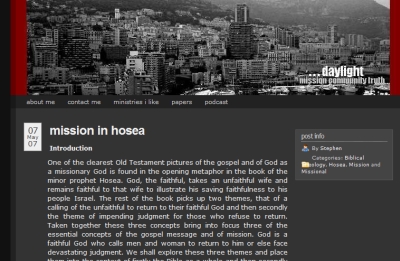
Mission in Hosea articleIt is always good to discover the work of others who share an interest in the crossover field of Bible and Mission. I recently came across a blog entry that reflected on the missional significance of the book of Hosea, written by Stephen Murray on his blog, ‘Daylight’. You can read it in its entirety here: Mission in Hosea.

I’d encourage you to read the whole article; here is his concluding paragraph to whet your appetite:

Hosea is a prophetic book against a stark historical background that gives us good insight into the workings and desires of a missionary God. The book shows us that God is a passionately loving God, even to the most undeserving of people, it shows us that God is a God who longs for reconciliation from our rebellious ways and finally it also shows that God is a God who will judge all rebellion once and for all. As we contemplate mission we cannot look past these three fundamental truths and so it is helpful to consider Hosea as making an important contribution to the canonical discussion of mission.

Chris Wright to give lecture on Bible and Mission at Redcliffe College

chris-wrightmissionofgod

Exciting news! On Tuesday 12 May 2009 Rev Dr Chris Wright will be delivering Redcliffe College’s Annual Lecture in World Christianity on the subject of The Bible and Mission.

I would argue that Chris is perhaps the most influential writer on the subject of Bible and mission around today, as evidenced by his magesterial volume, The Mission of God: Unlocking the Bible’s Grand Narrative. He writes and speaks with passion and persuasion.

We are thrilled that he has accepted Redcliffe’s invitation and are very much looking forward to the event. I’ll post more details in due course; it is a public lecture so why not come along?

To whet your appetite have a look at this interview I did with Chris last year for Encounters Mission Ezine: Mission: What the Bible is All About – An Interview with Chris Wright

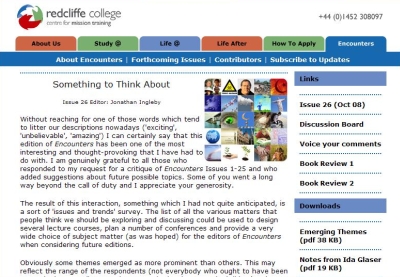
Encounters 26 on issues and trends in mission

Issue 26 of Encounters, the bi-monthly topical mission journal for which I serve as reviews editor, is now out. In celebration of reaching 25 issues Encounters canvassed a number of ‘mission people’ to ask how they would reflect on the journal so far and what issues had been missed or need addressing. It is an excellent analysis of current trends and issues in mission and includes contributors such as Jonathan Ingleby, Ida Glaser, Martine Lee, Jonathan Rowe, Rose Dowsett and Paul Thaxter.

In Jonathan’s editorial he mentions that two contributors note the importance of “Re-appropriating the Bible for mission”. In her contribution Ida Glaser suggests that,

Biblical interpretation is going to be increasingly important. My hobby horse is reading the Bible faithfully in the context of other faiths and of Islam in particular. There are also interesting questions about not only developing local interpretations but also teaching the Bible in different contexts…

And, of course, those different contexts raise the issue of how non-Christians read and respond to the Bible. So often we think of mission in terms of what Christians do – the Islamic context alerts us (or should do) to the importance of understanding what non-Christians are likely to be thinking about Christianity, about Christ and about the Bible before we ever meet them.

While Jonathan Rowe asks, “What about biblical issues from the NT as well as the OT? Or the influence of particular biblical books or theological themes (creation, resurrection) on our understanding of mission?”

Some interesting comments. Rowe’s point about the OT refers to the issue I edited in April 07 on Mission and the Old Testament. He is right, of course, that there are numerous possibilities for developing the theme. Watch this space…

Do check out Encounters Mission Ezine. It’s free and full of excellent stuff. Check out the Encounters tab above for a listing of all the issues or go direct to Encounters Mission Ezine.