Missional hermeneutics and Bible translation

What’s the point in a missional reading of the Bible if you can’t read the Bible?

In his Encounters response Chris Wright’s Bible and Mission lecture, Eddie Arthur (Executive Director of Wycliffe UK) has written a brief but powerful article that for me opened up the discussion in surprising and sobering ways.

there is a fundamental assumption in the lecture that people are able to read what Jeremiah wrote. Sadly, for a variety of reasons, many people quite simply do not have access to Jeremiah…

In a language with the economic capacity of English we have numerous translations of the whole Bible available. For many minority languages, it is often the case that only a selection from the Bible is printed or published. Perhaps a Gospel, or a whole New Testament, maybe with the Psalms or a selection of Old Testament stories. In truth, Jeremiah is likely to be way down the list of things that are published. Does the missional hermeneutic stress on the overarching narrative of the Bible give us any insight into how we should go about making the Scriptures available? Should we perhaps consider concentrating resources so as to translate the whole Bible for one group rather than making selections available to a number of groups? Or could a missional hermeneutic guide us in making more principled decisions about which passages should be seen as essential? On the pages of a mission magazine this might seem a sterile question, but in a world where 200 million people do not have the Scriptures in their own language, some hard choices need to be made and we need a good hermeneutical and theological basis upon which to make them.

At my home group tonight we had four different Bible translations between five people. I am very grateful for the different translations available to us in English; they often help to bring out different facets of the text, or at least facilitate different ways of reading the Bible (study, public reading, devotional, etc.). But it is embarassing, if not outrageous, that we in the West have so many versions, while vast numbers of people cannot read a single word of Scripture in their own langauge.

You can read the whole of Eddie’s article by following this link to the June 2009 edition of Encounters Mission Ezine: Issue 29 – The Bible and Mission
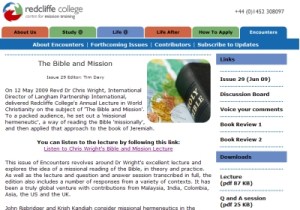
Encounters Mission Journal on the Bible and Mission

Encounters issue 29 - The Bible and MissionThe Encounters Mission Journal issue based on Chris Wright’s Redcliffe lecture on The Bible and Mission (and specifically, his missional reading of Jeremiah) is finally here! It’s been a lot of work to put together in a short space of time, but all concerned have done a great job. As well as the transcript of the lecture and a link to a downloadable audio file, it features eight response articles from a wide range of people with a lot of interesting things to say.

Here is part of my editorial:

This issue of Encounters revolves around Dr Wright’s excellent lecture and explores the idea of a missional reading of the Bible, in theory and practice. As well as the lecture and question and answer session transcribed in full, the edition also includes a number of responses from a variety of contexts. It has been a truly global venture with contributions from Malaysia, India, Colombia, Asia, the US and the UK.

John Risbridger and Krish Kandiah consider missional hermeneutics in the setting of the UK Church. David Spriggs writes on the relationship between the Bible and missional engagement in the ‘public square’. Eddie Arthur reflects on what a ‘missional hermeneutic has to say to those who translate and desseminate the Scriptures’. Brian Russell and Milton Acosta discuss missional hermeneutics as a method of reading the Bible. Finally, Anthony Loke and Rabbi and Chitra Jayakaran share what a missional hermeneutic might mean for their own contexts of Malaysia and India, respectively.

And these are the articles:

Lecture:  “Prophet to the Nations”: Missional Reflections on the Book of Jeremiah.
(Revd Dr Chris Wright)

Q and A:  Lecture question and answer session.

Response 1:  A UK pastor’s perspective.
(John Risbridger)

Response 2:  A missional hermeneutic and Scripture engagement.
(Eddie Arthur)

Response 3:  Jeremiah and mission in the public square.
(Revd Dr David Spriggs)

Response 4:  What does mission in exile really look like?
(Dr Krish Kandiah)

Response 5:  Breaking open the text.
(Dr Brian Russell)

Response 6:  Missional hermeneutics: some opportunities and questions.
(Dr Milton Acosta)

Response 7:  Missional hermeneutics in a Malaysian context.
(Revd Anthony Loke)

Response 8:  Missional hermeneutics in an Indian context.
(Rabbi and Chitra Jayakaran)

Over the coming weeks I’ll be reflecting on some of the points made in the issue. To read the articles or listen to the lecture, follow this link:

Go to The Bible and Mission – Issue 29 of Encounters Mission Journal

King Solomon’s expenses

Here in the UK we are currently embroiled in a succession of stories about the expenses our Members of Parliament have been claiming, which were recently made public. It puts me in mind of another review of a political leader’s expenditure set out by an Old Testament writer.

The popular view of King Solomon is that he was a good king who went bad later on in his reign. But the biblical account of his life, in the book of Kings at least, drops a number of hints to suggest a measure of ambiguity throughout his life. One aspect of this was his expenditure.

The people of Israel had been warned what might happen if they ever demanded a human king:

16 The king, moreover, must not acquire great numbers of horses for himself or make the people return to Egypt to get more of them, for the LORD has told you, “You are not to go back that way again.” 17 He must not take many wives, or his heart will be led astray. He must not accumulate large amounts of silver and gold. (Deut. 17:16-17, ESV)

 10 Samuel told all the words of the LORD to the people who were asking him for a king. 11 He said, “This is what the king who will reign over you will do: He will take your sons and make them serve with his chariots and horses, and they will run in front of his chariots. 12 Some he will assign to be commanders of thousands and commanders of fifties, and others to plow his ground and reap his harvest, and still others to make weapons of war and equipment for his chariots. 13 He will take your daughters to be perfumers and cooks and bakers. 14 He will take the best of your fields and vineyards and olive groves and give them to his attendants. 15 He will take a tenth of your grain and of your vintage and give it to his officials and attendants. 16 Your menservants and maidservants and the best of your cattle and donkeys he will take for his own use. 17 He will take a tenth of your flocks, and you yourselves will become his slaves. 18 When that day comes, you will cry out for relief from the king you have chosen, and the LORD will not answer you in that day.” (1 Sam. 8:10-18, ESV)

Fast-forward to Solomon’s reign where, among other things, he redraws tribal boundaries for tax purposes (1 Kgs. 4:1-19), conscripts forced labour for his building projects (5:13-18), spends twice as much time on his own house than he does on the Temple (6:38-7:1), and even imports horses from Egypt (10:28; cf. Deut. 17:16!).

Even the accounts of the opulance of his buldings and lifestyle seem to turn the reader from wonder, to hesitancy, to suspicion. Was the writer of Kings over-praising Solomon to make a point? Is there in fact a drip-drip-dripping of irony throughout the narrative that asks whether this was quite the golden age we thought it was?

Now of course the situations in Ancient Israel and contemporary Britain are completely different. But this at least reminds us that we should pay careful attention to what those in power do with their power, and not least with the public purse.

Chris Wright gives missional reading of Jeremiah at Redcliffe Lecture

I have blogged a few times in anticipation of Chris Wright’s public lecture on The Bible and Mission at Redcliffe College, which he delivered on Tuesday evening. It was a great night providing lots of food for thought (and blogging!).

Chris approached a missional reading of Jeremiah using three of George Hunsberger’s categories for how the term ‘missional hermeneutics’ is used (see GOCN website), and added one of his own:

1. The missional framework of the biblical narrative
2. The missional purpose of the texts
3. The missional locatedness of the readers
4. The missional cost to the messenger

It was fascinating to see his approach applied to an unexpected text like Jeremiah. The question and answer session was revealing as well. I’ve been asked whether the talk will be available.  Here’s the plan…

In written form
The June issue of Encounters (out early next month), Redcliffe’s mission journal, will be on the theme of The Bible and Mission. This will include the transcribed talk plus a number of short (c. 500 words) responses from a variety of contributors from academics to mission ‘practitioners’ (forgive the crude distinction!). Papers will also represent something of the global church with writing reflecting a number of cultural contexts. Sign up to Encounters updates

As a podcast
At the same time as the Encounters issue Slipstream will be making their June podcast available. As it happens June’s featured interviewee is (you’ve guessed it!) Chris Wright. Although the theme is not on Bible and Mission as such, Slipstream have kindly agreed to make the lecture available as an ‘extra’. Sign up to Slipstream updates

A few other observations about the evening…

It was packed! To my knowledge this was the most popular public lecture we have had at the College.

The subject of Bible and Mission is of interest both to the local Church and to mission agencies, both of whom were well represented.

Events are stronger if put on in partnership. Bible Society, Wycliffe UK, Keswick Ministries, Global Connections and Slipstream all played a valued part. Even the refreshments were a collaborative effort, thanks to Ethical Addictions!

Mission and the book of Ezekiel

The intriguingly titled Crazy Squirrel blog posted on Mission and the book of Ezekiel a while ago. He highlights some interesting resonances between mission then and now. Here are a couple of quotes

The book of Ezekiel is a good example of God seeking to be known by all nations, and wanting Israel to be His example. Ezekiel was written during a period of exile. Exile occurred primarily because Israel was not following God’s commandments of living a pure and holy life. They were not following their missiological purpose and lifestyle.

I like the last sentence (though would prefer the term ‘missional’ rather than ‘missiological’), making as it does the important connection between calling and behaviour.

Ezekiel’s contribution to mission theology of Israel shows that God’s work in the world aims at something larger than one nation. We can see here that Israel is not the sole desire of God; He wants the nations to know Him as well. In order for the nations to know God, Israel must be a pure witness, cleansed of their sin. Israel was to operate with the awareness that God’s range of vision is decidedly on all the world’s nations. At the time of the exodus, God’s intention with Pharaoh was made clear: Pharaoh, and also “all peoples of the earth,” were to acknowledge Yahweh (Exodus 14:18).

Here, purity, calling and God’s desire for the nations is tied together. If you want to read the whole article visit the Crazy Squirrel blog

Chris Wright Bible and Mission lecture update

Chris Wright’s 12 May public lecture at Redcliffe College on The Bible and Mission is fast approaching.

As well as setting out a missional hermeneutic of the Bible, he will also be putting this into practice by giving a missional reading of the book of Jeremiah. There will also be an opportunity for questions at the end.

Do you have any questions you would like to ask Revd Dr Wright? If so, and you’re not able to be there on the night, why not pass them to me using the comment facility below? I can’t make any promises but will try to fit them in… 

More details about Chris Wright’s The Bible and Mission Redcliffe Lecture

Square Mile initiative

Square MileJesus calls his followers to be salt and light in the world (Matt. 5:13-16). Salt and light make a difference. You would notice if they weren’t there. But,

‘Would anyone in your community notice if your church ceased to exist?’

This provocative question is asked by the Evangelical Alliance as part of a new initiative called ‘Square Mile’, which aims to encourage churches to engage in truly integral mission.

Here’s what they say,

Square Mile is an Evangelical Alliance initiative which aims to catalyse and equip Christians to take a truly integrated approach to mission, expressed in four dimensions:

Mercy: demonstrating God’s compassion to the poor
 
Influence: being salt and light in the public life of the community
 
Life Discipleship: equipping Christians for missional living as workers & neighbours
 
Evangelism: faithful and relevant communication of the gospel

For more information, check out the Square Mile website

Forthcoming book on reading the Bible missionally

Brian Russell (Asbury Seminary, Kentucky) has blogged about his forthcoming book on the missional interpretation of the Bible. It is due out next year from Wipf and Stock.

The title is, The Scripture Way of Mission: Reading the Bible Missionally for the Church and the World and it promises to be a great resource for thinking through, and putting into practice this way of reading Scripture.

Brian gives us a tentative outline and asks for feedback. I’m particularly intrigued by the second part of the book, which he outlines here:

Part Two: Reading the Bible for the Mission of God
Part Two of Unleashing the Scriptures focuses on specific practices for unleashing the missional message of the Scriptures into our lives and the lives of our communities of faith. If God’s mission is the core theme of the Scriptures, then it must become the focus of our reading and teaching of Scripture.

Understanding the centrality of mission in the Scriptures demands action. It is not enough to understand that mission stands at the center of the biblical witness. Our use of Scripture must (re)align with the Bible’s overarching aim of creating and shaping a missional community to reflect and embody God’s character to and for the World. This message needs to permeate throughout existing communities of faith and be experienced anew by those outside of these communities. In short, we must be reconverted to God’s mission and allow God to deploy us as agents of change in our communities and as ambassadors for God to those on the peripheries of our communities.

Chapter Eight, “Scripture Unleashed: Learning to Speak Human,” provides a method for engaging in the missional reading of Scripture. It will offer a step-by-step guide for reading the Bible through the lens of mission. It includes practical advice for transforming one’s current reading practices and for learning to read the Bible for humanity—for both insiders and outsiders to the Gospel message.

Chapter Nine, “The Practice and Possibilities of a Missional Reading,” offers concrete examples of missional interpretation that will enhance your own ability to read the Scriptures and translate their message for humanity.

Chapter Ten, “Transforming Our Communities—Engaging the World: A Conversion to Mission,” offers a framework for transforming Churches into missional communities. This chapter explores the role that missional interpretation plays in shaping a missional ethos in contemporary communities of faith and how this impacts the Church’s engagement with contemporary cultures. We will explore strategies for integrating a missional reading into all aspects of our communities.

Chapter Eleven, “Deployment,” brings Unleashing the Scriptures to a conclusion. It will summarize key findings and end with a challenge to those who teach and preach the Scriptures in local churches to unleash the Scriptures as a catalyst to mission.

Please do visit Brian’s blog and share your thoughts with him. It looks like an extremely valuable development in the area of Bible and Mission, and I commend him for being so open to others shaping his work.

Mission-Net, Deuteronomy and the University Alien

mission-net: congress 2009

It’s been a little while since I’ve blogged, what with Easter, going to Mission-Net and then having a few days holiday.

It was great to be at Mission-Net. My two seminars looked at (1) The ‘missional basis of the Bible’ along with an overview of the Old Testament; and (2) A study on Deut. 10:12-22 and what it tells us about our missionary God and our role as his people in the world.

The highlight for me was at the end of the second session. I had touched on the importance God places on caring for the vulnerable in society, as exemplified in the laws concerning the marginal groups (widow, orphan, alien). I had relayed a story from my student days where I had been lazy, sticking to people like myself rather than looking out for and befriending the ‘international’ students. A Greek student in the seminar talked about how she was going to make more of an effort to spend more time with a South-East Asian student she was aquainted with. It thrilled me to hear her say this! My prayer is that as she returns to her university she will learn from my mistake and, more importantly, allow God to mould her character and attitudes.

Mission, the resurrection and HIV AIDS

Today’s post is a contribution to Slipstream’s synchronised blogging day. Slipstream is part of the Evangelical Alliance and “exists to network, equip and grow leaders across the generations”. They asked bloggers to post an entry on the resurrection on Maundy Thursday.

In my recent post Human trafficking and mission I asked how we might connect certain texts in the Old Testament with the issue of contemporary slavery and trafficking. Today I want to highlight one aspect of the importance of the resurrection in relation to the global shadow of HIV/AIDS. In his The Mission of God: Unlocking the Bible’s Grand Narrative, Chris Wright offers the following comments, which are well worth reflecting upon:

Only the gospel offers and proclaims the promise of a new humanity to those whose present humanity has been shattered and shredded by this virus.

I say “only the gospel” with a double intention. First, because this essential gospel promise of eternal life for all who believe, founded on the cross and resurrection of Christ, is nonnegotiable and cannot be substituted for or sublimated into any of the other responses that we must make to HIV/AIDS, all of which have their own equally nonnegotiable validity and Christian interpretation. But secondly, I say only the Christian gospel, as distinct from all other religions and their view of death. For actually, it is the stark fact of death that throws up and defines most clearly the chasmic divide between religions and between the myriad views of what salvation might mean…

a missiology that omits the only ultimate answer to death from the range of responses to those in the grip of death has no claim to a Christian name either. (pp. 440-441, emphasis in bold is mine)