Brian Russell on Exploring New Language for Proclaiming the Gospel

brian russell catalyst articleFor an number of years Brian Russell has been an excellent advocate of a missional hermeneutic and how it relates to Church, the Bible and mission.

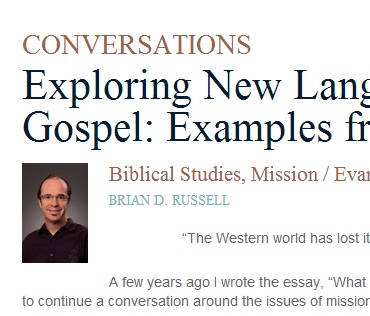
In the latest issue of the online journal Catalyst Brian contributes an article on Exploring New Language for Proclaiming the Gospel. He opens it up by saying:

The key to developing new language for proclaiming the gospel is learning to listen to the surrounding culture for its prevailing metaphors and stories. It’s not about our creativity as communicators but our capacity to listen and study attentively. Our assumption is that our missional God in the person of the Risen Christ is leading his people into the world on mission. Jesus goes before us. It’s our task to be attentive to the Spirit’s leading so that we may build on what God is already doing. In other words, the new language already exists. It’s up to us to find it, refit it with gospel content, and deploy it. Think of Paul on Mars Hill in Acts 17. It’s about committing to using the language of the street and the marketplace rather than only the language of the church. When we read the Scriptures within their ancient contexts, we discover that biblical authors drew deeply from the prevailing culture in deploying the metaphors and symbols of the day as vehicles for telling God’s story.

He then illustrates this with some examples from the books of Genesis, Exodus and Philippians before finishing with three questions for the reader to consider:

What are the dominant ideals and stories of the people whom God has sent you to serve?

How does the gospel engage these ideas?

What language is already present that can serve as a vehicle for clearly communicating the gospel in your context?

I’m really pleased to see Brian writing on these issues. Knowing the historical and cultural background to biblical texts can provide wonderful insights which fuel our understanding of the Bible and how it relates to mission. As Brian illustrates, it can also fuel how we do mission as well.

Here’s a link to a video where Brian explains his passion for what he does.

He has also contributed to issues of Redcliffe’s Encounters Mission Journal:

Reading the Bible with the Global Church – A Response from the United States – March 2013

Psalms 1-2 as an introduction to Reading the Psalms Missionally – June 2010

Breaking Open the Text: A reflection on Chris Wright’s Missional Reading of Jeremiah – June 2009

You can also read Brian’s blog articles on missional hermeneutics here
Bible and Mission resources for a new year

ImageOne of the aims of the Centre for the Study of Bible and Mission is to act as a signpost to loads of great resources that will help you think about mission in the Bible and the Bible in mission.

As I mentioned in Wednesday’s post on Ed Stetzer on Missions vs Missional, we are beginning a new academic year at Redcliffe College over the next few days. Whether they are studying as part of our Degree in Applied Theology in Intercultural Contexts or our MA in Bible and Mission, I will be pointing them to the Bible and Mission resources highlighted in this site. In particular, we have worked hard to list books and articles that will be useful. Many of these are freely accessible to read online so we’ve provided links where possible.

So, take a look around our resources section and enjoy! And if there is anything missing do let us know.

NT Wright on the missional nature of Paul’s theology in his new book Paul and the Faithfulness of God

NT Wright’s new 1700 page book on Paul and the Faithfulness of God is out in a few weeks and there is a video of an interesting interview with him by Michael Bird here.

What struck me was the importance Wright gives to the missional nature of the identity and activity of both Paul himself and also the churches he was planting. Here’s the key part of the interview, which begins at around 4 mins 15 seconds:

Paul was doing [his theology] in the service of the mission that he had. He wasn’t an armchair thinker. He was doing this because he believed it was his job. It was his vocation to plant churches (i.e., little communities of Jesus followers) in Caesar’s world, in such a way that they would be communities shaped by this message, by this gospel, by this theology, so that they would be united, so that they would be holy, so that they would be able to take forward the mission of God.

Here’s the blurb from SPCK’s website on the book itself:

We are proud to announce that the highly anticipated fourth volume of the Christian Origins and the Question of God series is currently in production and due for publication in October 2013!

Paul and the Faithfulness of God pays rich tribute to the breadth and depth of the apostle’s vision, and offers an unparalleled wealth of insights into his life, times and lasting impact.

Rowan Williams says:

‘Tom Wright’s long-awaited full-length study of St Paul will not in any way disappoint the high expectations that surround it.  From the very first sentence, it holds the attention, arguing a strong, persuasive, coherent and fresh case, supported by immense scholarship and comprehensive theological intelligence. ’

Paul and the Faithfulness of God will be bound as a 2-volume set and available in both paperback and hardback at £65 and £125 respectively.

Professor Wright has said of the work:

St Paul was highly controversial in his own day, and he remains so, not only for Christians and Jews but in western culture as a whole. In this new two-volume treatment I argue for a particular historical and theological understanding of him. He remains a deeply Jewish thinker, but his vision of the three central Jewish beliefs – one God, one people of God, one future for the world – was reworked around Jesus as the Messiah and around the holy spirit.

David G. Horrell, Professor of New Testament Studies, University of Exeter writes:

Tom Wright’s big book on Paul has long been eagerly awaited. And here it is! Massive in every sense of the word, this is a synthetic, scholarly, and comprehensive analysis of Paul, worked out using the key categories outlined in The New Testament and the People of God, showing how Paul, as a Jew in the Roman Empire, reworked the framework of monotheism, election, and eschatology around Jesus and the Spirit. Written with elegance and humour, full of detailed exegesis and engaging with a very wide range of contemporary scholarship, this major achievement will be a landmark in the field of Pauline studies for many years to come.

Ed Stetzer on Missions vs Missional

ImageAs we approach the start of a new academic year it’s good to ask some fundamental questions about what we mean by the term ‘mission’ and why it matters.

It seems that there has been a trend in recent years for fewer people to go into long-term work overseas. While there may be lots of reasons for this, one that is sometimes suggested is the growing conviction that we already have a mission field here in the UK. There is so much to do here so why go elsewhere?

Obviously it is utterly fantastic that we as a Church realise our already-sentness: that God has placed us to be bearers of his good news right where we are. And, of course, ‘where we are’ may be just as intercultural (if not more so) that many places around the world.

But where does that leave the need to send and support people to go overseas?

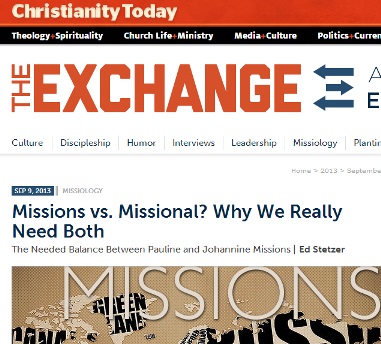
In an article for Christianity Today (Missions vs. Missional? Why We Really Need Both), US missiologist Ed Stetzer makes a helpful contribution to the discussion, arguing that we need both. Indeed,

The two issues are distinct and yet integrated. They are not mutually exclusive, but thrive best when they are both embraced and implemented in a local church body. Living on mission is not a missions issue, per se. It’s a Christian issue. Part of living on mission, however, must lead to missions…

Mission and missions need to live together. Missional churches—those focused on living on mission where we are—must remember that Jesus called us to reach people where the gospel is not. I want us to be missional, living as agents of God’s mission in context, but you can’t take John 20:21 in isolation without also remembering Matthew 28:18-20 and Acts 1:8.

In other words, a passion to reach the lost globally should impact how we live out our faith locally. Similarly, a missional mindset in our local community should shape us in such a way as to invest ourselves in the less-local. They fuel each other.

And as I prepare to teach my classes this semester (A Missional Intro to the OT; Missional Texts: Psalms and Genesis 1-11; Missional Texts: Isaiah; Reading the Bible Missionally) Stetzer’s article is a helpful reminder that a whole-Bible approach is essential. Just because I feel I can justify one course of action as biblical, this doesn’t mean it is the only biblical course of action. It is not that we are being unbiblical; rather we are not being biblical enough.

Roll on the new term!

Offline access to NIV freely available

I get a lot of hits on old posts notifying people that they can access different Bible versions on their phones. Often this happens for a limited amount of time, but YouVersion has just announced a more permanent opportunity to access the NIV, as well as some other versions. Here’s the blurb with links:

By Popular Demand: Offline Access to NIV & More

The New International Version (NIV) and 30 other versions from Biblica are now available for free download through the Bible App™. Biblica has been a valuable partner since YouVersion’s early days, and we’re thrilled with their bold move to make this diverse collection of versions available to the global YouVersion community.

These versions represent some of your favorites in 25 languages, including NVI in Spanish and Brazilian PortugueseKLB in KoreanNIV-UK in British EnglishHFA in GermanHTB in Dutch, and BDS in French. It’s a huge step forward in increasing worldwide Scripture engagement and availability.

If you download any of these versions to your device, you’ll be able to read it anytime, anywhere—even when you can’t connect to your service provider or to the Internet. And this is not a limited-time special offer.Beginning today, Biblica is making these versions available offline on an ongoing basis.

(If you’re not sure how to download a Bible version to your device, visit our support website to learn how easy it is!)

We are deeply grateful for Biblica’s partnership and all that it has already meant to YouVersion and to our community worldwide. Biblica continues to demonstrate increasing passion about the mission of helping this generation become the most Bible-engaged generation in history.

London Institute of Contemporary Christianity on the Bible

Today we had a faculty retreat day in preparation for the year ahead at Redcliffe. We were led in the morning by Antony Billington and Tracy Cotterell from LICC (London Institute of Contemporary Christianity) who helped us to reflect in really valuable ways on God’s Word and the nature of whole-life missional discipleship.

You can see a video here of Antony describing LICC’s approach to Bible Engagement. The website also has loads of resources on the Bible and mission. For example, their Bible & Culture section explains,

The Word of God, illuminated by the Holy Spirit, is the primary means for knowing God and being shaped into the image of his Son, our Lord Jesus Christ.  From beginning to end, Scripture tells of God’s redemptive purposes not only for the church but for all creation, including our own role in that great plan.

LICC remains committed to seeking wisdom for the big questions of our time and the minutiae of our daily lives by listening to God’s word.  But if we are to really equip Christians to show and share the transforming power of the Gospel in word and action, then we need to listen carefully, both to the attitudes and beliefs, concerns and fears of people in contemporary society and also to Christians’ own experiences and concerns.

Using henna to communicate the Gospel

Henna Stories websiteA couple of years ago I posted on a fantastic example of how the art of henna might be used in Bible engagement (you can read that post here: Henna storying the Bible). People still come across that post most days, which suggests the concept intrigues and resonates with them. I’ve also had the privilege of seeing a student submit some henna designs for an assignment on the Psalms here at Redcliffe.

Revisiting the topic I notice that there are now quite a few links out there on the subject. The Henna stories website is a good place to start, as is the section on Henna in the AfricaStories website. Two interesting articles can be found on the Indigenous Jesus blog: Contextualized Henna Art and Mehndi Gospel Paintings.

You may also like to check out a couple of videos: Creation to Christ and Henna and the Gospel.

What about your own context? What expressions of creativity are prized in your culture and how might they be used to convey the message of the Gospel?

Latest issue of Orality journal

Latest issue of Orality journal

A while ago I posted on the launch of a new journal from the International Orality Network, called Orality. The first issue of 2013 came out earlier in the year and features the following articles:

Literacy, Orality, and the Web – Gilles Gravelle. What oral communication can accomplish in Bible translation projects that print communication alone cannot.

Church Planting Movements among Oral Learners – Pam Arlund. Case studies of using orality strategies in church planting movements.

Using Rituals to Disciple Oral Learners: Part 1 – W. Jay Moon. What can we learn from the powerful effects of rituals from cultures and how can rituals be used for meaningful discipleship.

Contextualizing the Gospel in a Visual World – Clyde Taber. In a media saturated world, how do we contextualize Kingdom stories for the new generation?

Inside-out Stories – Marlene LeFever. When a ministry retools, what are the outcomes?

Mind the Gap: If This Is Your Land, then Where Are Your Stories? – A. Steve Evans. What and where are our stories that help us claim the land?

Ten Mistakes of a New Bible Storyteller – J.O. Terry. Wisdom from a storytelling practitioner.

Story Proof: The Science behind the Startling Power of Story – Tara Rye

Bible Storying course this November at Redcliffe

Bible Storying course this November at Redcliffe

Bible Storying Course image
Photo credit: Elyse Patten, Wycliffe Global Alliance Caption: Tevita Lalahi interacts during a Bible storytelling workshop on the island of ‘Eua

Here’s an exciting opportunity for anyone wanting to learn how to communicate the Bible to people who, for whatever reason, don’t do books.

The Bible Storying course is part of Redcliffe’s Centre for Linguistics, Translation and Literacy and is taught in partnership with the fantastic Wycliffe Bible Translators and SIL. If you are interested in the whole area of the Bible and orality then check out these blog posts on orality, and the Bible and Orality page of our Resources Section.

Here some further info about the Bible Storying course from the Redcliffe website:


Bible Storying course

Monday 18 – Saturday 23 November 2013

From the beginning of time, stories have formed an important part of how we communicate. Where there is no written language, telling stories helps the listener discover their history and see where they fit within a bigger story.

God’s Story as revealed in the Bible is no exception. There are many cultures around the world which rely on oral communication, and many more where large numbers of the population are not literate or do not read – even in the UK.

Our intensive Chronological Bible Storying course will give you the skills to help people engage with God’s Word through the retelling of Biblical Stories.  This method has been used with people who prefer audio or visual ways of learning as well as in cultures where the Bible is not available in printed form. It is taught in partnership with Wycliffe Bible Translators and SIL, as part of Redcliffe’s Centre for Linguistics, Translation and Literacy.


Who is the course for:

  • Anyone interested in learning about story crafting and biblical storying
  • Anyone already, or planning to, work with Scripture in an oral culture
  • Anyone already, or planning to, work with people who enjoy audio and visual ways of learning.

The course will help you to:

  • Tell a story to a small group, help others to learn the story, and lead a discussion about the spiritual application of the story
  • Understand the worldviews of the group, which stories are most appropriate to the group and and how to adapt your story to a given worldview
  • Begin story crafting with a Bibleless language group,  or people already with Scriptures but who need help in engaging with them to understand the Bible’s whole story.  They could be somewhere remote or even in your own town in the UK or Europe!
     

Details

  • Training is entirely oral and participatory – no texts or handouts
  • It’s an intense 6 day workshop – you must be present for all the days 
  • Dates: 18 – 23 November 2013, Monday – Saturday


Cost and to book

The cost is £275 for 6 days residential, or £187 non-residential (including lunch and dinner each day).

Visit Redcliffe’s website for booking details: Bible Storying course

Making Bible Studies Missional – part one

Today I’m beginning a new series of posts on what I consider to be absolutely crucial when thinking through the implications of a missional approach to the Bible: how does it impact small group Bible studies? Of course there are numerous ways of engaging with the Bible, both individually and corporately. I have, though, spent a good deal of my adult life in small group Bible studies either in the context of Church, Christian Union (either as a student or a student worker), or in a Bible/Mission training College setting.

I suspect this is the case for a lot of Christians here in the UK. So the small group Bible study is a key way in which we engage with the Bible. But how do we make our studies more missional? Is it enough to add a ‘mission application’ to the end of our traditional studies or does a missional approach change how we study the Bible together at a more fundamental level? This is what I want to tease out in this series of posts.

My hunch is that if the missional approach does not (in some way at least) find a home in preaching and small group studies then those of us who are advocating for a missional hermeneutic will not have done our job well enough. It is fantastic to see the growing engagement with missional hermeneutics in the academy, and amongst those who are already inclined to think in terms of mission. And there is still much to do in those spheres. But it can’t stop there. I am convinced that a missional approach to the Bible could be profoundly helpful in envisioning everyone in the Church to get excited about their participation in God’s mission, in their homes, workplaces, communities and in other contexts as well.

So in this series I will aim to reflect every now and then on questions that may help shape our Bible studies so that they are more aligned with the missional nature of the Bible.

What about you? Have you seen this done well? Do you know of good examples we could all learn from? What questions, challenges or opportunities do you perceive as we set out on this journey together. Leave a comment below, on Twitter or on our Facebook page.