Redcliffe College Biblical Hebrew Week 2010

Every year Tricia Johnson (Redcliffe’s main lecturer in Biblical Hebrew) and I team up to co-teach an intensive week of Hebrew. There are two courses: one for beginners (assuming no knowledge) and one for intermediates.

Here’s the blurb from the Hebrew Week page on Redcliffe’s website. There is also a pdf leaflet and booking form available.

Biblical Hebrew Week 2010 – Sunday 20 to Saturday 26 June 2010

Two courses to choose from:
Biblical Hebrew for Beginners
or
Moving on with Biblical Hebrew

In partnership with Wycliffe Bible Translators and the Centre for the Study of Bible and Mission

Our popular intensive Biblical Hebrew week returns for its fourth successive year. Choose from either the introductory course for beginners or the intermediate programme for those wanting to develop their grasp of the language.

Beginner’s course: Biblical Hebrew for Beginners

This course is designed for people who have had no previous exposure to Hebrew, or who would like to revisit the basics. The aims of this course are:

  • To cover the basics of the language (alphabet, grammar, vocabulary)
  • To work together on a variety of Old Testament texts
  • To better appreciate the literary character of the Old Testament
  • To gain the skills and confidence to continue learning after the week has finished

Intermediate course: Moving on with Biblical Hebrew

This intermediate course is for those who have already had some exposure to Biblical Hebrew, either on their own or through studying on a beginner’s course. The aims are:

  • To refresh, consolidate and build on your existing knowledge of Hebrew
  • To work in-depth on a variety of Old Testament texts representing the different genres of the Hebrew Bible
  • To develop your exegetical skills and think through some of the interpretive issues presented by the texts

We are delighted to be collaborating with Wycliffe Bible Translators in offering this Hebrew Week. Details of their own three-week intermediate course can be found at Wycliffe’s training website

Cost:  £350 residential or £270 non-residential.
Discounted rate (20% off for those working with churches or mission agencies):  £280 residential or £216 non-residential.
This fee covers over 35 hours of class time, materials and food (and accommodation if required). Places are limited so please book early.

More information:  For more details, including answers to questions such as “I’m no good at languages; does that matter?”; “Will I be put on the spot?” and “What does a typical day look like?”, please download the pdf leaflet.

To book:  Please print and complete the booking form contained within the leaflet.

In the meantime, if you have any questions about the course, please contact Tim Davy

Engaging young people with the Bible

This crucial issue is one of the subjects covered in this Saturday’s Youth Ministry course at Redcliffe. Here are further details taken from Redcliffe’s website:

Youth Ministry Course – day two: Discipleship with bite (and boots)

Saturday 27 March 2010

9.30am (for registration) – 4pm

Two buzzwords in youth ministry at the moment are discipleship and evangelism. It is all very well using these words with young people but what do they really mean on a day to day basis? And perhaps more importantly how can we get young people to engage with discipleship and evangelism? The second of three Saturdays aimed at equipping youth workers and volunteers in churches will give us ideas how to do this.

Do your young people appear unmotivated when it comes to church and especially sharing their faith? Dot Tyler from Emerging Generation will be talking about the practicalities involved in getting young people excited about their faith, and encouraging them to share that faith with others.

Where does the Bible fit into all this? How can we get young people excited about, and actively reading God’s word? Fiona Bridges has been involved in youth work for a number of years both in Australia and the UK and will look at how we can get young people engaged with the Word!

Are your young people talking about doing short term mission in some far off corner in the world, or perhaps they are planning out a gap year before heading to university? Maybe you are even planning to take a group of your young people on a mission trip. Mike Frith runs OSCAR, a website about everything to do with mission, and has also been on mission to a wide range of places himself. He will be speaking on the ins and outs of young people and mission and the issues that you, as a youth leader, should be aware of.

In addition to seminars, the day will provide plenty of opportunity for networking and finding out about resources. 

Cost: £18 per day or £50 for all three days. This will include a buffet lunch and refreshments.

For more details and to book visit Redcliffe’s website

Community reflection on the Psalms

On Wednesday the college community at Redcliffe will be spending the day reflecting on the Psalms and spirituality. There will be a time of corporate singing and prayer at the beginning, and I will be sharing on ‘Praying and Living the Psalms in Community’.

For the rest of the day there will be numerous activities as well as some workshops. Colleagues Rob Cook, Richard Johnson and Tricia Johnson will be leading optional sessions on a guided meditation, a poetry workshop, and Psalms and emotions, respectively.

Other activities (a number suggested by the students themselves) will include:

   – Spend time in quiet reflection and prayer
   – Be creative – respond to Psalms with music, art, dance, etc
   – Enjoy and reflect on the exhibition of Psalms artwork produced by students of the level two Psalms course over the years
   – read all through the psalms (possible in about 3 hours)
   – go for a walk: listening to psalms on ipod or with a Bible so that you can reflect on a psalm as you’re walking
   – listen to what God is saying to you or to how you are feeling and what you want to say to God and then write your own psalm
   – walk down to Gloucester Cathedral reading the Psalms of Ascent (120-134) as you go 
   – expressively read a psalm, emphasising on different words
   – get together with your prayer triplet and pray through a palm together – looking at what things stand out for each of you and why
   – Re-read some of material from the Spiritual Formation class and use that to draw closer to God.

We’ll then have a session at the end of the day to share what we’ve experienced and expressed.

We will also be producing a Psalms scroll together, which will feature the whole of the Psalter written out in hand in different languages.

I’ve written on Psalms and mission on previous posts
Biblical Basis of Mission course – week four 
Ian Stackhouse on the Psalms

Look out for tweets (#psalmsday) throughout the day and join in the conversation!

A quick note on the image in today’s post. This is one of many amazing creations by Ali Edmondson, a student here at Redcliffe. I’ve posted on her work before so take a look at more pieces here.

Changes to the Bible and Mission blog

Over the last couple of days I’ve been making a few changes to the structure of the blog, primarily with the purpose of integrating it more fully within the activities of Redcliffe’s new Centre for the Study of Bible and Mission.

A new initiative

For some time we have been working hard to develop a new initiative that will ‘serve the Church by engaging in research, teaching, writing and speaking on mission in the Bible, and the Bible in mission thinking, practice and training.’ Though we continue to fundraise we have now received sufficient support from such organisations as Wycliffe Bible Translators and Bible Society for me to have some time to devote to developing the Centre’s activities.

You can see a more detailed explanation of the Centre’s aims and activities on the About page. The main things are teaching (including a new MA in Bible and Mission); hosting an annual lecture and bi-annual consultation in Bible and Mission; research and writing; and hosting a Bible and Mission Scholar from the Majority World each year here at Redcliffe.

What about the blog?

At least for the time being it makes sense to house all the Bible and Mission activities on this site. So it is now more like a microsite than just a blog. Having said that the blog is front and centre and will actually be updated more frequently. It is the best medium by far for thinking aloud and getting across what we are doing in an immediate and accessible way.

I hope you enjoy the developments; let me know what you think!

Redcliffe College launches new MA in Bible and Mission

I’m really excited to announce a new postgraduate MA in Bible and Mission that is being launched at Redcliffe College, ready for September 2010. This has been one of my projects over the last couple of years and it is now going through the validation process with the University of Gloucestershire.

I’ve reproduced the MA in Bible and Mission course page from Redcliffe’s website below. A few aspects are worth highlighting. Firstly, the course is being developed in partnership with mission agencies. Among them, Wycliffe Bible Translators and Bible Society have been particularly involved. Secondly, the course will seek to bridge missiology and Biblical studies in an integrated way. Thirdly, it aims to help students reflect on the Bible missionally, and mission biblically. There will be a key emphasis on missional hermeneutics and it also reflects on the Bible as a tool of mission as well as a record and phenomenon of mission.

Any comments or questions? Leave a comment below…

With the increasing complexity of the Church’s mission in the world, clear and deep biblical reflection is essential. Not only should God’s people have a firm grasp of how mission fits into the Scriptures, we should also be confident and competent in using the Bible to engage missionally in a variety of cultural contexts.

Redcliffe’s MA in Bible and Mission enables students to explore mission in the Bible and the Bible in mission thinking and practice. It is being developed in partnership with various agencies including Wycliffe Bible Translators and Bible Society, both of whom will also be involved in the ongoing content of the course.

Students complete three required modules and choose one further module.

Method and Content in Missiological Study: Develop your competence in research methods at postgraduate level and gain an overview of Missiology.

Reading the Bible Missionally: Enhance your understanding of the Bible and mission by applying a ‘missional hermeneutic’ to the Scriptures.

Bible Engagement in Intercultural Contexts: Explore and evaluate different approaches to using the Bible in different cultural contexts, both in the ‘West’ and in the majority world.

Optional choice modules may include:
The Mission of the Church in the Context of Post-colonialism and Globalisation;
Crucial Issues in Asian Mission and Theology;
Crucial Issues in European Mission and Theology;
An Introduction to Global Leadership;
The Greening of Mission.

Studying part time over two years…
Studying the MA part time allows you to study exactly the same curriculum as the full time qualification. The compulsory modules are studied during the first year. The second year includes the optional modules and completion of the dissertation.

Studying the ‘flexible learning mode’ option…
This distance learning style course is ideal for mission practitioners working overseas or on home assignment, international students, and those who are unable to spend an extended period of time away from the workplace or home.

Visit Flexible Learning Mode MA to discover more.

So What Next?
We hope you have found this information helpful. Please do not hesitate to get in touch if you have any questions.

Here are a few links that may be helpful to you right now…

Biblical Basis of Mission course – week five

In session five of our Biblical Basis of Mission course we looked at mission, the Gospels and the book of Acts. Throughout the course I’ve had to make choices about what to focus on – such a vast subject! – and this week was no exception. As so often, I took my cues for this lecture from Chris Wright’s excellent book, The Mission of God (Nottingham: IVP, 2006). At one point he outlines the train of thought he imagines an early Christian might have considered:

1.  if the God of Israel is the God of the whole earth
2.  if all the nations (including Israel) stood under his wrath and judgment
3.  if it is nevertheless God’s will that all nations on earth should come to know and worship him
4.  if he had chosen Israel to be the means of bringing such blessing to all nations
5.  if the Messiah is to be the one who would embody and fulfill that mission of Israel
6.  if Jesus of Nazareth, crucified and risen, is that Messiah
7.  then it is time for the nations to hear the good news

‘It was time for the repeated summons of Psalms that the news of YHWH’s salvation should be proclaimed and sung among the nations, and for the vision of the prophets that YHWH’s salvation should reach the ends of the earth, to move from the imagination of faith into the arena of historical fulfillment.’ (p.501)

Given than Jesus’ ministry was focused on his fellow Jews, I was particularly keen for students to reflect upon the encounters Jesus had with Gentiles – pre-echoes if you like of the Early Church’s Gentile mission. For example, The Roman centurion’s servant (Matt. 8:5-13; cf. Ps. 107:3; Isa. 49:12); The Gadarene demoniac and the deaf-mute in Decapolis (Matt. 8:28-34; Mark 7:31-35); The Syro-Phoenician woman (Mark 7:24-31).

We also considered the missional way in which the Gospel writers themselves constructed their books. Take Luke, for example, who starts his 2-volume work in universal scope which narrows down as his Gospel progresses until we are in Jerusalem. Acts then opens in Jerusalem and then explodes back out into the international realm with wider and wider reach. Craig Blomberg’s illustration of the structure of Luke-Acts as an hour glass is helpful (see his excellent book, Jesus and the Gospels). You can see what I mean in this blog post by North West Church of Christ.

So, one more week to go. The final session is on mission, the Epistles and the book of Revelation.

The multicultural presence of God

We are half way through the first week of term at Redcliffe. Wednesday mornings see the College community coming together for a corporate time of devotions.

Today our new Principal, Rob Hay, delivered part two of his introductory preach. Part one, on Sunday, focused on the foretaste of heaven we see reflected in our community, which is comprised of around 30 different nationalities. Rob read from Rev. 7:9-12 which describes the multiethnic, multilingual multitude assembled and worshipping before the thrown of God.

It reminded me of something I read recently in an article by James Brownson (‘Speaking the Truth in Love’, International Review of Mission, Vol 83, No. 330 (1994), pp.479-504):

“All of humanity is called to glorify God, not by suppressing diversity and particularity, but by sanctifying it. The universal bond of humanity appears not so much in its set of common responses to its creator and sustainer, but rather by humanity’s diverse responses to the singular vision of God disclosed in the story of the life, death and resurrection of Jesus Christ.” (p.485)

Brownson then suggests that, “a missional hermeneutic begins with the assumption that the mode in which God is present among the faithful is irreducibly multi-cultural.” (p.485) So, he says, no single culture has a monopoly on understanding or describing God. We, the multiethnic Church must try to understand and worship God together, embracing our cultural diversity rather than constantly seeking our common denominators.

So, yes, it is and exciting and extraordinary privilege to be part of this multicultural community called Redcliffe College. But, yes, we are also a gathering of sinners still in need of God’s grace every day. Which is why Rob’s text for today’s talk was Eph. 5:15-21. We need to walk with integrity, forgiving and being forgiven, cultivating thankfulness and seeing God at work in the nitty-gritty of life. This will be the true test of our spirituality this year: will we seek to love one another when the going gets tough?

Biblical Basis of Mission course – week one

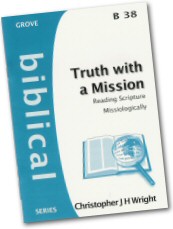
Truth with a MissionToday was the first day of lectures at Redcliffe and I began a six-week course with the first years called, The Biblical Basis of Mission, which is coupled with a six-week course next term on Issues and Trends in Contemporary Mission.
This morning we looked at some foundational stuff using Chris Wright’s introductory material on missional hermeneutics. It’s found in a few different places – Fanning the Flame: Bible, Cross and Mission (edited by P. Gardner et al, Grand Rapids: Zondervan, 2003); Out of Egypt: Biblical Theology and Biblical Interpretation (edited by C. Bartholomew et al, Carlisle: Paternoster, 2004); Text and Task: Scripture and Mission (edited by M. Parsons, Carlisle: Paternoster Press, 2006); and expanded in Wright’s The Mission of God: Unlocking the Bible’s Grand Narrative (Nottingham: Inter-Varsity Press, 2006) – but the most accessible format is his 2005 Grove booklet, Truth with a Mission: Reading Scripture Missiologically (Cambridge: Grove Books).

The issues we discussed included: the Bible as the story of God’s mission; the Bible’s call to mission; the Bible as the product of mission; the Bible as a tool of mission; mission as the theme of the Bible; the messianic and missional nature of the Bible; the difference between evangelism and mission; mission as first-and-foremost God’s activity; and more!

I love this quote in particular:

It is not so much, as someone has said, that God has a mission for his church in the world, as that God has a church for his mission in the world. Mission is not just something we do (though it certainly includes that). Mission, from the point of view of our human endeavour, means the committed participation of God’s people in the purposes of God for the redemption of the whole creation. (in Truth with a Mission, p. 14)

Next week, Mission and the Torah…

Encounters Mission Journal on the Bible and Mission

Encounters issue 29 - The Bible and MissionThe Encounters Mission Journal issue based on Chris Wright’s Redcliffe lecture on The Bible and Mission (and specifically, his missional reading of Jeremiah) is finally here! It’s been a lot of work to put together in a short space of time, but all concerned have done a great job. As well as the transcript of the lecture and a link to a downloadable audio file, it features eight response articles from a wide range of people with a lot of interesting things to say.

Here is part of my editorial:

This issue of Encounters revolves around Dr Wright’s excellent lecture and explores the idea of a missional reading of the Bible, in theory and practice. As well as the lecture and question and answer session transcribed in full, the edition also includes a number of responses from a variety of contexts. It has been a truly global venture with contributions from Malaysia, India, Colombia, Asia, the US and the UK.

John Risbridger and Krish Kandiah consider missional hermeneutics in the setting of the UK Church. David Spriggs writes on the relationship between the Bible and missional engagement in the ‘public square’. Eddie Arthur reflects on what a ‘missional hermeneutic has to say to those who translate and desseminate the Scriptures’. Brian Russell and Milton Acosta discuss missional hermeneutics as a method of reading the Bible. Finally, Anthony Loke and Rabbi and Chitra Jayakaran share what a missional hermeneutic might mean for their own contexts of Malaysia and India, respectively.

And these are the articles:

Lecture:  “Prophet to the Nations”: Missional Reflections on the Book of Jeremiah.
(Revd Dr Chris Wright)

Q and A:  Lecture question and answer session.

Response 1:  A UK pastor’s perspective.
(John Risbridger)

Response 2:  A missional hermeneutic and Scripture engagement.
(Eddie Arthur)

Response 3:  Jeremiah and mission in the public square.
(Revd Dr David Spriggs)

Response 4:  What does mission in exile really look like?
(Dr Krish Kandiah)

Response 5:  Breaking open the text.
(Dr Brian Russell)

Response 6:  Missional hermeneutics: some opportunities and questions.
(Dr Milton Acosta)

Response 7:  Missional hermeneutics in a Malaysian context.
(Revd Anthony Loke)

Response 8:  Missional hermeneutics in an Indian context.
(Rabbi and Chitra Jayakaran)

Over the coming weeks I’ll be reflecting on some of the points made in the issue. To read the articles or listen to the lecture, follow this link:

Go to The Bible and Mission – Issue 29 of Encounters Mission Journal

Chris Wright gives missional reading of Jeremiah at Redcliffe Lecture

I have blogged a few times in anticipation of Chris Wright’s public lecture on The Bible and Mission at Redcliffe College, which he delivered on Tuesday evening. It was a great night providing lots of food for thought (and blogging!).

Chris approached a missional reading of Jeremiah using three of George Hunsberger’s categories for how the term ‘missional hermeneutics’ is used (see GOCN website), and added one of his own:

1. The missional framework of the biblical narrative
2. The missional purpose of the texts
3. The missional locatedness of the readers
4. The missional cost to the messenger

It was fascinating to see his approach applied to an unexpected text like Jeremiah. The question and answer session was revealing as well. I’ve been asked whether the talk will be available.  Here’s the plan…

In written form
The June issue of Encounters (out early next month), Redcliffe’s mission journal, will be on the theme of The Bible and Mission. This will include the transcribed talk plus a number of short (c. 500 words) responses from a variety of contributors from academics to mission ‘practitioners’ (forgive the crude distinction!). Papers will also represent something of the global church with writing reflecting a number of cultural contexts. Sign up to Encounters updates

As a podcast
At the same time as the Encounters issue Slipstream will be making their June podcast available. As it happens June’s featured interviewee is (you’ve guessed it!) Chris Wright. Although the theme is not on Bible and Mission as such, Slipstream have kindly agreed to make the lecture available as an ‘extra’. Sign up to Slipstream updates

A few other observations about the evening…

It was packed! To my knowledge this was the most popular public lecture we have had at the College.

The subject of Bible and Mission is of interest both to the local Church and to mission agencies, both of whom were well represented.

Events are stronger if put on in partnership. Bible Society, Wycliffe UK, Keswick Ministries, Global Connections and Slipstream all played a valued part. Even the refreshments were a collaborative effort, thanks to Ethical Addictions!