NT Wright on the missional nature of the early church

A great quote from Tom Wright’s The New Testament and the People of God,

Why then did early Christianity spread? Because early Christians believed that what they had found to be true was true for the whole world. The impetus to mission sprang from the very heart of early Christian conviction. If we know anything about early Christian praxis, at a non- or sub-literary level, it is that the early Christians engaged in mission, both to Jews and to Gentiles. ‘The irresistible expansion of Christian faith in the Mediterranean world during the first 150 years is the scarlet thread running through any history of primitive Christianity. [quoting Hengel] This missionary activity was not an addendum to a faith that was basically ‘about’ something else (e.g. a new existential self-awareness). ‘Christianity was never more itself than in the launching of the world mission.’ [quoting Meyer]

Put simply, mission is part of the DNA of the people of God. Does my life reflect this? Does yours? How about your church? To stretch a metaphor, is mission the skin we are in or a fashion accessory we put on from time to time?

Andreas Köstenberger on Bible and mission

Andreas Köstenberger is Professor of New Testament and Biblical Theology at Southeastern Baptist Theological Seminary in the States. He has written on the Bible (particularly the New Testament) and mission in several books and articles. His website has a page highlighting these with some links as well so you can read some of them. Of particular note is his 1999 article in Missiology, ‘The Place of Mission in New Testament Theology: An Attempt to Determine the Significance of Mission within the Scope of the New Testament’s Message as a Whole’.

Here’s a link to the page: Andreas Köstenberger on Bible and mission

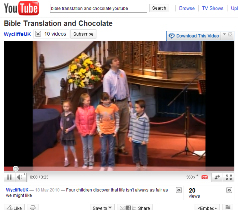
Bible translation and chocolate video

Eddie has posted a video of an excellent children’s talk on the distribution of Bible translations around the world.

As with all good children’s talks, it’s short, simple and gets across a powerful message that will also make adults sit up and think…

Redcliffe College launches the Centre for the Study of Bible and Mission

On Wednesday evening, Redcliffe College hosted the 2010 Annual Lecture in Bible and Mission, which incorporated the official launch of the Centre for the Study of Bible and Mission. The event was put on in partnership with Wycliffe Bible Translators, Bible Society and Keswick Ministries. We also streamed it live on ustreamtv, which seemed to work well.

The lecture hall at Redcliffe was full, which was great to see. After a brief welcome I gave a presentation about the ethos and activities of the Centre. David Spriggs from Bible Society then came to the front and prayed a wonderful prayer, dedicating the Centre to God.
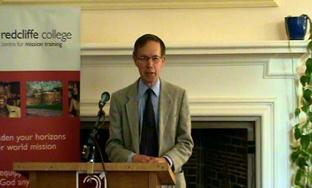
I then introduced Gordon Wenham who gave a lecture on the theme of ‘The Nations in the Psalms’. It was an excellent case study in tracing a theme canonically through the whole Psalter. I then gave a ten-minute ‘missional response’ in which I reflected particularly on ‘the Psalms in the Nations’; i.e., the Psalms as a tool of mission. We then had some time left over for an involved Q&A session.

When organising this event we have half an eye on how it might be used as a resource afterwards. Here’s what we are planning:

  • Encounters Issue 33 (June 2010 – due out in the first week of June) is on The Psalms and Mission and will feature the full text of Gordon’s paper along with my intro to the Centre and missional response. There will also be a number of other papers on issues relating to the Psalms and mission from a variety of perspectives.
  • We will be editing a video of the lecture and posting it on the web in the near future.
  • We will also make an audio version of the lecture available.

More on these in due course.

To finish this post, here’s an excerpt from a news item on Redcliffe’s website

The official launch of Redcliffe College’s new Centre for the Study of Bible and Mission took place on Wednesday 12 May at the College. This exciting initiative aims to serve the Church by engaging in research, teaching, writing and speaking on mission in the Bible and the Bible in mission.Web and digital media will be used extensively to make the news and activities of the centre widely accessible. There will be an annual public lecture and bi-annual consultation on an aspect of Bible and Mission, and the Centre will have visiting scholars from the two-thirds world who will input into the teaching programme and community life at Redcliffe.  The College is also working together with key agencies such as Wycliffe Bible Translators and Bible Society to develop the activities of the Centre, and is looking forward to being involved in events and initiatives such as the Keswick Convention and Biblefresh. 

Rob Hay, Principal of Redcliffe College commented: “At Redcliffe we are committed to ensuring our preparation of men and women for Christian service around the world is rooted in the Scriptures. Mission is the central theme of the Bible – and people involved in mission need to be equipped to demonstrate and proclaim the stories, images and truths of the Bible in their specific context. Redcliffe’s Centre for the Study of Bible and Mission makes a unique contribution to this area.”  

Speaking after the launch, Tim Davy, Director of the Centre, and Lecturer in Biblical Studies at Redcliffe said: “The evening summed up what is so exciting about the Centre. The lecture hall was packed with church members and leaders, biblical scholars and missiologists, mission agency personnel and students preparing for cross-cultural service. This reflects both the felt need and enthusiasm for what we are doing, and the importance of partnership, which lies at the heart of the whole initiative.” 

Vacancy for Head of Mission Studies at Redcliffe College

My friend and colleague Dr Kang-San Tan is moving on this Summer so Redcliffe is now advertising for a new Head of Mission Studies. For full details please visit Redcliffe’s website. Otherwise, here is the text from the main advert:
Shaping world changers:
Vacancy for Head of Mission Studies at Redcliffe College

Something special is happening at Redcliffe College… We have a new Principal, a new strategic vision and a motivated and experienced team. Now we are recruiting for a new Head of Mission Studies. If you want to join this dynamic, forward thinking, professional College, and have the skills and experience to match, we want to hear from you.

Redcliffe has spent over 100 years training women and men from all over the world to communicate the good news of Jesus Christ effectively across cultural differences in church, mission and development ministries around the world. But we are far from old fashioned! Our courses are innovative and wholistic and our college community exceeds 30 nationalities each year and prepares people of all ages.

We are looking for a new Head of Mission Studies to lead the Mission Studies department and contribute to the development of missiological thinking beyond Redcliffe. The teaching is at undergraduate and postgraduate level across a range of specialist courses.

The role requires a mission scholar who can combine effective communication skills in both lecture hall and conference venue with the ability to mentor students in a wholistic learning process. Ideally with a PhD but certainly with a strong academic background and a commitment to ongoing learning, you need to have had firsthand experience of cross-cultural mission and ministry.

If you would like an information pack and application form please go to www.redcliffe.org/homjob.

Closing date for applications: 17:00 GMT on Monday 14 June 2010.

Centre for the Study of Bible and Mission Facebook page

One of the ways of engaging with the Centre’s activities is to join the Centre for the Study of Bible and Mission page on Facebook.
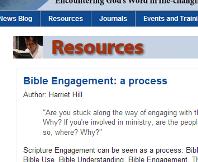
There is a growing community of people (over 200 at the moment) wanting to think and talk about mission in the Bible and the Bible in mission.

As well as links to this blog we also post news, events, quotes, questions and helpful links to resources.

So come and join in the conversation!

The process of Bible engagement

Harriet Hill, co-author of Translating the Bible into Action: How the Bible can be Relevant in all Languages and Cultures has posted a very helpful document on the Lausanne Global Conversation and Scripture Engagement websites.

It talks about Bible/Scripture engagement as a process covering:

  • Bible Availability – Do people have access to the Bible in a language and media that they are able to use?
  • Bible Awareness – Are people aware of the Bibles that are available? Are they exposed to them?
  • Bible Use – Do people choose to read or listen to the Bible?
  • Bible Understanding – Do people understand what they read?
  • Bible Engagement – Through interaction with the written word, do people encounter the Living Word (Christ)?

You can read the whole document here. She has invited feedback so why not have a look and then add your comments to one of the sites mentioned above?

Biblical wisdom and christian engagement with modern culture

This was the title of an excellent conference I attended at the weekend at the Queen’s Foundation in Birmingham. It was organised by Knut Heim, tutor in Biblical Studies at Queen’s and David Spriggs, Bible and Church consultant at Bible Society. Bible Society very generously subsidised the gathering, which attracted about twenty participants ranging from biblical scholars, church ministers, students, and others.

The purpose of the conference was to explore ways in which the UK church could reengage with biblical wisdom, particularly (but not exclusively) the Old Testament books of Proverbs, Ecclesiastes and Job.

There was a fantastic range of presentations ranging from a survey of the treatment of the Wisdom Literature in Old Testament scholarship over the last century, to creative ways of engaging contemporary culture with wisdom using web 2.0. An eclectic mix, but this was precisely the point: scholarship and church should be united in understanding and creativity to engage with biblical wisdom for the sake of the world.

I gave a paper on ‘Wisdom, Church and the Mission of God’, which used Chris Wright’s discussion on the Wisdom Literature in his book, The Mission of God as a framework to explore some practical ways in which the church might engage with God’s mission in the world.

All the papers are due to be available in a few weeks time; I’ll let you know when that happens.

I was particularly impressed by the work, creativity and energy of Matt and Juls Hollidge from Kore, who describe their vision as ‘to explore the heart and roots of our faith and to discover what the Kingdom of God looks like in our world.’ Check out the Kore website, which has some excellent resources.

Bible and mission at the Baptist Assembly

This year’s Baptist Assembly will include two seminars on the theme of Bible and mission (thanks to my Redcliffe colleague Darrell Jackson for pointing this out to me). They are both on Saturday 1 May.

Here are the details…

Through different eyes: Reading the Bible in a global community
More and more Christians based in the UK are finding their experience of the Bible wonderfully enriched, as the eyes of readers around the world unlock fresh perspectives. Richard Kidd, Joe Kapolyo and Kumar Rajagopalan will tackle some familiar texts – expecting you never to hear them the same way again!
Arranged by the Baptist Union of Great Britain and Baptist Colleges

One God, one Bible, one mission: Reading scripture as the story of a missionary movement
What is the biblical basis for understanding the one mission to which we are called? Glen Marshall and Roger Standing will help open our eyes and hearts to God’s big story and encourage us to discover the ways in which we are being invited to take part.
Arranged by the Baptist Union of Great Britain and Baptist Colleges 

Excellent to see Bible and mission getting such good air time at these high profile events. If you are going to the Assembly, check it out and let me know what you thought.

Lausanne global conversation on Scripture in mission

The Lausanne Movement is calling on Christians from around the globle to engage in various conversations that will help the church to engage with the big issues of contemporary mission.

The Global Conversation covers the following categories and topics:

Truth: Bearing witness to the truth of Jesus Christ
– Marketplace Ministry
– Personal Witness
– Truth and Secularity

Reconciliation: Pursuing peace in our broken world
– Environment
– Ethnicity and Identity
– Poverty and Wealth
– Resource Stewardship

World Faiths: Loving our neighbours of other faiths/worldviews
– Diaspora
– Unreached People Groups
– World Faiths

New Missions Priorities: Discerning God’s priorities for the future
– Children
– Forming Leaders
– Orality
– Urban Mission

Authenticity and Integrity: Living a Christ-like lifestyle
– Prosperity Gospel
– Women and Men
– The Human Future

Partnerships: Serving together in love and humility
– Globalization
– Indigenous Leadership
– Partnership Development
– Scripture in Mission

Below I’ve put the general blurb about the conversation along with descriptions about two of the topics most closely aligned with the Bible and mission: orality and Scripture in mission. Do have a look and get involved: Join the global conversation

The Big Picture
We are living in a time of enormous challenge and amazing opportunity for the church. The life and witness of the church around the world is being assailed by external pressures while simultaneously being weakened by internal troubles. Yet the church also faces unprecedented global opportunities for the spread of the gospel and open doors for ministry in regions traditionally closed to the witness of Christ.
Unfortunately, a concerted and well-reasoned response to these global issues and opportunities has been difficult because the church, and evangelicalism in particular, is highly fragmented.
The Lausanne Global Conversation is one step towards bringing together the global church to engage with these important issues related to world evangelization.
We believe these global issues need global conversations.
So let’s talk, let’s strategize, let’s work together. Above all, let’s pray–with a sense of expectation and hope–for the Lord to bring wisdom through the counsel of many (Proverbs 11:14).
Your voice in the conversation is needed. Every Christian has unique experience and insight to offer the church.

Orality
Two thirds of the people in the world are oral communicators – who can’t, don’t, or won’t learn through literate means. Western Christianity has, since the time of the Gutenberg Bible “walked on literate feet” and has directly or indirectly required literacy of others, ignoring the vast majority of people who are oral communicators. Literate Christians must make significant changes in evangelism, discipleship, leadership training and church planting to reach the 4,000,000,000 oral communicators world-wide.

Scripture in Mission
The purpose of the Scriptures as Paul wrote to Timothy is to make us wise about the way of salvation through faith in Jesus Christ and to equip us for every good work as God’s people (2 Timothy 3:14-17). The Scriptures therefore are essential to evangelism and to Christ-like transformation. However, where the Scriptures are not available or where people cannot study and apply them, we find “Bible poverty.”
In this conversation we want to consider the issue of “Bible poverty.” Bible poverty exists when people find themselves in a context or setting that blocks them from hearing the truths of the Scriptures. This happens, for example, when they do not have access to the Scriptures in a language they understand well, or they are unable to engage with the Scriptures in a meaningful way, or they do not have the opportunity to apply them to their lives.
Contexts such as these can be called “barriers.” Some barriers are universal or nearly so while others differ according to context. We want to consider what barriers exist in urban contexts, in rural contexts, in contexts where other major religions dominate, and in contexts of the post-modern West.
As we consider barriers to the Scriptures, we also want to identify the bridges that would allow people to transcend and overcome these barriers. In some cases the bridges are easy to identify, but in other cases they will require searching together under the guidance of the Spirit of God to discern the way forward.