Outline for Biblical Basis of Mission Course

I am currently preparing for a six-week ‘Biblical Basis of Mission’ module at Redcliffe, which will be available for first year, Professionals in Mission, Across the Cultures, Pick and Mix and day students. This is my course outline:

1. The Biblical Basis of Mission or The Missional Basis of the Bible?
2. Mission and the Torah.
3. Mission and the Prophets.
4. Mission and the Writings; plus the Inter-Testamental Period.
5. Jesus, Mission and the Gospels.
6. Mission and Acts, the Letters and Revelation.

I think it’s really important to look at the methodology of thinking about the Bible and Mission, hence the first session. Redcliffe is one of the UK’s two specialist centres for mission training, so most students are committed to mission in one way or another before they arrive. So this module has to be more than preaching to the choir, or furnishing them with a few affirming proof-texts. Students need to be grasp how the whole Bible relates to God’s mission. They also need to see how the Bible doesn’t just describe mission, but is itself a phenomenon and tool of mission. It also also shapes us as God’s missional people.

The Old Testament features significantly in the course. I see this as an outworking of the fact that mission is a whole-Bible phenomenon. I would love to spend more time on the Gospels especially, but this module functions as a short introduction (students have plenty of other opportunities during the year to go into more depth with both Old and New Testament material). I have followed the Hebrew division of the Old Testament – Torah, Prophets (most of the historical books plus Isaiah, Jeremiah, etc.) and Writings (Psalms, Proverbs, etc.) – out of convenience rather than theological conviction, though this would be an interesting discussion!

The Inter-Testamental Period provides important background to the Gospels. It would be nice to treat Luke-Acts together, so I may still tinker with the final couple of weeks.

If anyone knows of any good video resources, drop me a line…
Tyndale Bulletin archive

The wonderful people at Tyndale House have put online over 50 years worth of articles from the Tyndale Bulletin archive. This has been a key scholarly resource since its beginnings in 1956 so it is fantastic to have it all (apart from the latest three years) up there for all the world to access. There is no search function as such but you can always look for stuff using Ctrl-f.

Here’s what I found searching for ‘nations’:

Israel and the Nations: An Essay in Biblical Theology
Charles H.H. Scobie

God and His People in the Nation’s History: A Contextualised Reading of Amos 1 & 2
M. Daniel Carroll R.

Eschatology and Ethics: The Future of Israel and the Nations in Romans 15:1-13     
Scott Hafemann

The Destiny of the Nations in Revelation 21:1–22:5: A Reconsideration
Dave Mathewson

‘I Am Against You’: Yahweh’s Judgement on the Nations and its Ancient Near Eastern Context
Simon Sherwin

Malachi 1:11 and the Worship of the Nations in the Old Testament
Miss J. G. Baldwin

Happy hunting!

The Missionary Genius of the Bible

This is the title of V.F. Storr’s 1924 book on the Bible and mission (London: Hodder & Stoughton). I blogged the other day on R.F. Horton’s The Bible a Missionary Book. Storr saw his volume as following in Horton’s footsteps. Horton had lamented the lack of scholarly interest in the relationship between the Bible and mission before his book. Likewise, Storr felt the need to write his own book because nothing had been done (in English at least) since Horton’s work, which by the then had gone out of print.

Storr begins his book by depicting the changing ways people at that time were understanding the world: increasingly interconnected and dynamic. Those engaged in mission, he says, are not just saving souls, but affecting the development of nations. This changing dynamic asks a crucial question:

“How has it affected our view of the missionary message of the Bible? Missionary work has, of course, always found its main support in the Bible, in the belief, that is, that the Bible contains the record of a divine revelation given to the world, a revelation universal in scope, intended for all men, and therefore to be made available for all men… A great cause needs a great backing; and to match the growing sense of the largeness of missionary enterprise must be an enlargement of the appeal which we make to the Bible. It is, for instance, not enough to quote from Scripture a series of proof-texts in support of missions. The proof-text suspended in mid-air is useless. It must be related to context. It must be shown to stand out from a background which is essentially missionary in colour. We must, in a word, see the revelation in the Bible in its large, bold outlines, in the big sweep of its movement, in its progressive character and unfolding purpose.” (pp.11-12)

I like Storr’s use of langauge; the depiction of a proof-text suspended in mid-air is nicely evocative. But I was particularly struck by his claim that

“A great cause needs a great backing; and to match the growing sense of the largeness of missionary enterprise must be an enlargement of the appeal which we make to the Bible.”

Storr felt his world was becoming increasingly interconnected, which was changing the nature of the church’s mission. In a climate of complexity, his answer was to reflect on what the Bible says and how it says it. This task is ever urgent. I wonder what he would have made of the global village we live in today? I am sure his answer would still be the same.

Missional hermeneutics 100 years ago

I spent a good chunk of time today reading R.F. Horton’s The Bible A Missionary Book (Second Edition, Edinburgh: Oliphant, Anderson & Ferrier).

Horton’s take on the mission theme in the Bible is a little different to many of the biblical theologies of mission I’ve been reading of late. Rather than diving into selected texts that provide a ‘biblical basis of mission’ he starts with the premise that the Bible as a whole is a missionary book. The interesting thing is that Horton was writing a century ago, his book being published in 1908.

In some senses, of course, it is a product of its time. There is (to my mind) an overconfidence in the ‘objectivity’ of certain critical methodologies. This relates to his overal methodology but also to details such as the dating of certain texts and how this shapes his view of certain developments in the OT.

He is also rather dismissive of the OT, to the extent that he treats the NT first, with the chapters on the OT as, primarily (but not exclusively), functioning as the precurser to NT mission.

Nevertheless, there is much to chew on. Here are some quotes:

“As the friends of missions have been suspicious of critical scholarship, so scholarship has been too absorbed in its own pursuits to pay express attention to missions. But the two must learn to understand one another, if the missionary cause is to make rapid and solid progress” (p.9)

“of what use is the Bible, if it is not God’s book for man, and of what meaning is the Gospel if it is not God’s message to the world?” (p.10)

“To support the missionary enterprise by the quotation of certain proof-texts is quite inadequate. When we are fumbling among these texts we are in the position of one who cannot see the wood for the trees. The texts appear to be unrelated axioms, and if suspicion is cast upon the correctness or the genuineness of a text, the authority for missions seems to melt away… The first thought, then, is not to enter into a minute examination of certain texts or passages, which may easily be collected from all parts of Scripture, but rather to stand off a little and endeavour to gain a conception of Scripture as a whole, to ask ourselves the question, What is the bearing and the trend of this book?” (pp.23-24, 28)

“There are two ways by which missionary zeal is created and maintained: one, the study of the missionary facts, and the other the study of the Bible as the missionary book. Each method is indispensable. To know the Bible without knowing the efforts which are being made to spread the truth is to miss the most valuable of all commentaries on Scripture; and commentators who ignore the work of missions, as unfortunately many of them do, make of the Bible a hortus siccus, because they lose the sense that it is an organism still living and at work…” (p.187)

“It is in the hope that Bible students may be enabled to intelligently discern the missionary purpose ingrained in the Scriptures, and to feel the enthusiasm which comes from seeing the great purpose of God developed through long ages of history and of religious life, that the foregoing pages have been written.” (p.189)

Having felt very pleased with myself – and not to say proud of Redcliffe’s library 🙂 – that I had stumbled upon what must by now be a very rare book, I Googled it tonight and discovered the whole thing online! According to the website www.archive.org it is out of copyright. It can be read online or downloaded: Read it here

I shall have a closer look at this website in due course and let you know what other Bible and Mission goodies are available.

International Journal of Frontier Missions archive

International Journal of Frontier MissionsWhile roaming the web this week I came across the online archive for the International Journal of Frontier Missions . This is the journal of the International Society for Frontier Missiology (ISFM) and is published by William Carey International University.
The whole lot is readily available of the web, which is fantastic. The issue I was particularly looking for was volume 13:1 from 1996 on the theme, which featured the following articles:

  • The Great Commission in the Old Testament – Walter C. Kaiser, Jr.
  • All the Clans, All the Peoples – Richard Showalter
  • The Supremacy of God Among all the Nations – John Piper
  • Challenging the Church to World Missions – David Hesselgrave
  • Biblical Foundations for Missions: Seven Basic Lessons – Thomas Schirrmacher
  • Seeing the Big Picture – Ralph D. Winter
  • Melchizedek and Abraham Walk Together in World Missions – W. Douglas Smith, Jr.
  • The Biblical Basis and Priority for Frontier Missions – William O’Brien

As well as this specific issue there are loads of other interesting sounding Bible and Mission articles throughout the archive:

  • Relational Bible Storying and Scripture Use in Oral Muslim Contexts – Jack Colgate
  • Re-Contextualization: Restoring the Biblical Message to a Jewish-Israeli Context – Gavriel Gefen
  • Allah in Translations of the Bible – Kenneth J. Thomas
  • Selecting and Using Scripture Portions Effectively in Frontier Missions – Rick Brown
  • Snowflakes: the Common Ground of God’s Wisdom – Rick Leatherwood
  • Comparing Modern-day Alternatives to Biblical Conversion – David F. Wells
  • The Biblical Narrative as Agent for Worldview Change – Don Pederson
  • Chronological Bible Storying to Tribal and Nomadic Peoples – J. O. Terry
  • Genesis Teaches Mayan Believers the Character of God – Cynthia Klatt
  • The Role of the O.T. In Evangelism – Don Pederson
  • A Missionary Hermeneutic – David J. Hesselgrave
  • Biblical Studies and Frontier Missions – Larry Caldwell
  • Reaching Buddhists through Old Testament Wisdom Literature – Keith Carey
  • The Theme of Judgment in Isaiah and the Quran – Carol Wright
  • Old Testament Principles on Reaching the Refugee – Brenda Thompson
  • Paul’s Boast and God’s Glory: Frontier Missions in Romans 15:17-21 – Michael McClymond

Enjoy!

A missional reading of the book of Ruth

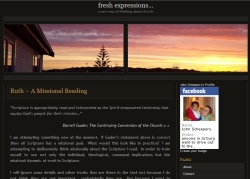
freshexpressionsJohn Scheepers’s fresh expressions blog features a nice reflection on a missional reading of Ruth, building on the work of Darrell Guder.

His starting point is a quote from Guder’s The Continuing Conversion of the Church:

 “Scripture is appropriately read and interpreted as the Spirit-empowered testimony that equips God’s people for their mission…”

What, he wonders, would it look like if we read the book of Ruth this way? He highlights his reading under four headings:

1. God’s mission is universal in scope.

2. God’s mission is particular in execution.

3. God’s mission is integrally linked to covenant faithfulness.

4. God’s mission has an integral call for the care of widows and the vulnerable.

Read the post in full

Michael Gorman on missional hermeneutics

Gorman-blogMichael J. Gorman is a Professor of Sacred Scripture at St. Mary’s Seminary & University in Baltimore, and is known for books like Elements of Biblical Exegesis, Apostle of the Crucified Lord, and Inhabiting the Cruciform God.

Over the last few weeks he has been blogging on missional hermeneutics, which make interesting reading. Here are some of the questions he suggests a missional reading will ask of a text:

• What does this text say, implicitly or explicitly, about the missio Dei and the missional character of God?
• What does this text reveal about humanity and the world?
• What does this text say about the nature and mission of God’s people in the world, that is, about the church understood as an agent of divine mission rather than as an institution, civic organization, or guardian of Christendom?
• How does this text relate to the larger scriptural witness, in both testaments, to the missio Dei and the mission of God’s people?
• In what concrete ways might we deliberately read this text as God’s call to us as the people of God to participate in the missio Dei to which it bears witness?
• What does this text call us to unlearn and then learn afresh?
• What powers that could deceive, seduce, and harm the world or the church does this text unveil and challenge—or call us to unveil and challenge?
• How does this text call us as God’s people to be both different from and involved in the world?

Here is a link to the ‘missional hermeneutic’ category in Michael Gorman’s blog, Cross Talk

Missional hermeneutics and Bible translation

What’s the point in a missional reading of the Bible if you can’t read the Bible?

In his Encounters response Chris Wright’s Bible and Mission lecture, Eddie Arthur (Executive Director of Wycliffe UK) has written a brief but powerful article that for me opened up the discussion in surprising and sobering ways.

there is a fundamental assumption in the lecture that people are able to read what Jeremiah wrote. Sadly, for a variety of reasons, many people quite simply do not have access to Jeremiah…

In a language with the economic capacity of English we have numerous translations of the whole Bible available. For many minority languages, it is often the case that only a selection from the Bible is printed or published. Perhaps a Gospel, or a whole New Testament, maybe with the Psalms or a selection of Old Testament stories. In truth, Jeremiah is likely to be way down the list of things that are published. Does the missional hermeneutic stress on the overarching narrative of the Bible give us any insight into how we should go about making the Scriptures available? Should we perhaps consider concentrating resources so as to translate the whole Bible for one group rather than making selections available to a number of groups? Or could a missional hermeneutic guide us in making more principled decisions about which passages should be seen as essential? On the pages of a mission magazine this might seem a sterile question, but in a world where 200 million people do not have the Scriptures in their own language, some hard choices need to be made and we need a good hermeneutical and theological basis upon which to make them.

At my home group tonight we had four different Bible translations between five people. I am very grateful for the different translations available to us in English; they often help to bring out different facets of the text, or at least facilitate different ways of reading the Bible (study, public reading, devotional, etc.). But it is embarassing, if not outrageous, that we in the West have so many versions, while vast numbers of people cannot read a single word of Scripture in their own langauge.

You can read the whole of Eddie’s article by following this link to the June 2009 edition of Encounters Mission Ezine: Issue 29 – The Bible and Mission

Encounters Mission Journal on the Bible and Mission

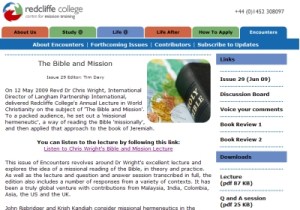
Encounters issue 29 - The Bible and MissionThe Encounters Mission Journal issue based on Chris Wright’s Redcliffe lecture on The Bible and Mission (and specifically, his missional reading of Jeremiah) is finally here! It’s been a lot of work to put together in a short space of time, but all concerned have done a great job. As well as the transcript of the lecture and a link to a downloadable audio file, it features eight response articles from a wide range of people with a lot of interesting things to say.

Here is part of my editorial:

This issue of Encounters revolves around Dr Wright’s excellent lecture and explores the idea of a missional reading of the Bible, in theory and practice. As well as the lecture and question and answer session transcribed in full, the edition also includes a number of responses from a variety of contexts. It has been a truly global venture with contributions from Malaysia, India, Colombia, Asia, the US and the UK.

John Risbridger and Krish Kandiah consider missional hermeneutics in the setting of the UK Church. David Spriggs writes on the relationship between the Bible and missional engagement in the ‘public square’. Eddie Arthur reflects on what a ‘missional hermeneutic has to say to those who translate and desseminate the Scriptures’. Brian Russell and Milton Acosta discuss missional hermeneutics as a method of reading the Bible. Finally, Anthony Loke and Rabbi and Chitra Jayakaran share what a missional hermeneutic might mean for their own contexts of Malaysia and India, respectively.

And these are the articles:

Lecture:  “Prophet to the Nations”: Missional Reflections on the Book of Jeremiah.
(Revd Dr Chris Wright)

Q and A:  Lecture question and answer session.

Response 1:  A UK pastor’s perspective.
(John Risbridger)

Response 2:  A missional hermeneutic and Scripture engagement.
(Eddie Arthur)

Response 3:  Jeremiah and mission in the public square.
(Revd Dr David Spriggs)

Response 4:  What does mission in exile really look like?
(Dr Krish Kandiah)

Response 5:  Breaking open the text.
(Dr Brian Russell)

Response 6:  Missional hermeneutics: some opportunities and questions.
(Dr Milton Acosta)

Response 7:  Missional hermeneutics in a Malaysian context.
(Revd Anthony Loke)

Response 8:  Missional hermeneutics in an Indian context.
(Rabbi and Chitra Jayakaran)

Over the coming weeks I’ll be reflecting on some of the points made in the issue. To read the articles or listen to the lecture, follow this link:

Go to The Bible and Mission – Issue 29 of Encounters Mission Journal

King Solomon’s expenses

Here in the UK we are currently embroiled in a succession of stories about the expenses our Members of Parliament have been claiming, which were recently made public. It puts me in mind of another review of a political leader’s expenditure set out by an Old Testament writer.

The popular view of King Solomon is that he was a good king who went bad later on in his reign. But the biblical account of his life, in the book of Kings at least, drops a number of hints to suggest a measure of ambiguity throughout his life. One aspect of this was his expenditure.

The people of Israel had been warned what might happen if they ever demanded a human king:

16 The king, moreover, must not acquire great numbers of horses for himself or make the people return to Egypt to get more of them, for the LORD has told you, “You are not to go back that way again.” 17 He must not take many wives, or his heart will be led astray. He must not accumulate large amounts of silver and gold. (Deut. 17:16-17, ESV)

 10 Samuel told all the words of the LORD to the people who were asking him for a king. 11 He said, “This is what the king who will reign over you will do: He will take your sons and make them serve with his chariots and horses, and they will run in front of his chariots. 12 Some he will assign to be commanders of thousands and commanders of fifties, and others to plow his ground and reap his harvest, and still others to make weapons of war and equipment for his chariots. 13 He will take your daughters to be perfumers and cooks and bakers. 14 He will take the best of your fields and vineyards and olive groves and give them to his attendants. 15 He will take a tenth of your grain and of your vintage and give it to his officials and attendants. 16 Your menservants and maidservants and the best of your cattle and donkeys he will take for his own use. 17 He will take a tenth of your flocks, and you yourselves will become his slaves. 18 When that day comes, you will cry out for relief from the king you have chosen, and the LORD will not answer you in that day.” (1 Sam. 8:10-18, ESV)

Fast-forward to Solomon’s reign where, among other things, he redraws tribal boundaries for tax purposes (1 Kgs. 4:1-19), conscripts forced labour for his building projects (5:13-18), spends twice as much time on his own house than he does on the Temple (6:38-7:1), and even imports horses from Egypt (10:28; cf. Deut. 17:16!).

Even the accounts of the opulance of his buldings and lifestyle seem to turn the reader from wonder, to hesitancy, to suspicion. Was the writer of Kings over-praising Solomon to make a point? Is there in fact a drip-drip-dripping of irony throughout the narrative that asks whether this was quite the golden age we thought it was?

Now of course the situations in Ancient Israel and contemporary Britain are completely different. But this at least reminds us that we should pay careful attention to what those in power do with their power, and not least with the public purse.