Chris Wright gives missional reading of Jeremiah at Redcliffe Lecture

I have blogged a few times in anticipation of Chris Wright’s public lecture on The Bible and Mission at Redcliffe College, which he delivered on Tuesday evening. It was a great night providing lots of food for thought (and blogging!).

Chris approached a missional reading of Jeremiah using three of George Hunsberger’s categories for how the term ‘missional hermeneutics’ is used (see GOCN website), and added one of his own:

1. The missional framework of the biblical narrative
2. The missional purpose of the texts
3. The missional locatedness of the readers
4. The missional cost to the messenger

It was fascinating to see his approach applied to an unexpected text like Jeremiah. The question and answer session was revealing as well. I’ve been asked whether the talk will be available.  Here’s the plan…

In written form
The June issue of Encounters (out early next month), Redcliffe’s mission journal, will be on the theme of The Bible and Mission. This will include the transcribed talk plus a number of short (c. 500 words) responses from a variety of contributors from academics to mission ‘practitioners’ (forgive the crude distinction!). Papers will also represent something of the global church with writing reflecting a number of cultural contexts. Sign up to Encounters updates

As a podcast
At the same time as the Encounters issue Slipstream will be making their June podcast available. As it happens June’s featured interviewee is (you’ve guessed it!) Chris Wright. Although the theme is not on Bible and Mission as such, Slipstream have kindly agreed to make the lecture available as an ‘extra’. Sign up to Slipstream updates

A few other observations about the evening…

It was packed! To my knowledge this was the most popular public lecture we have had at the College.

The subject of Bible and Mission is of interest both to the local Church and to mission agencies, both of whom were well represented.

Events are stronger if put on in partnership. Bible Society, Wycliffe UK, Keswick Ministries, Global Connections and Slipstream all played a valued part. Even the refreshments were a collaborative effort, thanks to Ethical Addictions!

Mission and the book of Ezekiel

The intriguingly titled Crazy Squirrel blog posted on Mission and the book of Ezekiel a while ago. He highlights some interesting resonances between mission then and now. Here are a couple of quotes

The book of Ezekiel is a good example of God seeking to be known by all nations, and wanting Israel to be His example. Ezekiel was written during a period of exile. Exile occurred primarily because Israel was not following God’s commandments of living a pure and holy life. They were not following their missiological purpose and lifestyle.

I like the last sentence (though would prefer the term ‘missional’ rather than ‘missiological’), making as it does the important connection between calling and behaviour.

Ezekiel’s contribution to mission theology of Israel shows that God’s work in the world aims at something larger than one nation. We can see here that Israel is not the sole desire of God; He wants the nations to know Him as well. In order for the nations to know God, Israel must be a pure witness, cleansed of their sin. Israel was to operate with the awareness that God’s range of vision is decidedly on all the world’s nations. At the time of the exodus, God’s intention with Pharaoh was made clear: Pharaoh, and also “all peoples of the earth,” were to acknowledge Yahweh (Exodus 14:18).

Here, purity, calling and God’s desire for the nations is tied together. If you want to read the whole article visit the Crazy Squirrel blog

Chris Wright Bible and Mission lecture update

Chris Wright’s 12 May public lecture at Redcliffe College on The Bible and Mission is fast approaching.

As well as setting out a missional hermeneutic of the Bible, he will also be putting this into practice by giving a missional reading of the book of Jeremiah. There will also be an opportunity for questions at the end.

Do you have any questions you would like to ask Revd Dr Wright? If so, and you’re not able to be there on the night, why not pass them to me using the comment facility below? I can’t make any promises but will try to fit them in… 

More details about Chris Wright’s The Bible and Mission Redcliffe Lecture

Square Mile initiative

Square MileJesus calls his followers to be salt and light in the world (Matt. 5:13-16). Salt and light make a difference. You would notice if they weren’t there. But,
‘Would anyone in your community notice if your church ceased to exist?’

This provocative question is asked by the Evangelical Alliance as part of a new initiative called ‘Square Mile’, which aims to encourage churches to engage in truly integral mission.

Here’s what they say,

Square Mile is an Evangelical Alliance initiative which aims to catalyse and equip Christians to take a truly integrated approach to mission, expressed in four dimensions:

Mercy: demonstrating God’s compassion to the poor
 
Influence: being salt and light in the public life of the community
 
Life Discipleship: equipping Christians for missional living as workers & neighbours
 
Evangelism: faithful and relevant communication of the gospel

For more information, check out the Square Mile website

Forthcoming book on reading the Bible missionally

Brian Russell (Asbury Seminary, Kentucky) has blogged about his forthcoming book on the missional interpretation of the Bible. It is due out next year from Wipf and Stock.

The title is, The Scripture Way of Mission: Reading the Bible Missionally for the Church and the World and it promises to be a great resource for thinking through, and putting into practice this way of reading Scripture.

Brian gives us a tentative outline and asks for feedback. I’m particularly intrigued by the second part of the book, which he outlines here:

Part Two: Reading the Bible for the Mission of God
Part Two of Unleashing the Scriptures focuses on specific practices for unleashing the missional message of the Scriptures into our lives and the lives of our communities of faith. If God’s mission is the core theme of the Scriptures, then it must become the focus of our reading and teaching of Scripture.

Understanding the centrality of mission in the Scriptures demands action. It is not enough to understand that mission stands at the center of the biblical witness. Our use of Scripture must (re)align with the Bible’s overarching aim of creating and shaping a missional community to reflect and embody God’s character to and for the World. This message needs to permeate throughout existing communities of faith and be experienced anew by those outside of these communities. In short, we must be reconverted to God’s mission and allow God to deploy us as agents of change in our communities and as ambassadors for God to those on the peripheries of our communities.

Chapter Eight, “Scripture Unleashed: Learning to Speak Human,” provides a method for engaging in the missional reading of Scripture. It will offer a step-by-step guide for reading the Bible through the lens of mission. It includes practical advice for transforming one’s current reading practices and for learning to read the Bible for humanity—for both insiders and outsiders to the Gospel message.

Chapter Nine, “The Practice and Possibilities of a Missional Reading,” offers concrete examples of missional interpretation that will enhance your own ability to read the Scriptures and translate their message for humanity.

Chapter Ten, “Transforming Our Communities—Engaging the World: A Conversion to Mission,” offers a framework for transforming Churches into missional communities. This chapter explores the role that missional interpretation plays in shaping a missional ethos in contemporary communities of faith and how this impacts the Church’s engagement with contemporary cultures. We will explore strategies for integrating a missional reading into all aspects of our communities.

Chapter Eleven, “Deployment,” brings Unleashing the Scriptures to a conclusion. It will summarize key findings and end with a challenge to those who teach and preach the Scriptures in local churches to unleash the Scriptures as a catalyst to mission.

Please do visit Brian’s blog and share your thoughts with him. It looks like an extremely valuable development in the area of Bible and Mission, and I commend him for being so open to others shaping his work.

Mission-Net, Deuteronomy and the University Alien

mission-net: congress 2009

It’s been a little while since I’ve blogged, what with Easter, going to Mission-Net and then having a few days holiday.

It was great to be at Mission-Net. My two seminars looked at (1) The ‘missional basis of the Bible’ along with an overview of the Old Testament; and (2) A study on Deut. 10:12-22 and what it tells us about our missionary God and our role as his people in the world.

The highlight for me was at the end of the second session. I had touched on the importance God places on caring for the vulnerable in society, as exemplified in the laws concerning the marginal groups (widow, orphan, alien). I had relayed a story from my student days where I had been lazy, sticking to people like myself rather than looking out for and befriending the ‘international’ students. A Greek student in the seminar talked about how she was going to make more of an effort to spend more time with a South-East Asian student she was aquainted with. It thrilled me to hear her say this! My prayer is that as she returns to her university she will learn from my mistake and, more importantly, allow God to mould her character and attitudes.

Mission, the resurrection and HIV AIDS

Today’s post is a contribution to Slipstream’s synchronised blogging day. Slipstream is part of the Evangelical Alliance and “exists to network, equip and grow leaders across the generations”. They asked bloggers to post an entry on the resurrection on Maundy Thursday.

In my recent post Human trafficking and mission I asked how we might connect certain texts in the Old Testament with the issue of contemporary slavery and trafficking. Today I want to highlight one aspect of the importance of the resurrection in relation to the global shadow of HIV/AIDS. In his The Mission of God: Unlocking the Bible’s Grand Narrative, Chris Wright offers the following comments, which are well worth reflecting upon:

Only the gospel offers and proclaims the promise of a new humanity to those whose present humanity has been shattered and shredded by this virus.

I say “only the gospel” with a double intention. First, because this essential gospel promise of eternal life for all who believe, founded on the cross and resurrection of Christ, is nonnegotiable and cannot be substituted for or sublimated into any of the other responses that we must make to HIV/AIDS, all of which have their own equally nonnegotiable validity and Christian interpretation. But secondly, I say only the Christian gospel, as distinct from all other religions and their view of death. For actually, it is the stark fact of death that throws up and defines most clearly the chasmic divide between religions and between the myriad views of what salvation might mean…

a missiology that omits the only ultimate answer to death from the range of responses to those in the grip of death has no claim to a Christian name either. (pp. 440-441, emphasis in bold is mine)

New Bible and Mission book

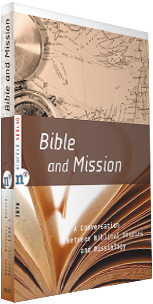
Bible and Mission bookJust flagging up a very interesting looking new book that I will be reviewing in the next few weeks from publishers Neufeld Verlag:

Bible and Mission: A Conversation Between Biblical Studies and Missiology edited by Rollin G. Grams, I. Howard Marshall, Peter F. Penner and Robin Routledge (Schwarzenfeld: Neufeld Verlag, 2008)

Here are the publisher blurb and contents:

In the narrow orientations in theological education, we seldom find a meaningful conversation between the different departments. However, it is vital to bridge between the various areas of study and to listen to research work done in the other “camp”. This book is an attempt to contribute to the conversation between Missiology and Biblical Studies.

Articles in this book offer some perspectives on various aspects of witness, evangelism and mission as one finds them in the Bible. They are supplemented and enriched by others who bring mission perspectives to bear on the biblical text. The deep conviction that this book affirms is that biblical as well as missiological research will only benefit if its representatives continue a conversation between the two areas.

1. Mission and Covenant in the Old Testament – Robin Routledge

2. Some Geographical and Intertextual Dimensions of Matthew’s Mission Theology – Rollin G. Grams

3. The Use of the Book of Acts in Mission Theology and Praxis – Peter F. Penner

4. Paul’s Mission According to Romans – I. Howard Marshall

5. Reconciliation as a Missiological Category for Social Engagement: A Pauline Perspective from Romans 12:1-21 – Corneliu Constanteanu

6. The Personification of Righteousness within a Metaphoric and Narratorial Setting: A Perspective on the Content of Paul’s Proclamation of the Gospel – David Southall

7. The Status and Calling of Strangers and Exiles: Mission According to First Peter – Christoph Stenschke

8. Missions, the Judgment of God, and the Centrality of Scripture – A Response to David Macdonald Paton from 2 Peter – Scott Hafemann

9. How a Missiologist Utilizes the Bible – J. Andrew Kirk

10. The Bible, the Qur’an and Mission – David W. Shenk

The review will appear in the June edition of Encounters Mission Ezine, which will focus on the theme of ‘Bible and Mission’ and will be based on the Chris Wright lecture at Redcliffe College on 12 May.

Human trafficking and mission

A practical question for those engaging in Bible and Mission: How do we relate verses like the following with the MTV Exit video below? Check out Stop the Traffik as well.

Deuteronomy 10:17-18
For the LORD your God is God of gods and Lord of lords, the great, the mighty, and the awesome God, who is not partial and takes no bribe. He executes justice for the fatherless and the widow, and loves the sojourner, giving him food and clothing. (ESV)

Psalm 68:5-6
Father of the fatherless and protector of widows
   is God in his holy habitation.
God settles the solitary in a home;
   he leads out the prisoners to prosperity,
   but the rebellious dwell in a parched land. (ESV)

Job 31:16-23
“If I have withheld anything that the poor desired,
   or have caused the eyes of the widow to fail,
or have eaten my morsel alone,
   and the fatherless has not eaten of it
(for from my youth the fatherless grew up with me as with a father,
   and from my mother’s womb I guided the widow,
if I have seen anyone perish for lack of clothing,
   or the needy without covering,
if his body has not blessed me,
   and if he was not warmed with the fleece of my sheep,
if I have raised my hand against the fatherless,
   because I saw my help in the gate,
then let my shoulder blade fall from my shoulder,
   and let my arm be broken from its socket.
For I was in terror of calamity from God,
   and I could not have faced his majesty. (ESV)

(If you are having trouble viewing the embedded video, click here to see the video)

Bible and Mission talks at Mission-Net

mission-net: congress 2009Mission-Net, the pan-European mission youth congress, takes place next week in Oldenberg, Germany.

One of the seminar streams is entitled, ‘Is Mission Really in the Bible?’. I will be giving two talks on mission and the Old Testament (‘Do you understand the Old Testament? A journey into God’s missionary heart’) on Saturday 11 and Sunday 12, both at 1.45pm to 3pm.

Other speakers on this seminar track include:

  • Eddie Arthur (Wycliffe UK) – ‘A missionary God for a missionary people’
  • Dr Matthias Radloff (Institut Biblique et Missionnaire Emmaüs) ‘For heaven’s sake: An interview with Moses Abraham, and a few other guests’ and ‘Highway to Heaven – from nowhere to somewhere’
  • Dr. Detlef Blöcher (Deutsche Missionsgemeinschaft) – ‘Putting feet on your faith! Integral mission and the Micah-Initiative’
  • Dr. Volker Rabens (Theologisches Seminar Adelshofen) – ‘Missional life in the power of the Holy Spirit: How the Spirit  transforms and empowers us’
  • Dr. Peter Kuzmic (Evangelical Theological Seminary, Osijek, Croatia) – ‘The Holy Spirit: He will change you, if you let him!’
  • Lauro Castelli (WEC International) – ‘It’s war!! Spiritual warfare and missions’

I’ll also be on the Redcliffe College stand in the exhibition area. If you will be at Mission-Net, do come and say hello!