Mission and the Psalms – liturgy is not play acting

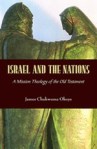
Israel and the Nations by James Chukwuma OkoyeI’ve been thinking ahead to a module on Redcliffe’s Applied Theology in Intercultural Contexts degree programme called, ‘Missional Texts: Psalms and Genesis 1-11’. Here is a nice quote from Okoye found in his wonderful book, Israel and the Nations: A Mission Theology of the Old Testament. It is part of a chapter on Psalm 96:

The psalmist calls on Israel and the nations to be united in the worship of the one God, Yahweh. The gentiles may be restricted only to the “courts,” that is, the courtyards of the temple, which are open to non-Jews, yet the “wall of separation” has begun to crumble, if not in fact, surely in the religious imagination.

The praise and worship of the nations, which the prophets predicted of the eschatological future, are transferred to the present in our psalm (Gunkel and Begrich 1998, 25).

The coming of Yahweh is, first of all, liturgical: the royal glory and power of Yahweh are made manifest to the worshipers, who accordingly prostrate in obedient submission to their King. The very assembly of praise enacts the reign of God, for the assembly thereby recognizes itself as servants coming into the presence of their lord to acknowledge Yahweh’s rule and to declare the dealty to Yahweh (Mays 1994a, 64). As Walter Brueggemann affirms, “liturgy is not play acting, but is the evocation of an alternative reality that comes into play in the very moment of the liturgy” (1984, 144). The alternative reality is that of a society that has been made right under God – true worship leads to true society. Liturgy is the beginning of the dismantling of the old order of injustice and faithlessness (ibid., 146). Insofar as Israel and the families of nations participate in the worship of Yahweh they are sharing in the dismantling of the old order and the emergence of the new order under Yawheh.

But the coming of Yahweh is at the same time eschatological. Cultic gatherings at the temple anticipate the gathering of the nations and peoples of the earth to the shrine of Israel’s God, who is over the nations (Willis 1997, 302). The eschatological promise is that all the earth will also enjoy the just effects of the rule of Yahweh.

In a subtle manner, Psalm 96 merges the praise of “all the earth” and that of Israel. The Israelite who makes such an “oratorical outreach” (Marlowe 1998, 451) is being invited to pull down the wall of separation that continued to keep apart fellow worshipers of Yahweh. (pp.106-107)

If you’d like to look into the Psalms and mission in more depth, have a look at issue 33 of Redcliffe’s Encounters Mission Journal, which was on the theme of The Psalms and Mission.
Hearing hostile voices on the Bible and mission

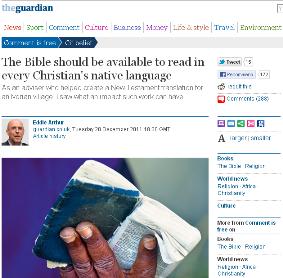
Eddie Arthur article on the Guardian websiteYesterday our good friend Eddie Arthur, UK Director of Wycliffe Bible Translators and visiting lecturer here at Redcliffe, wrote an article for the Guardian newspaper’s website on Bible Translation.

You can read the article here: The Bible should be available to read in every Christian’s native language

It is well worth a read and is doubly informative. Firstly, in a succinct way Eddie explains in layman’s terms some of the reasons why Bible Translation is so important. Secondly, it is fascinating and frustrating to read the comments that people have made (there have been about 300 comments since it went live less than 24 hours ago).

There are lots of discussions about both the Bible and mission, some related to the article, some not. I’d encourage you to scroll through some of the comments as, at the very least, they give a flavour of some of the hostility towards the Christian faith, the Bible, and the missionary activity of the church.

So why open oneself up to this kind of hostility? In the world of new media we have the opportunity to connect in ever-increasing ways. We also have the possibility of being misunderstood and dismissed as well. But who knows what might come of this kind of discussion? So good on you, Eddie, for putting yourself out there.

In a recent lecture we were looking at the Bible page on Facebook. In a Youtube video, the founder of the page, Mark Brown talks about how such hostility can turn into opportunities for the Gospel. I’ve linked to it below.

So let’s pray that in the midst of the debate God will be at work in those who otherwise might not have encountered his Word.

Mission and Daniel

Christian Mission - Old Testament Foundations and New Testament DevelopmentsThe book of Daniel is not really renown for its missional perspective.  However, in a recent Missional Introduction to the Old Testament lecture we asked the class to ‘stretch their missional muscles’ and discover how Daniel could be read and understood missionally?   Subsequently, I came across a chapter in Christian Mission: Old Testament Foundations and New Testament Developments, by Stanley Porter and Cynthia Long Westfall (pages 59-60) that has some intriguing insights into Daniel and the kingdom of God.  Below is a short extract.

In both Daniel 1-7 and the New Testament, the kingdom is something that is planted by God and subsequently grows, eventually resulting in a wider awareness of God.  Again in Daniel, the kingdom begins as a stone that grows in to a mountain (Dan. 2:35).  In the subsequent narratives, this growth is reflected in the increasingly orthodox testimony of the Babylonian and Persian monarchs.  In the parable of the Mustard Seed in Matt 13:31-32, Jesus likens the growth of the kingdom of God to the way in which a tiny mustard seed can eventually become a tree that is substantive enough to provide shelter for the birds.  In this concise parable, Matthew combines several terms and phrases that show that he is directly drawing on Daniel for inspiration…. What the parable in Matthew reflects is not only a reuse, but also a reapplication of the material from Daniel 4.  What originally spoke of the growth of Nebuchadnezzar’s kingdom and the sustenance provided by it is reused by Matthew to speak of the same things in relation to the kingdom of God. In the parable of the Yeast (Matt 13:33), the kingdom of God is likened to yeast that works its way through the dough, bringing out growth as it does so.

In both Daniel 1-7 and the New Testament, the faithful are called to engage society.  In Daniel 1-7, the faithful are participants in structures that are not part of the kingdom of God.  Their presence there creates a testimony that sometimes put them at odds with the power structures, but that also transforms those structures.  In each case, the faithful are rescued from crisis and witness a royal acknowledgement of God.  A basic example of how members of the kingdom are to be engaged in society comes in Jesus’ response to the question, “Should we pay taxes to Caesar?” (Matt 22:15-22).

Youversion offer another chance to download the NIV Bible app for free

If you want the NIV on your phone to use offline now is your chance! In a recent email YouVersion made this announcement:

Download the Offline NIV

For a limited time, you’ll be able to download the New International Version(NIV) for offline use in the Bible App. From 12:00 AM December 1 through 11:59 PM December 12—Central Time U.S. (GMT -6)—once again, you can download the NIV. If you missed your chance last time, or if you know someone who did, spread the word and make sure you take advantage of this opportunity! (When you download a version, that means you can read it in the Bible App—even when you can’t connect to your service provider or to the Internet.) Special thanks go to Biblica and Zondervan for making the NIV available to the YouVersion community!

Thank you Biblica, Zondervan and YouVersion 🙂

The Gospel and Cultural Diversity

Bible and Mission by Richard BauckhamDoes the presence of a single ‘grand narrative’ that is the biblical story reduce, flatten or fight against cultural diversity? Is it just another example of a totalising ideology that seeks to impose itself at the expense of particularity?
I believe the Bible answers these questions with a resounding, ‘no!’. I’ve posted before on what James Brownson calls the ‘irreducibly multi-cultural‘ mode of the presence of God (see The Multicultural Presence of God). But here is a nice quote from Richard Bauckham in his Bible and Mission: Christian Witness in a Postmodern World. In it he suggests not only that the Bible does not flatten cultural diversity, but that it celebrates and requires it. Indeed, the biblical metanarrative confronts those competing stories (in our own day, globalisation being a dominant one) that would seek to totalise:

The biblical story is apt to clash with the global metanarratives of power, and… with local narratives that ape them. But this is not necessarily the case with all the local individual narratives it encounters. The biblical story is not, as the narrative of economic globalization has been called, a cultural tidal wave sweeping away all the wonderful diversity of human culture. Perhaps the miracle of tongues at Pentecost in Acts 2 is a symbol of this. It is a miracle that symbolically transcends the diversity of human languages: they no longer divide people or impede understanding, as they did at Babel. But this diversity of human language is not abolished. Everyone hears the gospel in their own language. The miracle was in one sense quite superfluous, since virtually everyone there could have understood Greek, Aramaic or Latin. There was no practical need for such profligate speaking in all kinds of local languages. But God reverses Babel in such a way as rather conspicuously to affirm human cultural diversity. When Paul states that in Christ there is no longer Jew, Greek, barbarian or Scythian (Colossians 3:11), what he denies is cultural privilege, not cultural diversity.

The biblical story is not only critical of other stories but also hospitable to other stories. On its way to the kingdom of God it does not abolish all other stories, but brings them all into relationship to itself and its way to the kingdom. It becomes the story of all stories, taking with it into the kingdom all that can be positively related to the God of Israel and Jesus. The presence of so many little stories within the biblical narrative, so many fragments and glimpses of other stories, within Scripture itself, is surely a sign and an earnest of that. The universal that is the kingdom of God is no dreary uniformity or oppressive denial of difference, but the milieu in which every particular reaches its true destiny in relation to the God who is the God of all because he is the God of Jesus.

It’s worth noting that talking about Pentecost as a ‘reversal’ of Babel is a complex and contested issue. Check out Wycliffe’s Eddie Arthur on Babel, Pentecost and the Blessing of Diversity to explore more.

Shalom as a way into the Biblical story

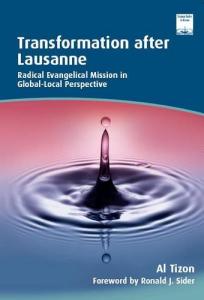
Transformation After Lausanne - TizonThere are numerous concepts or images that we could use to trace the storyline of the Bible (covenant, election, kingdom, etc). What about the concept of the presence, disruption and restoration of shalom?

Here’s a nice quote from Al Tizon’s very helpful book, Transformation After Lausanne: Radical Evangelical Mission in Global-Local Perspective:

Only a shallow translation of the Hebrew word shalom would limit its definition to the idea of the absence of conflict and peace. Although it certainly includes peace, shalom also conveys the justice and righteousness that produces that peace (Jer. 6:13, 28). Shalom denotes a state wherein God rules, resulting in a harmonious relationship between God and humankind. And flowing from that relationship come: 1) the wholeness of persons, physical, psychological, spiritual and emotional well-being, 2) the wholeness of human interactions – love and family, social justice, righteousness and peace, and 3) the wholeness of the relationship between humankind and the rest of creation – ecological sustenance and environmental stewardship…

God’s affirmative evaluation of the entire created order reflects the biblical theological fact that the world began in a state of shalom. Shalom existed because God ruled the universe.

The account of the fall of humanity in Genesis 3 conveys the tragic disruption of that shalom. Through Adam and Eve’s disobedience via the serpent’s deception, sin entered into the world… In essence the act [of disobedience] challenged God’s rule, and consequently shalom existence collapsed.

Tizon’s book is well worth a read. You can read a review of it by my colleague, Darrell Jackson in issue 33 of Redcliffe’s Encounters Mission Journal, which was on the theme of The Psalms and Mission.

What does the Bible say about justice?

The theme of the day here at Redcliffe has been justice. It wasn’t a planned thing but from 9-11 I was teaching on Isaiah and Micah in the first year Missional Introduction to the Old Testament class; from 11-12 our college devotions included Matthew Price, International Director of The Lawyers Christian Fellowship; from 2.30-3.30 I led a postgraduate seminar on ‘Bible and mission at the margins: missional reflections on the widow orphan and alien in Deuteronomy’.

There is some really exciting stuff going on at college in this whole area. In particular my colleagues Andy and Carol Kingston-Smith are heading up a new initiative called ‘JusTice – Justice and Advocacy in Mission’. Here’s a link for more information on the Redcliffe website. Also, here’s a their new media links

JusTice Facebook

JusTice Twitter

JusTice blog


Was Jonah a missionary?

Chris Wright's The Mission of GodAll first years at Redcliffe are required to take a Bible overview consisting two modules: ‘A Missional Introduction to the Old Testament’ and ‘A Missional Introduction to the New Testament’ (see these two posts for the rationale behind a missional approach to teaching the Bible: Making a Biblical Studies programme missional, part 1 & part 2).

Students are currently wrestling with the assignment for the OT course, which this year is to discuss the extent to which they think the book of Jonah would be an appropriate subject for a Bible study series at a church’s mission weekend.

For obvious reasons I’m not going to discuss this at length but I thought this was a nice quote from Chris Wright’s The Mission of God on the subject:

The book of Jonah has always featured in biblical studies of mission, sometimes as almost the only part of the Old Testament deemed to be of any relevance. Here at least is someone who has some semblance of being an actual missionary, sent to another country to preach the word of God. However, for all the fascination of the character and adventures of Jonah, the real missional challenge of the book undoubtedly and intentionally lies in its portrayal of God. If Jonah is intended to represent Israel, as seems likely, then the book issues a strong challenge to Israel regarding their attitude to the nations (even enemy nations that prophets placed under God’s declared judgment), and regarding their understanding of God’s attitude to the nations. The concluding open-ended question of the book is an enduring, haunting rebuke to our tendency to foist our own ethnocentric prejudices on to the Almighty.

It is interesting and informative to compare and contrast the response to Jonah to the word of divine judgment on a pagan nation with that of Abraham. Commissioned to proclaim Nineveh’s doom, Jonah ran away and jumped in a boat, alleging later that he had done so precisely because he suspected that YHWH would revert to type and show compassion. Informed of God’s intention to investigate the outcry from Sodom and Gomorrah, Abraham jumps to intercession and finds YHWH prepared to be even more merciful than he initially bargained for.

Nathan MacDonald finds a thread running through texts such as Genesis 18, Exodus 32-34, Psalm 103:6-10 and Ezekiel 18. “The Judge of all the earth,” who will unquestionably do what is right, is also the “gracious and compassionate God” who “takes no pleasure in the death of the wicked but rather that they turn from their ways and live.” The character of YHWH is exercised in forgiveness and mercy, extended to all nations, not just to Israel. (p.461)

Are we failing to communicate the Gospel effectively to four billion people?

International Orality NetworkIt was recently reported that there are now seven billion people in the world today. This is just a short post to remind us all that the majority of those seven billion people are oral communicators.

The International Orality Network make the following points on their website:

The Need
There are 4 billion oral learners in the world, with a minority of resources attempting to reach them for Christ.

The People
The remaining Unreached People Groups are predominantly oral societies

The Solution
Communicate the message of Christ to people in ways that make sense to them – instead of in ways that make sense to us!

What will this mean in your context?

And while we are on the subject of statistics, 350 million people (that’s 5% of the entire world population) don’t have a single word of the Bible in their heart language.

Milestones can be important. They cause us to stop and consider where we have come from, where we are, and where we are heading. As we reflect upon the enormous number of 7,000,000,000 we might consider:

  • how can I learn to address the preference for oral communication in my own community?
  • how can I play a part in getting the word of God to people who don’t have it?

Essentially they both address the same question: how can I engage people with the Bible in a way that is most meaningful to them?

These are some of the questions we consider in courses at Redcliffe College, both at undergraduate and postgraduate level. And check out Wycliffe Bible Translators‘ website as well to see how you can find out, or get involved more in these vital areas.

Chronicles Lense

According to Fee and Stuart the book of Chronicles is,

a brilliant retelling of the story of Judah intended to give the present generation a sense of continuity with its great past and to focus on the temple and its worship as the place where that continuity could now be maintained’. How to Read the Bible Book by Book, page 101

In other words it draws from other portions of the Bible, especially 1 & 2 Samuel and 1 & 2 Kings, which portray Israel’s history as an ever increasing spiral of sin and idolatry, which inevitably lead to exile. However, in contrast with these books, Chronicles reflects events and circumstances from a positive perspective. The authors intention was not to ‘rewrite’ history but to communicate where the community should find its identity; in God. It was written to answer the questions, ‘are we still in covenant, are we still God’s chosen people, and do we still fit into God’s plan?”.

While we in the West have not experienced exile per se, there is a well documented trend that the Church here is in decline. Also, there are many books written to explain the intricacies and development of this phenomenon. One message to come out of this research (especially those who look into the effects of Christendom) is that the Western Church has neglected or forgotten how to be missional into its own contemporary situation, therefore inevitably aiding to its own decline. While understanding the need and importance of this work, sometimes there is a negativity that overshadows any positive accomplishments. Could this be said to be a reading of history through the lenses of Kings? If so, do we need to try on the lenses of Chronicles to find some sense of continuity with the past, and therefore understand at a more profound level how the Western Church actively entered into Mission with God. In doing so we might be encouraged to see the extent our identity is found in Christ, become motivated to partake in the Spirit’s mission in bringing the restoration and reconciliation of God to the here and now.

What do you think?