What will Revelation 7 sound like?

Consider this quote by Craig Keener in his NIVAC commentary on Revelation 7 (pp249-250):

How should we envision Revelations’s multicultural throng? Both archaeology and writings from John’s day show us that his audience knew of not only the Mediterannean world, but also of kingdoms and traders from west and east Africa, India, China, and the British Isles, all peoples so remote from the first Christians that the image of “every tribe” may have demanded considerable faith. Our geographical knowledge today is richer, and the gospel entrenched in far more cultures. Imagine the multicultural chorus of saints from all ages – ancient Israel’s Levite psalmists, clapping African saints with joyful praises, European Reformers with their majestic hymns, monks with their Gregorian and Ethiopian Coptic chants, Latin American Pentecostals with shouts of triumph, messianic Jews dancing the horah, and a generation of North American street evangelists doing gospel rap!

Many Christians today think that the gospel obliterates cultural distinctions (and sometimes expect Christians from other cultures to simply join their churches and assimilate into their “normal” cultural style of worship). But this text suggests that, far from obliterating culture, God takes what is useful in each culture and transforms it into an instrument of praise for his glory.

On Wednesday 30 March Wycliffe’s Eddie Arthur will be delivering Redcliffe’s 2011 Lecture in Bible and Mission on Reading the Bible with the Global Church. In view of Keener’s comments it would be interesting to consider what our worship might look like if we did that alongside the global church as well.

Mission accomplished – the book of Revelation

We’ve reached the astonishing vision of Rev. 7 in Redcliffe’s module on Revelation. I’ve posted before on this chapter when considering what James Brownson describes as the multicultural presence of God. This time Chris Wright provides the insights in a chapter on Particularity and Universality in the Bible, in his The Mission of God (pp249-251, his italics):

Revelation 4-7 is a comprehensive single vision-a neck-searching, mind-boggling vision-in which John “sees” the whole universe from the vantage point of God’s throne at its center. The meaning of the history of the world is symbolized in a scroll in God’s right hand, which was slain. In other words, the cross of Christ is the key to the unfolding purposes of history; or, in terms of our argument here, the unfolding mission of God. Why is Christ worthy to govern history? Because he was slain. And what difference has that made? The song of the living creatures and twenty-four elders explain it for John, and for us.

You are worthy to take the scroll and to open its seals,
because you were slain,
and with your blood you purchased men for God
from every tribe and language and people and nation.
You have made them to be a kingdom and priests to serve our God,
and they will reign on the earth. (Rev 5:9-10)

The song gives three reasons why the cross is the key to history.

• First, it is redemptive. People who were lost, defeated, or enslaved in sin have been “purchased” for God. Humanity will not go down the drainpipe of history into the abyss.

• Second, it is universal. Those who have been so redeemed will come from “every tribe and language and people and nation.”

• Third, it is victorious. The Lamb wins! He and his redeemed people will reign on the earth.

The echoes of Old Testament Scripture are clear. The universality of the Abrahamic promise is captured in the list of tribe, language, people and nation. And the specific calling on Israel in Exodus 19:5-6, to be God’s kingdom of priests in the midst of all the nations of the whole earth, has now itself been internationalized and projected into an eternal future of serving God (as priests) and reigning on earth (as kings). The rightful place of redeemed humanity is that they are restored to their original status and role within creation: under God and over creation, serving and ruling. This is the wonderful combination of priesthood and kingship that redeemed humanity will exercise in the redeemed creation.

The climax of this vision, with the sixth seal, brings together the 144,000 crowd, representative of the historic twelve tribes of Israel, with the immediately following panorama of that innumerable multinational host of the redeemed, the final fulfillment of what God promised Abraham:

After this I looked and there before me was a great multitude that no one could count, from every nation, tribe, people, and language, standing before the throne and in front of the Lamb. They were wearing white robes and were holding palm branches in their hands. And they cried out in a loud voice:

“Salvation belongs to our God,
who sits on the throne,
and to the Lamb.” (Rev 7:7-9)

If, when God first called Abraham and designated him and his barren wide in their old age to be the fountainhead of his whole mission to rescue creation and humanity from the woes of Genesis 3-11, we imagined the sharp intake of breath among the astonished heavenly hosts, then in John’s vision we are not left merely to our own imagination. For he goes on to tell us:

All the angels were standing round the throne and around the elders and the four living creatures. They fell down on their faces before the throne and worshiped God, saying:

“Amen! Praise and glory
and wisdom and thanks and honor
and power and strength
be to our God for ever and ever. Amen!” (Rev 7:11-12)

And God, in the midst of the resounding praises, will turn to Abraham and say, “There you are. I kept my promise. Mission accomplished.”


Why read the Bible with the global church?

Reading the Bible with the Global ChurchOn 30 March Eddie Arthur (UK Director of Wycliffe Bible Translators) will be giving the 2011 Annual Lecture in Bible and Mission here at Redcliffe on the subject of Reading the Bible with the Global Church.

It seems to me that the act of Bible reading is itself a cross-cultural experience. Within the pages of the Bible we have the Spirit-inspired thoughts, songs, stories, instructions, visions and poems of a remarkably diverse group of people. As I read the text I am constantly engaged in a process of understanding the language and ideas of people unlike myself. I am constantly crossing borders and boundaries. This is one of the many reasons why it is essential to recognise the worth in reading alongside others, and especially others from different cultures. The wonderful diversity of the global church parallels and broadens the cultural diversity of the biblical writers and figures themselves.

In anticipation of the event and as part of an ongoing discussion we would love to hear your views and your stories:

  • Why do you think it is important to read the Bible alongside brothers and sisters from around the globe?
  • Do you have stories of how you’ve experienced this?
  • How can this be encouraged practically?

Please join the conversation by leaving a comment below, or posting something on Twitter or Facebook.

Redcliffe’s 2011 Lecture in Bible and Mission

Reading the Bible with the Global ChurchThis year’s Annual Lecture in Bible and Mission will be held on Wed 30 March, 7pm to 9pm. It is the key public event of the year for the Centre for the Study of Bible and Mission, with previous speakers being Chris Wright on The Bible and Mission and Gordon Wenham on The Nations in the Psalms.

Our lecturer this year is Eddie Arthur, Executive Director of Wycliffe Bible Translators, who will be speaking on the subject, ‘Reading the Bible with the Global Church: Opening our eyes to see how God speaks worldwide’.

It is being put on in partnership with Bible Society, Wycliffe Bible Translators and Biblefresh.

Here are the details from Redcliffe’s website:

We all come to the Bible with our own perspectives, insights and blind spots, which is why reading it with others is vital. But often the groups we are part of come from similar cultural backgrounds. Are there things we could be missing?

Imagine being part of a Bible Study group made up of believers from Britain, Bangladesh, Brazil, Burkina Faso and Bulgaria. How might this open our eyes to read God’s Word afresh?
At this year’s lecture in Bible and Mission Eddie Arthur will explore what it means to read the Bible alongside believers around the world. There will also be discussion groups led by church leaders to unpack what this might look like in a local congregation context.

About Eddie Arthur
Eddie Arthur is the Executive Director of Wycliffe Bible Translators. Previously he has worked as part of the translation team for the Kouya NewTestament in Ivory Coast and as the National Director for a Wycliffe partner organization in Ivory Coast and Mali. You can read more of Eddie’s thoughts on Bible translation and life on his website kouya.net, or follow him on Twitter @kouya

Cost
The evening is free, but prebooking is required.

To book
Please complete the online form or call 01452 308 097.

Directions
Please see our directions page for details on how to find us.


Suffice it to say that it should be an excellent evening! Eddie is a clear and deep thinker, a great communicator, and someone with a wealth of experience in the thinking and practice of Bible and mission.

More reflections to follow in the run up to the event…

#Biblefresh training and three transformative moments in my Bible reading

This Saturday 5 March, 9.30 – 12.30 at Redcliffe we are holding the first of our Biblefresh training events. To kick off we will be doing an overview of the Bible called, Grasping the big picture – a journey from Genesis to Revelation. Here’s the blurb:

Just as the picture on the box helps us to see how a jigsaw puzzle fits together, knowing the big story of the Bible can transform our reading of God’s word. Join us for a fun, interactive guided tour as we weave our way through God’s amazing story from Genesis to Revelation.

Come along!

I first attended a Bible overview as a student. Vaughan Roberts spent a day with us showing how the whole Bible fits together. It totally transformed the way I read the Bible.

Reflecting on that experience now I can pinpoint three major points of transformation in my reading of the Bible:

1. The coherent story of the Bible
Realising that the Bible is a single, coherent narrative (though made up of a rich variety of mini narratives, to say nothing of the the non-narrative elements of Scripture);

2. The literary variety of the Bible
Realising that different literary genres require different ways of reading in order to understand and apply the text;

3. The missional nature of the Bible
Realising that mission is not just a theme the Bible talks about in places but actually defines the origins, content and purpose of Scripture.

If you made a similar list of defining moments in your Bible reading, what would you include?


The mission impulse of Luke-Acts

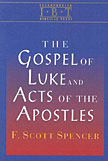
The Gospel of Luke and the Acts of the Apostles by F. Scott SpencerIn his recent book The Gospel of Luke and the Acts of the Apostles (Abingdon, 2008) F. Scott Spencer describes the ‘”mission” impulse that drives the two-volume project.’ (p.95) Indeed, his book is structured around the explicit theme of mission.

He then fleshes this out in more detail illustrating some of the ways we can understand the Bible as (to put it one way) the product and record of God’s mission:

For all the scholarly debates about the genre(s) of Luke and Acts… in a very basic sense, these books present a grand mission story-that is, the story of God’s world-restoring mission advanced in word and deed through his Son Jesus Christ and Christ’s emissaries. The main characters keep on the move, and the plot largely coheres around a series of journeys across the eastern Mediterranean world. And these characters are fundamentally missionaries undertaking mission journeys-not commercial trips, political junkets, scientific expeditions, tourist excursions, recreational getaways, or any other type of travel we might imagine. These treks proceed by the divine commission for the sole purpose of carrying out God’s will and extending God’s rule on earth.

We may outline both Luke and Acts according to a broad four-part scheme of fulfilling God’s mission:

I. Preparing God’s Mission
Luke 1-4    Acts 1-7

II. Establishing God’s Mission
Luke 4-9   Acts 8-12

III. Expanding and Interpreting God’s Mission
Luke 9-19   Acts 13-21

IV. Defending God’s Mission
Luke 20-24   Acts 21-28

The headings are self-explanatory, charting a rapid, progressive growth in God’s mission through Section III, and then slowing down in Section IV to solidify the movement and defend it against detractors. (pp.95-96, his italics)

Catalyst online journal

Catalyst Online Journal

Catalyst Online is a journal for United Methodist (UM) seminarians but is also available on the web for the wider public. Its aims are

  • to alert seminarians to significant resources within the classical Christian tradition;
  • to highlight evangelical perspectives on Christian faith and practice;
  • to stimulate serious consideration of classical Christianity;
  • and to encourage a seminary experience fully within the Wesleyan tradition of uniting the two so long divided, knowledge and vital piety

It is well worth a look with some excellent scholars contributing articles.

Having looked through the archive here are three particular highlights for someone with an interest in Bible and Mission (I may well have missed some so add a comment to include others):

Missional Musings on Paul By Michael J. Gorman (volume 37.2, February, 2011)

What is a Missional Hermeneutic? by By Brian D. Russell (Volume 37.4, April, 2010)

Reading The Bible As One Story by Michael W. Goheen (Volume 33.3, March, 2007)

Why is the Gospel of Mark neglected in most of the Bible and Mission literature?

In preparation for the lecture ‘Mark and the Mission of God’, I was surprised by the distinct absence of this Gospel throughout the Bible and Mission literature. There seems to be much greater emphasis on Matthew, Luke and even John concerning Mission theology and not so much on Mark. To say that Mark is not used at all would be a fallacy, as a smattering of references can be noted. But even the mighty Bosch in Transforming Mission only cites four references from this Gospel.

Could this be the product of previous generations of scholars not taking Mark seriously, by relegating it behind the later Gospels, whose writers rework, edit, mould, and shape some of Mark’s original writing? Or is it that the concept of Mission is so intrinsic to Mark that it is often missed by in-depth exegesis? Do we miss the wood for the trees? Often it can be the cursory reading of a book that enables the reader to see the overall big picture. In their The Biblical Foundations for Mission Senior and Stuhlmueller write,

One of the first things to be noted about the Gospel of Mark is that it faithfully transmits the basic content and thrust of the kingdom ministry of Jesus. Given the mission implications of this motif, we should not overlook this fundamental datum before turning to Mark’s particular emphasis. (p213)

Perhaps with the emphasis on form, redaction and other critical methodologies or the rush to find the ‘historical Jesus’, we have missed the basic premise that Mark was more missionally minded than we first thought.

Reviews of Chris Wright’s The Mission of God

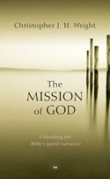
Chris Wright's The Mission of GodAs this blog has noted on numerous occasions, Chris Wright’s The Mission of God: Unlocking the Bible’s Grand Narrative is a seminal work in the field of Bible and Mission. It is essential reading for students (both undergraduate and postgraduate) here at Redcliffe and forms the basis of the Reading the Bible Missionally module on our MA in Bible and Mission. While there are an increasing number of other important works around on the subject, anyone wanting to read, write, research or speak on the Bible and Mission will need to continually engage with Wright’s book.

In April 2008 I edited issue 17 of Redcliffe’s Encounters Mission Journal on the theme of Mission and the Old Testament. This focused on The Mission of God which had been published a few months earlier and includes an interview with Wright about his book, as well as two reviews. As the book straddles the two disciplines of Biblical Studies and Missiology, we asked Prof Gordon McConville and Dr Kang-San Tan to evaluate the volume in the light of the two fields.

Mission: What the Bible is All About – An interview with Chris Wright
(Tim Davy)

Chris Wright’s The Mission of God: An Old Testament Scholar’s Perspective (Prof J. Gordon McConville)

Chris Wright’s The Mission of God: A Missiologist’s Perspective
(Dr Kang San Tan)

But there are plenty of other reviews of The Mission of God out there. To that end this post highlights a number of online reviews and we’ll keep it up to date as we come across more. If you know of any not mentioned here, or want to contribute a review, drop me a line in the comment box below.

evepheso blog

SBL review by Christopher N. Chandler

Global Missiology review by Mark R. Kreitzer

fbcnewlondon blog review by Mike Leake

vialogue blog

beginningwithmoses website review by Michael J. Glodo

9marks website review by Mike Gilbart-Smith

The Bible, Joy and Creation Care

What motivates us for creation care and how does this relate to a biblical view of mission?

In ch. 12 of The Mission of God, Chris Wright gives a missional framework for creation care under the heading, Mission and God’s Earth. The subheadings do a good job of telling the story:

The Earth is the Lord’s

– The goodness of creation (A good creation can only be the work of a good God; Creation is intrinsically good);
– The sanctity (but not divinity) of creation;
– The whole earth as the field of God’s mission and ours;
– God’s glory as the goal of creation;
– God’s redemption of the whole creation

Care of Creation and Christian Mission

– Creation care is an urgent issue in today’s world;
– Creation care flows from love and obedience to God;
– Creation care exercises our priestly and kingly role in relation to the earth;
– Creation care tests our motivation for mission
– Creation care is a prophetic opportunity for the church
– Creation care embodies a biblical balance of compassion and justice

Often our care of creation comes from a sense of responsibility and stewardship, which is both biblical and necessary. But might joy be a spur to action as well?

Texts like the following have a kind of infectious joy about them:

There go the ships, and Leviathan, which you formed to play in it. (Ps. 104:26)

Let the heavens be glad, and let the earth rejoice;
let the sea roar, and all that fills it;
let the field exult, and everything in it!
Then shall all the trees of the forest sing for joy,
before the LORD, for he comes, for he comes to judge the earth. (Ps. 96:11-13)

Even Yahweh’s speeches in Job depict something of the joy God has in his creation, almost like a parent who never tires of showing pictures of their child.

My point is this: our responsibility towards God’s good creation should motivate us to care for creation, but so should our enjoyment of creation. Or, to put it another way, not just our enjoyment of creation but our joining with creation with its own enjoyment, both in the wonderful ways God has created it/us, but also in the way creation ‘enjoys’ and praises God.

(for more on these ideas of joy and creation see such writers as William Brown, Gordon McConville, and Terence Fretheim).

(This is ‘Green Week’ at Redcliffe. We are giving the care of creation a special emphasis as we consider what we could do more of and less of).