OSCAR celebrates 10th birthday

OSCAR, the online UK information service for world mission, is celebrating its 10th birthday today. Based at Redcliffe College, it’s a phenomenal resource for anyone interested or involved in mission.

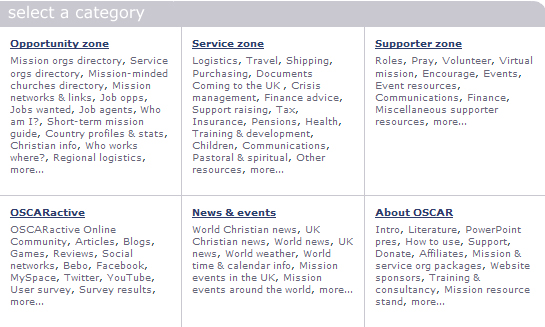
To get an idea of the sorts of things they cover have a look at this snapshot:

Happy birthday OSCAR, and thanks so much for all you do to resource mission. It’s a privilege to work alongside you here at Redcliffe!

What does the Bible say about power?

This is the title of a Lent series put on in partnership between the Methodist Relief and Development Fund and the Evangelical Alliance.

The attainment and abuse of power has not, to my knowledge, always been a prominent theme in scholarship. Is this because those with power tend not to think about it, in the same way as those with money tend not to think that money is not an issue?

Three books among many that deal with the issue are Mary Evans commentary on 1 & 2 Samuel in the NIBC series; Dewi Hughes’ Power and Poverty: Divine and Human Rule in a World of Need; and my doctoral supervisor Gordon McConville’s God and Earthly Power: An Old Testament Political Theology, Genesis-Kings.

Here’s the blurb for the MRDF series:

Power – we have more of it than we think.

Poverty robs people of much more than food, clean water and access to education – it robs them of the power to control their lives.
The Bible has a lot to say about the uses and abuses of power. This study pack draws on examples from scripture and the contemporary world to explore the nature of power; and challenges us to think about the power we have and how we can use it.
 
The six-part course includes:
  • in-depth Bible studies
  • modern day examples of empowerment from MRDF’s work
  • engaging group discussions
  • ideas for individual and group action

For more details, as well as downloads and links, visit the MRDF website.

Bible reading in Italy

Interesting story on the nova research centre website about the reading habits of Italians, which came out of a survey done by Eurisko for the Catholic Biblical Federation and raises a number of missiological issues. See, for example, this quote:

despite the fact that the 40 years following Vatican II have seen a steady increase in the number of homes possessing a Bible and the onset of the Internet age and multimedia communication, for many Italians the Bible remains a closed, mysterious book.

nova also mentions the XII Ordinary General Assembly of the Synod of Bishops, which was held in October 2008 with the theme, “The Word of God in the Life and Mission of the Church”. Here is a link to a particularly relevant part of the report on the Vatican’s website.

nova is based at Redcliffe and researches mission in Europe in order to innovate mission in Europe. It’s a fantastic resource doing excellent work. If you’ve any interest in thinking about or doing mission in a European context have a look at the nova website.

New Chris Wright book on The Mission of God’s People

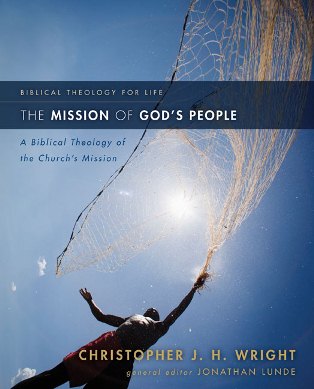
Zondervan have announced the September 2010 publication of a new book by Chris Wright entitled, The Mission of God’s People: A Biblical Theology of the Church’s Mission. This is sure to be another very significant publication from one of the foremost writers of our generation on Bible and Mission.

Here is the publisher blurb:

In The Mission of God’s People, Chris Wright shows how God’s big-picture plan directs the purpose of God’s people, the church. Wright’s pioneering 2006 book, The Mission of God, revealed that the typical Christian understanding of “missions” encompasses only a small part of God’s overarching mission for the world. God is relentlessly reclaiming the entire world for himself. Wright emphasizes what the Old Testament teaches Christians about being the people of God. He addresses questions of both ecclesiology and missiology with topics like “called to care for creation,” “called to bless the nations,” “sending and being sent,” and “rejecting false gods.” As part of the Biblical Theology for Life Series, this book provides you—whether you’re a pastor, teacher, or lay learner—with first-rate biblical study while at the same time addressing the practical concerns of contemporary ministry. The Mission of God’s People promises to enliven and refocus the study, teaching, and ministry of those truly committed to joining God’s work in the world.

Zondervan also note a talk that Wright gave the Assemblies of God Theological Seminary’s Spring Lectureship, which focused on the message of The Mission of God’s People, which is available for free here.

Last year Chris came to Redcliffe to deliver a public lecture on ‘The Bible and Mission’. Here is my post on the subsequent Bible and Mission issue of Encounters Mission journal, which was based on the lecture and responses to it.

Jesus, the Gospels and mission

As part of a course on the Gospels, General Epistles and Revelation we spent time this morning ‘Responding to the Gospels’. In previous weeks we have covered the background to the Gospels and each Gospel in turn. Today I gave the class a few different options for reflecting on the Gospels, after which we shared our insights and reactions. Here are my instructions for some of the optional activities:

1. Reflection on The Return of the Prodigal Son
Read Luke 15
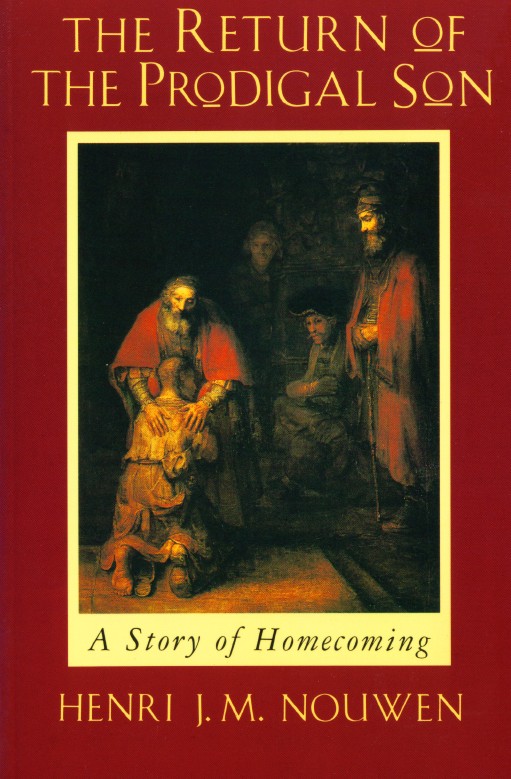
Reflect on Rembrandt’s painting
Flick through Henri Nouwen’s book
Think about how the two brothers and the father are portrayed
How do they relate to one another?
How is their lost-ness portrayed?
With whom do you identify?
Look for details; the Father’s hands; the son’s knife, the embrace

2. Jesus in Art
How has Jesus been portrayed in art? How have different eras and cultures depicted him? How might these help us to reflect on the person and work of Jesus, perhaps in new ways?
A number of art books are available. Also, they look for images on the web; a good place to start is www.wikipedia.org/wiki/Depiction_of_Jesus

3. Quotations from Philip Yancey’s The Jesus I Never Knew
There is a pile of Yancey’s quotations at the front. Pick some and chew them over. Look up the relevant passages in the Gospels. Several copies of the book are available so read around the quotes for further inspiration.

4. Revisiting the text
Revisit a passage, theme or issue in the Gospels that has interested/confused/inspired/frustrated you. Get some commentaries and other resources and spend some time working it through.

5. Spiritual theology and the Gospels
Have a look at what Eugene Peterson has to say about the Gospels as part of his Spiritual Theology series (nb. Christ Plays in Ten Thousand Places, and Tell it Slant).

6. Meditation
Read, reflect on and pray through part or all of John 13-17. What do we as individuals or as a church need to learn from this immensely rich passage?

I happened to have a spare copy of Henri Nouwen stunning book, The Return of the Prodigal Son, which I am giving away to the member of the class who writes the best comment on this post in relation to ‘Jesus, the Gospels and mission’. Let the contest begin!!

Community reflection on the Psalms

On Wednesday the college community at Redcliffe will be spending the day reflecting on the Psalms and spirituality. There will be a time of corporate singing and prayer at the beginning, and I will be sharing on ‘Praying and Living the Psalms in Community’.

For the rest of the day there will be numerous activities as well as some workshops. Colleagues Rob Cook, Richard Johnson and Tricia Johnson will be leading optional sessions on a guided meditation, a poetry workshop, and Psalms and emotions, respectively.

Other activities (a number suggested by the students themselves) will include:

   – Spend time in quiet reflection and prayer
   – Be creative – respond to Psalms with music, art, dance, etc
   – Enjoy and reflect on the exhibition of Psalms artwork produced by students of the level two Psalms course over the years
   – read all through the psalms (possible in about 3 hours)
   – go for a walk: listening to psalms on ipod or with a Bible so that you can reflect on a psalm as you’re walking
   – listen to what God is saying to you or to how you are feeling and what you want to say to God and then write your own psalm
   – walk down to Gloucester Cathedral reading the Psalms of Ascent (120-134) as you go 
   – expressively read a psalm, emphasising on different words
   – get together with your prayer triplet and pray through a palm together – looking at what things stand out for each of you and why
   – Re-read some of material from the Spiritual Formation class and use that to draw closer to God.

We’ll then have a session at the end of the day to share what we’ve experienced and expressed.

We will also be producing a Psalms scroll together, which will feature the whole of the Psalter written out in hand in different languages.

I’ve written on Psalms and mission on previous posts
Biblical Basis of Mission course – week four 
Ian Stackhouse on the Psalms

Look out for tweets (#psalmsday) throughout the day and join in the conversation!

A quick note on the image in today’s post. This is one of many amazing creations by Ali Edmondson, a student here at Redcliffe. I’ve posted on her work before so take a look at more pieces here.

Tyndale House

Over the last 65 years since it was founded Tyndale House has become one of the most significant centres for biblical research in the world. It is a great blessing to the Church and has been influential across the globe, not least through the constant stream of research students and scholars from around the world who make use of its facilities.

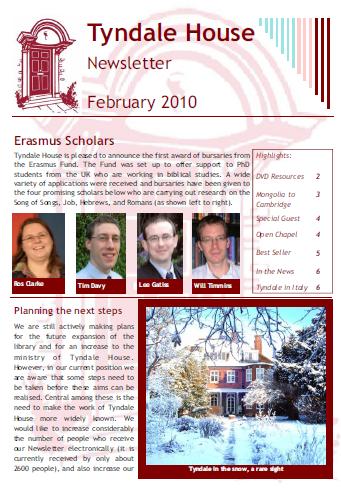
I am particularly grateful for TH having recently received some funding towards my PhD through the ‘Erasmus Fund’. You can read more about this and other news in the latest newsletter, which came out this week.

I would encourage you to take an interest in the work of TH and make use of the Tyndale House website as well, which is bursting with useful resources.

Bible and Mission at Edinburgh 2010

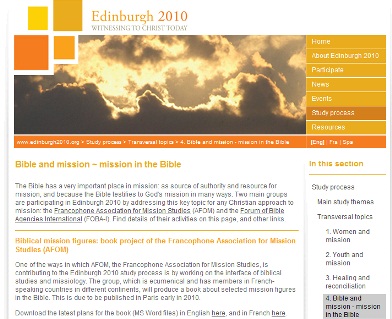
One of the study topics of this year’s Edinburgh 2010 conference is entitled, ‘Bible and mission ~ mission in the Bible’. It is one of the ‘transversal topics’ (along with Women and mission; Youth and mission; Healing and reconciliation; Contextualization, inculturation and dialogue of worldviews; Subaltern voices; and Ecological perspectives on mission), which are themes that thread across the main study areas of Foundations for mission; Christian mission among other faiths; Mission and post-modernity; Mission and power; Forms of missionary engagement; Theological education and formation; Christian communities in contemporary contexts; Mission and unity – ecclesiology and mission; and Mission spirituality and authentic discipleship.
The intro on the Bible and mission page has the following introduction:
The Bible has a very important place in mission: as source of authority and resource for mission, and because the Bible testifies to God’s mission in many ways. Two main groups are participating in Edinburgh 2010 by addressing this key topic for any Christian approach to mission: the Francophone Association for Mission Studies (AFOM) and the Forum of Bible Agencies International (FOBA-). Find details of their activities on this page, and other links.
For more information visit the Edinburgh 2010 Bible and Mission page

Vern Poythress on language, Bible and mission

My thanks to Antony Billington of LICC for flagging up about this book on his Billington’s blog.

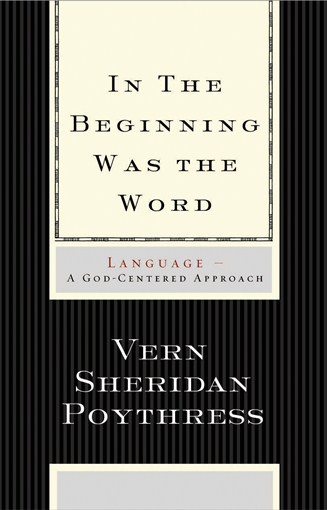
Vern Poythress has made his recent book, In the Beginning Was the Word: Language—A God-Centered Approach (Wheaton: Crossway Books, 2009) available online on his website. It has some interesting stuff on the nature of language within the context of Bible and mission, so is well worth a look.

Here is the contents followed by an excerpt

Chapter 1: The Importance of Language 11

Part 1: God’s Involvement with Language
Chapter 2: Language and the Trinity 17
Chapter 3: God Speaking 23
Chapter 4: God’s Creation of Man 29
Chapter 5: God Sustaining Language 39
Chapter 6: Creativity in Language 42
Chapter 7: Exploring Examples of Language 50
Chapter 8: The Rules of Language 60
Chapter 9: God’s Rule 64
Chapter 10: Responding to God’s Government 78

Part 2: From Big to Small: Language in the Context of History
Chapter 11: Small Pieces of Language within the Big Pieces 85
Chapter 12: Imaging 91
Chapter 13: World History 97
Chapter 14: The Fall into Sin 103
Chapter 15: Redemption through Christ 116
Chapter 16: Peoples, Cultures, and Languages 124
Chapter 17: Principles for Cultural Reconciliation 131
Chapter 18: Good and Bad Kinds of Diversity 138
Chapter 19: Human Action 149

Part 3: Discourse
Chapter 20: Speaking and Writing 163
Chapter 21: Analysis and Verbal Interpretation 170
Chapter 22: Interpreting the Bible 180
Chapter 23: Genre 186

Part 4: Stories
Chapter 24: Storytelling 195
Chapter 25: The Story of Redemption 206
Chapter 26: Many Mini-redemptions 209
Chapter 27: Counterfeit Stories of Redemption 219
Chapter 28: Modern Reinterpretations of Redemptive Stories 229
Chapter 29: Stories about Jesus 234

Part 5: Smaller Packages in Language: Sentences and Words
Chapter 30: Sentences in Use: Foundations in Truth 243
Chapter 31: Foundations for Meaning in Trinitarian Inter-personal Action 251
Chapter 32: Subsystems of Language 259
Chapter 33: Words and Their Meanings 270
Chapter 34: From Words to Perspectives 280

Part 6: Application
Chapter 35: Truth as a Perspective 289
Chapter 36: Living in the Truth 297

Interaction with Other Approaches to Language
Appendix A: Modernism and Postmodernism 303
Appendix B: Doubt within Postmodernism 311
Appendix C: Non-Christian Thinking 320
Appendix D: Platonic Ideas 326
Appendix E: The Contribution of Structural Linguistics 332
Appendix F: Translation Theory 338
Appendix G: Symbolic Logic and Logical Positivism 350
Appendix H: The Theory of Speech Acts 353
Appendix I: Reaching Out to Deconstruction 370

Supplementary Reflections
Appendix J: Special Cases of Human Speech 385
Bibliography 391
General Index 401
Scripture Index 411

Thus, even though the fall has had its effects, the universality of the reach of the gospel confirms that we will still find “language universals,” universal capability throughout all languages that make the gospel expressible in each language. The Bible can be translated into each—and has been translated into many languages, more than any other book. Because the Bible is breathed out by God (2 Tim. 3:16) to address all nations (Luke 24:47), it is true and pertinent to every culture. God so designed it. We know it is universal in its reach, not by intellectual insight that has given us a godlike superiority, but simply because God has told us so, and we trust him. But that universal reach is not worked out in practice without missionaries and translators having to confront surprising knots, complexities, resistances, and rich perspectival diversities.

The Bible is not acultural. It does not owe its universality to rising above cultures into thin, disembodied universal philosophical platitudes (which would actually falsify its very specific message). In the Bible God addresses immediate issues in the first century and in the Hebraic cultures of Old Testament times. Through the apostle Paul God warns the Corinthian church about divisions; he warns the Galatian churches to rely on Christ and not on circumcision. God also speaks universally, by indicating to all nations how he accomplished worldwide salvation precisely in the once-for-all, culturally and historically specific events concerning the descendants of Abraham leading up to Christ. As part of its universal scope, the Bible also contains many general, universal statements: “All have sinned and fall short of the glory of God” (Rom. 3:23). “The Lord is one” (Deut. 6:4). “Righteous are you, O Lord, and right are your rules” (Ps. 119:137). God expects us to believe his universal claims, and not to evaporate them by artificially restricting them to one culture.

The missiologist does not need to “make” the Bible universal. It is already that (Acts 1:8). Rather he needs to help people in each culture take their place as disciples in the Bible’s universal world history. (pp.142-143)

The Bible as the true story of the world

Under this heading in their book, Living at the Crossroads: An Introduction to Christian Worldview (Grand Rapids: Baker Academic Books, 2008), Michael Goheen and Craig Bartholomew make some important points about the reality that is rendered in the Bible. This is a reality with profoundly important missional implications. This is a lengthy quote, but it will take you less time to read it than it took me to type it 🙂

When Jesus came, he announced that he was himself the goal of this redemptive story, the climax of God’s dramatic activity. Such a claim was completely astonishing. Jesus was not simply another rabbi offering some new religious or ethical teaching by which to enrich one’s own life. He claimed that in his person and work the meaning of history and of the world itself was being made known and accomplished. He warned that all people must find their place and meaning within his story, and no other.

When we speak, therefore of the Bible as a story, we are making a normative claim about the story told in the Bible: it is public truth. It is a claim that this is the way God created the world; the story of the Bible tells us the way the world really is. Thus, the biblical story is not to be understood simply as a local tale about the Jewish people. It begins with the creation of all things and ends with the renewal of all things. In between, it offers an interpretation of the meaning of cosmic history. Christopher Wright puts it this way: “The Old Testament tells its story as the story or, rather, as part of that ultimate and universal story that will ultimately embrace the whole of creation, time, and humanity within its scope. In other words, in reading these texts we are invited to embrace a metanarrative, a grand narrative.”

Thus our stories, our reality-indeed, all of human and non-human reality-must find their place in this story. In Mimesis, Erich Auerbach makes this point in a striking contrast between Homer’s Odyssey and the biblical story: “Far from seeking, like Homer, merely to make us forget our own reality for a few hours, [the Old Testament] seeks to overcome our reality: we are to fit our own life into its world, feel ourselves to be elements in its structure of universal history…. Everything else that happens in the world can only be conceived as an element in this sequence; into it everything that is known about the world… must be fitted as an ingredient of the divine plan.” Normally, when we read myths and novels, or when we watch movies, television, or plays, we are meant at least in part to gorget about our own world and to enter and live in the fictional world for a time. When the story ends, we emerge on the other side , return to our own world, and resume our own lives. We have indulged in a kind of escape from reality into fiction, perhaps hoping to be informed, enriched, or at least entertained while we have been “away.” Some of us will seek to carry back some nuggets of truth or wisdom or beauty as souvenirs from the world of artifice, giving us perhaps some new (but admittedly limited) insight into an aspect of our lives in the “real” world. But it is not that way with the biblical story. The Bible claims to be the real world. The story, among all stories, claims to tell the whole truth about the way our won world really is. Here, inside this story, we are meant to find the meaning of our lives. Here we must find a place in which our own experience was meant to fit. Here we are offered insight into the ultimate significance of human life itself.

Thus, the gospel is public truth, universally valid, true for all people and all of human life. It is not merely for the private sphere of “religious” experience. It is not about some otherworldly salvation postponed to an indefinite future. It is God’s message about how he is at work to restore his world and all of human life. It tells us about the goal of all history and thus claims to be the true story of the world. (pp.3-4, their italics)