Storytelling the gospel

How do you engage people with the Bible when they live in an oral culture? The whole area of literacy, oral culture, Bible translation and ‘storying’ is a crucial one in mission today. After all, as Grant Lovejoy of SIL puts it:

Does the spread of the Gospel depend on literacy? Jesus Christ is the eternal and living Word, after all, as John declares (John 1:1). The timeless message of His saving grace is proclaimed from one generation to the next in the Bible, the written Word of God. Are those who cannot—or will not—read the Word on the printed page essentially cut off from the Good News of salvation?

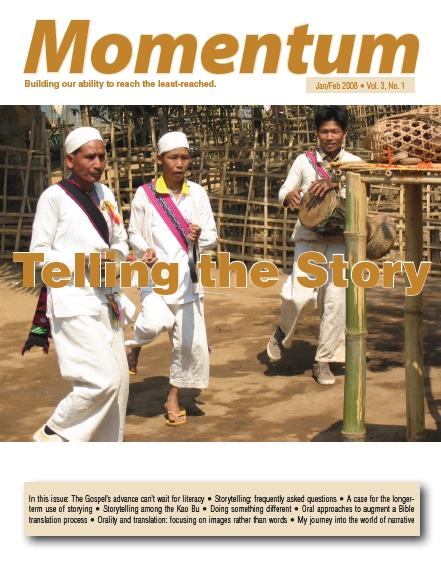
For one resource, have a look at the Jan/Feb 2008 edition of Momentum, which looks at the whole issue from a variety of perspectives:
http://www.strategicnetwork.org/wp-content/uploads/2008/05/200801.pdf

Here is the contents

The Gospel’s advance can’t wait for literacy by Grant Lovejoy
Storytelling: frequently asked questions by Karl J. Franklin
A case for the longer-term use of storying by Roy Sloane
Storytelling among the Kao Bu by Tai Kadai
Doing something different by Steve Douglass
Oral approaches to augment a Bible translation process by Jim Stahl
Orality and translation: focusing on images rather than words by Janet Stahl
My journey into the world of narrative by Larry Dinkins

There is also a very helpful page on resources, both in electronic and book form.

Metaphors We Lead By

The other day I took a session on Redcliffe’s MA in Global Leadership in Intercultural Contexts. We were thinking through the nature of metaphors and how they describe and shape the identities and actions of leaders.

Although they contain many good observations I expressed a few reservations about the way I’ve often heard character studies used as models for leadership. To what extent do they account for the ancient contexts in which the leader operated? Are we supposed to immitate everything they did (no!); if not, what criteria do we use to decide what is worth copying and what isn’t? In what sense, then, is their life a normative model?

So, is there a different angle we can take? One option is metaphor. I’ve blogged before on the power of metaphor in mission. It seems to me that a number of lessons could be learned in the context of leadership as well.

The title of the lecture was ‘Metaphors We Lead By’, a play on the title of Lakoff and Johnson’s foundational book, Metaphors We Live By (Chicago: University of Chicago Press, 2003, originally published in 1980).

A few points to make:

1. Metaphors can never account for every aspect of the thing they are describing (saying that my wife is ‘a rose’ emphasises her beauty but doesn’t account, for example, for her sense of humour or her intelligence);
2. We use metaphors much more frequently than we realise;
3. Metaphors have the power to shape how we act as well as how we talk about things.

For me, the shocking thing when I realised these things was not that I am objective and can decide in a detached way which metaphor or model I might adopt; the reality is that I am already operating under the influence of metaphors that are such a part of my conceptual make-up, I may not even be able to say what they are!

As a leader, your choice of metaphor (though nb. it may not be a conscious choice) might be ‘father’, ‘general’, ‘servant’, ‘gardener’, ‘captain’, etc. Each one emphasises different attributes and will influence how we relate to those we are leading in different ways. So we cannot rely on just one metaphor, but several or many.

Rob Hay, Redcliffe’s Principal and course leader for the Leadership MA passed on this article which was helpful:
K.W. Parry’s article, ‘The thing about metaphors and leadership’, Business papers (2008), pp.6-23.

So, which metaphor(s) do you lead by and how does it affect how you lead and your relationships with those you lead?

The Bible and mission in faith perspective

This is the title of the doctoral thesis of Chris Wigram, International Director of European Christian Mission, the full contents of which are archived on the University of Utrecht’s website. Here is the abstract and contents:

The thesis ‘The Bible and Mission in Faith Perspective: J.Hudson Taylor and the Early China Inland Mission’ by Christopher E.M. Wigram analysis the hermeneutical assumptions that underlay Hudson Taylor’s approach to biblical interpretation, and the significance of his approach for the mission which he founded, the China Inland Mission. The thesis sheds light on a hitherto unexplored aspect of Taylor’s spirituality. It also provides an instructive example of how sections of Protestant evangelicalism in the later nineteenth century reacted to the growth of biblical criticism; Hudson Taylor grounded the authority of scripture in its inner spiritual and Christological meaning, and was not afraid to emply elaborate allegory. It is set in the context of the cultural and religious influences that moulded new initiatives in mission and contributed to the rise of the Holines movement and faith expressions of mission.

Chapter 1: Introduction
Chapter 2: The Bible in mission before J. Hudson Taylor
Chapter 3: The immediate influence of movements and individuals on J. Hudson Taylor
Chapter 4: The Bible in J. Hudson Taylor’s spirituality
Chapter 5: The Bible in J. Hudson Taylor’s worldview
Chapter 6: The Bible in J. Hudson Taylor’s missionary teaching and preaching
Chapter 7: The Bible in the activities of the China Inland Mission until 1905
Chapter 8: Conclusion

This looks like a really useful case study of the way the Bible was understand and used in a specific missional setting.

David Bosch on the international hermeneutical community

Biblical interpretation is a community business. In a previous post I drew on our need for each other (i.e., the whole people of God in all its multicultural wonder) to worship God wholly. I drew on the words of James Brownson who said, “no single culture has a monopoly on understanding or describing God. We, the multiethnic Church must try to understand and worship God together, embracing our cultural diversity rather than constantly seeking our common denominators” (p.485 of ‘Speaking the Truth in Love’, International Review of Mission, Vol 83, No. 330 (1994), pp.479-504).

A similar point is made by David Bosch in the context of theological interpretation, which I think could also be applied to biblical interpretation:

Instead of viewing my interpretation as absolutely correct and all others by definition as wrong, I recognize that different theological interpretations, including my own, reflect different contexts, perspectives, and biases. This is not to say, however, that I regard all theological positions as equally valid or that it does not matter what people believe; rather, I shall do my utmost to share my understanding of the faith with others while granting them the right to do the same. I realise that my theological approach is a “map”, and that a map is never actual “territory” (cf Hiebert 1985b:15; Martin 1987:373). Although I believe that my map is the best, I accept that there are other types of maps and also that, at least in theory, one of those may be better than mine since I can only know in part (cf 1 Cor 13:12).

For the Christian this means that any paradigm shift [this subject matter of Bosch’s current chapter] can only be carried out on the basis of the gospel and because of the gospel, never, however, against the gospel (cf. Küng 1987:194). Contrary to the natural sciences, theology relates not only to the present and the future, but also to the past, to tradition, to God’s primary witness to humans (:19f). Theology must undoubtedly always be relevant and contextual (:200-203), but this may never be pursued at the expense of God’s revelation in and through the history of Israel and, supremely, the event of Jesus Christ (:203-206). Christians take seriously the epistemological priority of their classical text, the Scriptures.

I realize that, in stating the above, I have hardly solved any problems. Scripture comes to us in the shape of human words, which are already “contextual” (in the sense of being written for very specific historical contexts) and are, moreover, open to different interpretations. In making the affirmation above I am, however, suggesting a “point of orientation” all Christians (should) share on the basis of which dialogue between them becomes possible. No individual or group has a monopoly here. So, the Christian church should function as an “international hermeneutical community” (Hiebert 1985b:16) in which Christians (and theologians) from different contexts challenge one another’s cultural, social and ideological biases. This presupposes, however, that we see fellow-Christians not as rivals or opponents but as partners (Küng 1987:198), even if we may be passionately convinced that their views are in need of major corrections.” (D. Bosch, Transforming Mission: Paradigm Shifts in Theology of Mission, Maryknoll: Orbis Books, 1991, p.187) 

I think this is very helpful because it avoids relativism and maintains a commitment to the Scriptures, yet acknowledges that our interpretations are just that, interpretations. We, the church, need each other to understand God and his Word together. And we, the church, are a multilingual, multicultural interpretive community.

So we need to do our theology together, as well as worship together. Which reminds me of J.I. Packer oft-quoted phrase, which I tweak here in the light of the above “The purpose of theology is doxology. We study [together] in order to praise [together].”
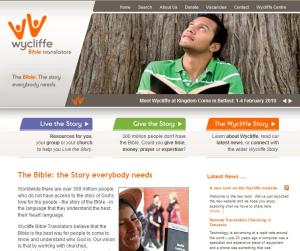
New look website for Wycliffe Bible Translators

Wycliffe Bible Translators have just launched their new website. Why not take a few moments to have a look around it and (re)learn about this exciting and crucial ministry.

From the Wycliffe blog:

Welcome to the new look!  We’ve just launched the new website and we hope you enjoy exploring what we have to share here.

The Bible: the Story everybody needs – The Bible contains the amazing story of God’s love for us and how he can be known by all of creation.  For that reason, we want everybody on the planet to have access to God’s word in the language they understand best, to make it possible for them to get to know God for themselves.

We’ve organised the site into three sections:  Live the Story is full of resources to help you, your group or your church to interact with the Bible.  Give the Story shows the variety of ways we can be part of sharing the Story with others, by praying, giving, going or telling others about the need for Bible translation.

The Wycliffe Story includes latest news, blogs and contact information.  It also explains more about us: including the story of how Cameron Townsend’s heart was moved by the Cakchiquel man who asked “If your God is so great, why can’t he speak my language?”

As Wycliffe UK and others worldwide work together to provide God’s word to people in their heart language, more and more individuals, networks, churches and organisations are connecting with us to see this happen by 2025.

Biblefresh

Biblefresh is an exciting new initiative that is just being launched around the UK to encourage Bible reading and engagement. Here’s some info about it from the EA/Slipstream website

What is Biblefresh?
Biblefresh is a joint initiative which aims to encourage and inspire churches across the UK to make the most of the year 2011, empowering Christians to a deeper level of engagement with the Bible. The initiative brings together nearly a hundred agencies to raise the level of biblical literacy across the UK, through the following four tracks:

1. Bible reading

According to recent research only 1 in 7 Christians are likely to read the Bible outside of a church meeting. Making use of developments in digital technology and creative publishing, this track seeks to inspire Christians to read the Bible afresh, individually, in groups and as whole churches. Watch out for the Biblefresh handbook, packed full of creative suggestions and inspirational material arriving in May 2010.

2. Bible training

Our research tells us that only half of church leaders are confident in their Bible knowledge. Forty percent of Christians even feel undermined in their confidence in Scripture particularly after the recent militant atheism onslaught. Many Christianswho teach the Bible, such as Sunday school teachers and house-group leaders, have received no training in interpreting and applying the Bible. This Biblefresh track aims to equip Christians with improved Bible handling skills. Initiatives include:

– opportunities to learn at the major Christian festivals including: Keswick, Soul Survivor, Spring Harvest, CRE

– special courses and seminars at Bible colleges, churches and institutes around the UK

3. Bible translation

With over 200 million people without the Scriptures in their own language and 2393 language groups yet to have their own Bible, Biblefresh will be asking churches during 2011 to give financial support to a translation project facilitated jointly by Bible Society and Wycliffe Bible Translators, enabling more people worldwide to access the Bible. However we also recognise that the Bible is ‘foreign’ to many people in our own communities. This track also seeks to make the Bible more accessible to those outside the church.

4. Bible experiences

This track seeks to provide fresh experiences of the Bible to draw people back to reading and living it. Through the arts; particularly film, music and painting this track seeks to whet the appetite for biblical engagement. During 2011 the Biblefresh tour and resources will highlight some of the ways this can be achieved by local churches.

Download the Biblefresh Leaders Guide for more helpful information.

Changes to the Bible and Mission blog

Over the last couple of days I’ve been making a few changes to the structure of the blog, primarily with the purpose of integrating it more fully within the activities of Redcliffe’s new Centre for the Study of Bible and Mission.

A new initiative

For some time we have been working hard to develop a new initiative that will ‘serve the Church by engaging in research, teaching, writing and speaking on mission in the Bible, and the Bible in mission thinking, practice and training.’ Though we continue to fundraise we have now received sufficient support from such organisations as Wycliffe Bible Translators and Bible Society for me to have some time to devote to developing the Centre’s activities.

You can see a more detailed explanation of the Centre’s aims and activities on the About page. The main things are teaching (including a new MA in Bible and Mission); hosting an annual lecture and bi-annual consultation in Bible and Mission; research and writing; and hosting a Bible and Mission Scholar from the Majority World each year here at Redcliffe.

What about the blog?

At least for the time being it makes sense to house all the Bible and Mission activities on this site. So it is now more like a microsite than just a blog. Having said that the blog is front and centre and will actually be updated more frequently. It is the best medium by far for thinking aloud and getting across what we are doing in an immediate and accessible way.

I hope you enjoy the developments; let me know what you think!

Missional Bible Study

One of the questions I have with missional hermeneutics is this: ‘What difference will it make in a mid-week Bible Study group? How should this way of reading the Bible affect how we study the Scriptures on a day to day basis?’

One answer to this is provided by George Hunsberger in a Gospel and Our Culture newsletter from September 1999:

The authors of Missional Church declare that “the way to the formation of missional communities begins and ends in our confrontation with and by the Scriptures” (p. 246). If that is true, we will need to learn a new way of placing ourselves in front of the text. Bible study guides and methods that focus on each individual’s relationship to God will not be enough. We will need to learn to read the Bible together as a community that is called and sent by God.

This was part of a pilot initiative to encourage local congregations to engage in Bible study that sought to shape the ‘community of witness’.

The five questions Hunsberger suggests we ask of texts are:

Mission – How does this text send us and equip our witness?
Context – How does this text read us and our world?
Gospel – How does this text evangelize us with good news?
Change – How does this text convert us in personal and corporate life?
Future – How does this text orient us to the coming reign of God?

There is much more to be said on this. Consider this post an opening move…

Themelios journal available free and online

The journal ‘Themelios’ is now available to read for free on The Gospel Coalition website. Here is its blurb:

The Themelios journal is now available online

Themelios is an international evangelical theological journal that expounds and defends the historic Christian faith.

Its primary audience is theological students and pastors, though scholars read it as well. It was formerly a print journal operated by RTSF/UCCF in the UK, and it became a digital journal operated by The Gospel Coalition in 2008.


It’s an excellent resource, especially for students, and covers a variety of themes. One Bible and Mission example is Mission in the Bible: Non-Existent in the Old Testament but Ubiquitous in the New? A Review Article by Craig Blomberg.

HippoBooks African Evangelical imprint

I received Langham Partnership‘s January Enews yesterday, which featured a book in a new Africa Bible Commentary series brought out by a new imprint, HippoBooks.

Here’s how HippoBooks describes its imprint…:

HippoBooks is a shared imprint among several publishers and partners. Together, our vision is to stimulate spiritual and intellectual growth in the African church by developing books by African Christian authors who address African realities from an evangelical perspective.

The imprint is comprised of a broad range of serious Christian and theological publications written especially for pastors, church leaders, and academics (theological students, teachers, and scholars). Titles in this imprint include Bible commentaries and new works in biblical studies, cultural studies, ethics, history, systematic theology, and more.

…and the commentary series:

The Africa Bible Commentary Series builds on the vision of the acclaimed Africa Bible Commentary — to reach African pastors, students and lay leaders, with top notch biblical and theological scholarship, by Africans, for Africa, and the world.

These commentaries are divided into preaching units that contain detailed exposition of each passage as well as contemporary applications. The unit is not intended to be preached as a sermon, but as a resource for sermon preparation. Each unit is followed by two or three questions that could be used for a small group or personal study. Academic issues relating to the Greek text and disputes about interpretation are dealt with in extensive end notes.

The Langham Enews also linked to a review by Craig Blomberg of Samuel Ngewa’s commentary in this series on the Pastoral Epistles. Here’s an excerpt:

Affluent Westerners need to read this volume if only for the applications.  The most poignant of all for me came under 1 Tim. 5:18 (“workers  deserve  their wages”) when Ngewa described returning to Africa after graduate school and being told what his wife’s and his salaries would be by the Western mission agency that would be paying them.  When he explained about his extra needs due to resettling costs and having a baby, his request for a higher salary was denied because, as he explains, “any increase would make the gap between what we earned and the average pastor earned too large. . . .  The irony of the situation is that the person who declined our request was a missionary who was requesting more than our salaries combined to support each of his children! (p. 128)”

 Read the full review

Finally a quote from Chris Wright on the HippoBooks homepage:

“[It’s] time for the West to listen to the voice of the global Church.”