 Back in April 2007 I edited an issue of Encounters Mission Ezine, on the theme of Mission and the Old Testament. Every now and then I will blog on these articles as contributors came up with some really interesting stuff.
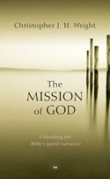
At the time, Chris Wright’s The Mission of God had just come out so we featured an interview with him about it. As the book spans both Missiology and Biblical Studies, I was interested to see what specialists from each discipline would make of it. So I asked both Dr Kang-San Tan, Head of Mission Studies at Redcliffe College, and Prof Gordon McConville, Professor of Old Testament Theology at the University of Gloucestershire, to review it.
Both described The Mission of God as “remarkable”. Here are a couple of extracts from their reviews.
Prof Gordon McConville:
The product of Wright’s readiness to embrace the particularity of Israel in his view of mission is a holistic Gospel. The exodus model shows that political freedom is part of God’s purpose for humanity; similarly, the Jubilee (Leviticus 25) illustrates an economic aspect. Such facets of social existence are inseparable from the spiritual life, and the twin dangers of over-spiritualizing and over-politicizing the Gospel are well addressed (pp. 275-88). Mission ultimately embraces all dimensions of human life, including praise (p. 132), pastoral and ethical concerns (pp. 182-86), and environmental issues (pp. 397-420). And this vision informs evangelism, since ‘the fundamental theology behind [the Jubilee] also lies behind our practice of evangelism’ (p. 300). In these ways, the particularity of Israel is put to the cause of a universal proclamation. In God’s purpose, Israel not only witnesses to the nations, but the nations are finally brought under covenant obedience along with Israel. Ultimately too, the divine mission overcomes death, for a biblical concept of salvation is distinguished from all others by its promise of the defeat of death itself (p. 440).
Read Prof McConville’s review article in full
Dr Kang-San Tan:
Although it was not the expressed purpose of the book, The Mission of God contributes towards the closing of the existing gap between missiology and biblical studies. Instead of separating theology and biblical studies from mission contexts, Wright approaches the texts of scripture through a mission paradigm. In some circles, theological and biblical studies have been considered academic and scientific, while missiology still finds itself under suspect by scholars of other academic disciplines. Part of the distrust may come from missiologists using biblical proof-texts to justify their mission theories and strategies. To some extent, Wright demonstrates in action, more than words, that mission readings and careful exegesis of scripture are both needed for critical missiology.
Read Dr Tan’s review article in full
 I said recently that I would blog on Eddie Arthur’s blog
  I’ll blog more about the immense variety of creative responses another time; for now I want to highlight one student for whom this assessment became a catalyst for a new creative vocation. Ali Edmondson is now in her final year on the BA (hons) in Applied Theology. Her piece of Psalms coursework was a mosaic, ‘Hands’ (opposite), inspired by Psalm 24 (‘The earth is the LORD’s and everything in it…’).
 Since that initial piece she has developed her obvious, God-given creative gift and produced a number of other stunning mosaics that reflect deeply on biblical texts. ‘Mary’ (opposite) came about as a result of work Ali was doing on my Isaiah course.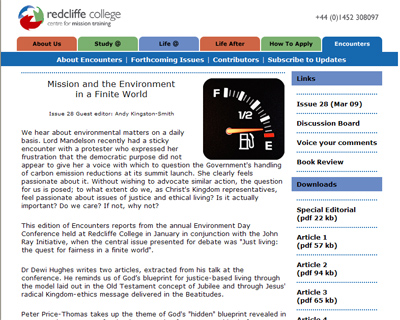

 Centre for the Study of Bible & Mission