Missional hermeneutics and solidarity with the poor

Emerging from the Dark Age Ahead - FenshamA missional reading of the Bible should be considered in relation to God’s commitment to issues of justice and righteousness. As Richard Bauckham so ably puts it, the biblical story has as a prominent theme God’s ‘downward movement of solidarity’ with the marginalised (see a post on Bauckham here).

In Charles Fensham’s Emerging from the Dark Age Ahead: The Future of the North America Church (2011, Clements Academic) the author spends a chapter dealing with ‘Reading the Bible for the Present Church’ in which he discusses missional hermeneutics, especially in relation to the work of David Bosch.

He highlights seven themes:

Towards a hermeneutic rooted in the mission of God;

Towards a missional hermeneutic in solidarity with the poor;

Towards a hermeneutic with a life-giving and liberating Christic missional norm;

Towards a hermeneutic in community of the Spirit;

Toward a hermeneutical community of discerned spirits;

Towards a hermeneutics of missional repentence (metanoia);

Towards a missional hermeneutic of doxology in poiesis for wholeness

Here’s a quote relating to the theme of solidarity I found interesting:

‘I concur with David Bosch and Harold Wells that there is a deeper poetry behind our solidarity with the poor. This is the poetry of the social Trinity who missions to us—the broken creation. God’s care for the poor and marginalized arises out of who God is as self-giving community in relation to the broken and suffering creation. We are the margin of God…

To speak of missional hermeneutics then, is to speak of a hermeneutics in which the self-giving love of the community of God is the norm. The impulse for the margins comes not from “above” but rather from the transcendent who is also immanent.’ (pp.42, 43)

What do you think?

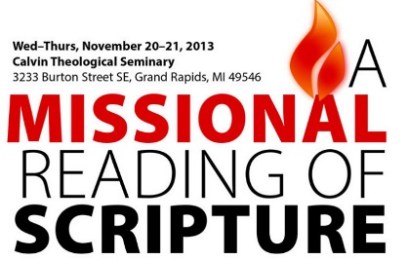
A Missional Reading of Scripture conference

A Missional Reading of Scripture conferenceCalvin Theological Seminary in the US is holding an excellent looking conference this November on the theme of ‘A Missional Reading of Scripture’.

As well as including some key missional hermeneutics scholars, I like the way it aims to address the application of the approach to matters of preaching and theological education as well.

Here are some details plus a link to CTS’s website.

A Missional Reading of Scripture

Wed-Thurs, November 20-21, 2013

3233 Burton Street SE, Grand Rapids, MI 49546  


Over the past century a number of scholars have recognized that mission is not simply a peripheral theme in the biblical story. Rather, it is a central thread in the biblical writings and central to the identity of the church. Thus, a missional hermeneutic is a way of reading Scripture in which mission is a central interpretive key that unlocks the whole narrative of Scripture. It 

does not simply study the theme of mission but reads the whole of the biblical canon with mission as one of its central themes. This conference will explore what it might mean to read both the Old Testament and the New Testament with a missional hermeneutic, and what that might mean for missional praxis of the church, specifically preaching, theological education, and the life of the local congregation.  


Speakers & Plenary Topics 

Christopher J.H. Wright – A Missional Reading of the Old Testament

Michael W. Goheen – A Missional Reading of Scripture and Preaching

N.T. Wright – A Missional Reading of the New Testament

Darrell L. Guder – A Missional Reading of Scripture and Theological Education

For more information visit the Calvin Theological Seminary website

In living by God we live for humanity

A Light to the Nations - Martin-AchardOne of the options available to final year students on Redcliffe’s applied theology degree is a module called ‘Missional Texts: Isaiah’. As well as getting into contemporary scholarship on the book I encourage them to consider how ‘Bible and Mission’ scholars have engaged with Isaiah over the years.

Here’s an interesting quote from Robert Martin-Achard’s 1962 book, A Light to the Nations (Edinburgh: Oliver and Boyd):

‘In preaching consolation to his brethren, Deutero-Isaiah is also declaring that their triumphant return testifies to the incomparable greatness of Yahweh. The miracle by which Israel lives extols its God’s greatness before the whole universe. The ultimate destiny of the world depends on the existence of Israel in the midst of the nations; in living by Yahweh the Chosen People lives for mankind. Such is the missionary outlook that emerges from the oracles of Deutero-Isaiah.‘ (his italics)

What struck me about this quote was the phrase, ‘in living by Yahweh the Chosen People lives for mankind‘. The issue of continuity and discontinuity between OT, NT and now is complex. But I think here we get a glimpse of the connection between the identity of God’s people in relation to the purpose of God’s people. We find our life in God so that we might serve the world by inviting them (implicitly or explicitly) to share in that life.

What do you think?

Amazing Bible and Mission job opportunity at Bible Society

Amazing Bible and Mission job opportunity at Bible Society

Our good friends at Bible Society are advertising for the role of Dean of Studies and Research. It’s a very strategic and exciting role. Here’s some blurb:

The Dean of Studies and Research leads Bible Society’s engagement with the Higher Education sector. This is part of Bible Society’s engagement with culture, increasing the profile and impact of the Scriptures and positioning Bible Society as the knowledge transfer partner of choice

A new book on missiological hermeneutics

Missiological HermeneuticsA very welcome new book has been published recently entitled, Missiological Hermeneutics: Biblical Interpretation for the Global Church. It is written by Shawn Redford and is published by Wipf and Stock as part of the American Society of Missiology Monograph Series.

Here’s some blurb and contents:

How have those engaged in the mission of God been challenged to reinterpret Scripture through their experience? In what ways were the missionaries in the Bible challenged to reevaluate Scripture in their own time? Redford attempts to give shape to the nature of missional hermeneutics by examining Scripture, present-day cultural values, historical struggles, and the experience of those who are engaged in the mission of God. In order for missionaries to overcome the scientific polarization in Western hermeneutics, they must be able to perceive and learn from the overarching missional and spiritual hermeneutics found throughout Scripture so that they can balance missional, spiritual, historical-critical, and even unforeseen hermeneutical paths, providing increased confidence in biblical interpretation.

Contents

one – Introduction · 1
two – Biblically Informed Missional Hermeneutics · 8
three – A Missional Critique of Current Hermeneutical Theory · 85
four – A Missional Critique of the Hermeneutics Used in a Difficult Missional Issue: A Case Study · 133
five – The Role of Mission Praxis upon Missiological Hermeneutics: A Case Study · 232
six – Conclusion · 290

John Piper and Walter Brueggemann on the Psalms

This morning I showed a couple of clips on the Psalms to the Missional Introduction to the Old Testament class here at Redcliffe. John Piper and Walter Brueggemann would disagree about a lot of things but, each in their own way, they both highlight in these clips the compelling and necessary richness of the Psalter for our own experience of life together with God in a world of pain.


Stuttgart Theological Topics journal

Stuttgart Theological Topics is a dual-language journal (German and English – mainly known as Stuttgarter Theologische Themen) containing ‘lectures of the EUSABIA Professional Conference for Bible, Theology and Missions’.

Issues 2 to 5 (2007-2010) are available online for free as PDFs and you can even hear MP3 recordings of the talk on which the articles are based.

Do view and download PDFs and MP3 go to: Stuttgarter Theologische Themen journal

Here’s a list of the contents for vols 1-5.

Volume 5 (2010)  Bible Interpretation in the Horizon of Old Testament Theology and in Interaction with the Islamic View of Scripture

Ida Glaser – Reading Genesis in the Context of Islam: Windows on the Texts

Peter Wassermann – Ishmael or Isaac? The salvation-historical interpretation of the Sons of Abraham

Martin Goldsmith – The Indwelling of God among Mankind: The SHEKHINA

Markus Piennisch – The Biblical-Semitic Aspect of Hermeneutics: An Introduction to the Field of Study


STT Vol. IV (2009)  The Interchange of Christianization and Islamic Expansion in Historical and Missionary Perspective

Peter Riddell – The Call to Islam: Diverse Methods and Varied Responses

Ramy Wannous – The Crusades from the View of an Arab Christian belonging to the Orthodox Faith

Peter Wassermann – The Influence of Scholasticism of the Development of Theology in Christianity and Islam

Markus Piennisch – Religions in the Perspective of Christian Missions: Historical and theological Aspects


STT Vol. III (2008)  Currents in New Testament Interpretation on their Effects on Theology and Missions

Peter Wassermann – Son of God and Son of Man, Part 1: Testimonies of the Old Testament

Richard Harvey – The Impact of Christianity on the Development of Messianic Jewish Thought

Peter Wassermann – Son of God and Son of Man, Part 2: Testimonies of the New Testament

Markus Piennisch – The “Biblical-Semitic Aspect” in the Basic Structure of the WORD-DEED of God (dabar)


STT Vol. II (2007)  The Impact of Christian History and Theology on Judaism and Islam and its Significance for Missions Today

Samuel Shahid – The Impact of Christianity on the Arab Peninsula in Pre-Islamic Times

Abd al-Masih – Which Witnesses and Methods did the Lord Jesus use to call many Muslims to Himself? (upon request)

Richard Harvey – The Impact of Christianity on the development of Messianic Jewish Thought

Markus Piennisch – Christian Theology in the Islamic Context: Missionary and Hermeneutical Perspectives

Skittles and Bible Translation statistics

In a previous post I mentioned a video that illustrates the Scripture access statistics using chocolate: Bible Translation and Chocolate.

I came across this one today which uses skittles instead. A fun way of presenting a sobering challenge.

Michael Kelly on Biblical Theology and Missional Hermeneutics

Eyes to See, Ears to Hear

Michael Kelly has written a thought-provoking essay entitled, ‘Biblical Theology and Missional Hermeneutics: A Match Made for Heaven… on Earth?’

He first gives a brief survey some themes in biblical theology and missional hermeneutics and then uses speech-act theory to bridge the two disciplines. I’ve not come across much, if anything, that has sought to relate speech-act theory to the Bible and mission conversation so this is a welcome exploration.

In case my description makes it sound like a rather dry prospect, here are a few quotes:

a good biblical-theological… reading of the OT text will be generative of mission in God’s world, sweeping up the readers and their communities in the great story of redemption being “told” by the ongoing application of the gospel of Jesus Christ to every corner of creation. A good reading will shape readers to align themselves with God’s mission. (p.62)

a missional hermeneutic will involve approaching Scripture-the whole story, including God’s intention for creation and humanity-with eyes to see how we might be drawn into this very real and visisble, bodily hope in our world. (p.71)

A missional hermeneutic engages self-consciously in this time of tension, and allows the interpreter full appreciation of the pain so often experienced in this world. A missional hermeneutic is not idealistic or triumphalistic, but brings real healing to places of real pain. (p.71)

Understanding Scripture as a divine speech act embedded in real historical human context, intended to change both the thinking of its readers and the actions of its readers, may indeed provide a helpful way to think about how Scripture functions as generative of mission… the overarching, divinely intended effect of the story to which biblical theology attends is that its readers align themselves with God’s mission in the world (p.73)

Christian missional obedience, then, goes beyond obedience to individual passages here or there (as vital as that obedience is when a passage is properly interpreted). The Bible, while offering real words of hope to a pilgrim community, also sends that pilgrim community into God’s world to be agents of blessing to every corner of the world. Christian missional obedience extends to actively aligning our story with the true story of the world as narrated by God through Scripture, as the Scripture comes to us and encourages, motivates, admonishes, comforts, warns, and promises. In other words, can we say that Scripture functions to shape its obedient readers toward God’s comprehensive mission in the world, to act in accord with this mission, a mission seen climactically embodied in the life, death, and resurrection of Jesus Christ? (p.74)

To put it simply: the mission of God seen through Jesus Christ was a mission of suffering and grief, in the hope and promise of restoration. Our Christotelic approach guards us from triumphalism, giving both a grief and a confidence to our being swept up into the mission of God. We understand the mission of God not simply in creational (or new creational) categories, but also in the categories of incarnation, humility, and sacrifice. The story of Jesus Christ, in both his death and resurrection, in pain and joy, shapes our living into God’s mission. (p.74)

So, well worth a read! The bibliographic details are: Kelly, M.B. ‘Biblical Theology and Missional Hermeneutics: A Match Made for Heaven… on Earth?‘ in P. Enns, D.J. Green and M.B. Kelly (eds) Eyes to See, Ears to Hear: Essays in Memory of J. Alan Groves (Phillipsburg: P&R Publishing, 2010), 61-76. (the link here goes to Amazon, which includes a preview of the book, though not of Kelly’s article).

Paul’s Missionary Methods – new book

Paul's Missionary Methods

A new book is due out in early 2013 that marks the centenary of the publication of Roland Allen’s Missionary Methods: Saint Paul’s or Ours? (Allen’s book is available for free at http://www.archive.org here: Missionary Methods: Saint Paul’s or Ours?). Here are the publisher details:   

Paul’s Missionary Methods: In His Time and Ours

Edited by Robert L. Plummer and John Mark Terry

What does Paul’s missions strategy mean for today?

A century ago Roland Allen published Missionary Methods: Saint Paul’s or Ours?, a missiological classic which tackled many important issues, including what biblically rooted missions looks like in light of the apostle Paul’s evangelistic efforts. Although Allen’s work is still valuable, new understandings have been gained regarding Paul’s milieu and missionary activity, and how his practices ought to inform missions in our ever-changing world.

Using the centennial anniversary of Allen’s work as a springboard for celebration and reflection, the contributors to Paul’s Missionary Methods have revisited Paul’s first-century missionary methods and their applicability today. This book examines Paul’s missionary efforts in two parts. First Paul is examined in his first-century context: what was his environment, missions strategy and teaching on particular issues? The second part addresses the implications of Paul’s example for missions today: is Paul’s model still relevant, and if so, what would it look like in modern contexts?

Experts in New Testament studies and missiology contribute fresh, key insights from their fields, analyzing Paul’s missionary methods in his time and pointing the way forward in ours.

Contents

Part One: Paul in the New Testament
1. Paul’s Religious and Historical Milieu – Michael F. Bird
2. Paul the Missionary – Eckhard J. Schnabel
3. Paul’s Gospel – Robert L. Plummer
4. Paul’s Ecclesiology – Benjamin L. Merkle
5. Paul’s Mission as the Mission of the Church – Christoph W. Stenschke
6. Paul’s Theology of Suffering – Don N. Howell, Jr.
7. Paul and Spiritual Warfare – Craig Keener

Part Two: Paul’s Influence on Missions
8. Paul’s Missions Strategy – David J. Hesselgrave
9. Paul’s Strategy: Determinative for Today? – Michael Pocock
10. Paul and Indigenous Missions – John Mark Terry
11. Paul and Church Planting – Ed Stetzer with Lizette Beard
12. Paul and Contextualization – M. David Sills
13. Paul and Leadership Development – Chuck Lawless

Postscript
14. Roland Allen’s Missionary Methods at One Hundred – J. D. Payne

Here’s a link to a sample: Paul’s Missionary Methods: In His Time and Ours