Lausanne World Pulse on the Bible and Orality

The latest issue of Lausanne World Pulse features an article titled, ‘International Orality Network’s Declaration on Making Disciples of the World’s Oral Learners through Audio Scripture Engagement’.

It it they make the point that

There are 4.35 billion people in our world who are oral learners. They are found in many cultural groups in the villages and in global cities around the world. We recognize that sixty percent of the world’s population can’t, won’t, or don’t hear the gospel when we share it simply because it’s often coming through literate means they don’t understand and to which they do not relate.

The word of God is unchangeable, but the manner or method in which it is communicated does change. We celebrate that God has worked intentionally throughout history to bring his word to the peoples of the world utilizing various media formats, including oral communication, scribe and hand written text, the printed page, and digital means.

The Gutenberg Press enabled a print revolution and unprecedented spread of the word of God. Oral means were available prior to Gutenberg, but a scripture literacy revolution was empowered by means of making the full Bible available to every person who could read. We stand today at another seminal point in history in which digital technology makes it possible for every oral learner to engage with God’s word in audio and audio/visual formats.

The International Orality Network aim

to influence the Body of Christ to make disciples of all oral learners. We believe that the foundation of discipleship is the shaping by, and obedience to, the word of God. It is the inalienable right and privilege of every person to have access to the word of God in his or her own heart language and in a media format he or she understands.

They then issue a number of challenges:

We call upon the Body of Christ to expand the reach of this revolution by making the entire word of God available to every person who can hear.

We call upon the Church to embrace engagement of the audio scripture among oral learners with great urgency.

We call upon the Church to engage all unengaged, unreached people groups and to place into their hands any and every available audio portion of God’s word in their heart language.

We call upon the Body of Christ to devote energies, strategies, and resources to provide access for all oral learners to engage the entire word of God through audio/digital means, so that every tribe, tongue, and people group may hear, understand, and have the opportunity to respond!

Missional hermeneutics reading part 2

Today on the Reading the Bible Missionally module of Redcliffe’s MA in Bible and Mission we finished off our foundational work surveying the missional hermeneutics literature, before plunging back into Chris Wright’s The Mission of God: Unlocking the Bible’s Grand Narrative.

Following our look at Wright and Bauckham’s approaches (mentioned in the previous post), students came prepared to share about writers such as Michael Goheen, Dan Beeby, Darrell Guder and James Brownson.

Here are references to some of their works. If you are interested in taking it further check out our Bible and Mission books and articles page.

Beeby, H.D. Canon and Mission (Harrisburg: Trinity Press International, 1999).

Beeby, H.D. ‘A Missional Approach to Renewed Interpretation’ in C. Bartholomew, C. Greene and K. Möller (eds), Renewing Biblical Interpretation (Carlisle: Paternoster Press, 2000), 268-283.

Brownson, J.V. ‘Speaking the Truth in Love’, International Review of Mission, Vol 83, No. 330 (1994), 479-504.

Brownson, J.V. Speaking the Truth in Love: New Testament Resources for a Missional Hermeneutic (Harrisburg: Trinity Press International, 1998).

Goheen, M.W. ‘Continuing Steps Towards a Missional Hermeneutic’Fideles, Volume 3 (2008), pp.49-99.

Goheen, M.W. A Light to the Nations: The Missional Church and the Biblical Story (Grand Rapids: Baker Academic, 2011).

Guder, D. ‘Missional Hermeneutics: The Missional Authority of Scripture‘, Mission Focus, Annual Review, 15 (2007), 106-121.

Guder, D. ‘Missional Hermeneutics: The Missional Vocation of the Congregation – and How Scripture Shapes That Calling‘, Mission Focus, Annual Review, 15 (2007), 125-142.

Missional hermeneutics reading part 1

Today we had the first two sessions of the Reading the Bible Missionally module on Redcliffe’s MA in Bible and Mission. The course itself takes its structure from Chris Wright’s The Mission of God: Unlocking the Bible’s Grand Narrative. By the end of the course we have read the whole thing. But fantastic though Wright’s book is, it is also important for students to have a good grasp of other writers in the field.

So today we had an introduction to the development and legitimacy of a missional hermeneutic, alongside discussions of the methodologies of Chris Wright and Richard Bauckham.

To get a flavour of some of the literature have a look at this microsite’s Bible and Mission books and articles page. In the meantime, here is a selection of the things we’ve been looking at today:

Bauckham, R. ‘Mission as Hermeneutic for Scriptural Interpretation‘, Currents in World Christianity Position Paper, Number 106 (1999).

Bauckham, R. The Bible and Mission: Christian Witness in a Postmodern World (Carlisle: Paternoster Press, 2004).

Goheen, M.W.  ‘A Critical Examination of David Bosch’s Missional Reading of Luke’ in C.G. Bartholomew, J.B. Green and A.C. Thiselton (eds.), Reading Luke: Interpretation, Reflection, Formation (Grand Rapids: Zondervan, 2005), pp.229-264.

Hunsberger, G. ‘Proposals for a Missional Hermeneutic: Mapping a Conversation‘, Gospel and Our Culture Newsletter eSeries, 2 (January 2009). Subsequently published as G. ‘Proposals for a Missional Hermeneutic: Mapping a Conversation’, Missiology, 39:3 (July 2011).

Wright, C.J.H. The Mission of God: Unlocking the Bible’s Grand Narrative (Leicester: Inter-Varsity Press, 2006).

Wright, C.J.H. Truth with a Mission: Reading All Scripture MissiologicallySouthern Baptist Journal of Theology, 15.2 (2011), pp.4-15.

Tomorrow we turn our attention to Dan Beeby, James Brownson, Michael Goheen and Darrell Guder.

Christmas Unwrapped

As ever, Bible Society are thinking of creative ways to engage people with the Bible this Christmas. They have produced a series of envelope stickers that depict the story of the nativity along with a website where people can read the Christmas story for themselves.

The images themselves are beautifully done. Here is a video from the Christmas Unwrapped website.

Some Bible and Orality websites

This week in our module Story, Song and Social Networks: Bible Engagement and Oral Culture students had to report on websites and ministries that deal with issues of orality and Bible Engagement. I asked them to explore the websites and consider three questions:

1. How do they define or assume orality in relation to the people they work with?

2. What kinds of projects interest you?

3. How do you think the projects might be contextualised to a different context you are interested in?

Lots of great discussion!

We used the list of sites available on the Bible and Orality resources page. Currently the list is as follows:

Bible Society
Bible Storying
Chronological Bible Storying
Communication Across Barriers
Faith Comes By Hearing
Global Recordings Network
International Orality Network
The Java Club
OneStory Partnership
Orality Strategies
Scripture Engagement
Scriptures in Use
Simply The Story
Story4All
T4 Global Blog
Wycliffe Bible Translators (UK) 

Are there any sites we’ve missed? Leave a comment to suggest ones you think we should be including.

And if you want to reflect on issues of Bible and orality in more depth, you can always come to Redcliffe on either the BA(Hons) in Applied Theology in Intercultural Contexts, or even the MA in Bible and Mission!

Free access to Chris Wright Truth with a Mission

When students arrive for Redcliffe’s BA(Hons) in Applied Theology in Intercultural Contexts I get them all to read Chris Wright’s 2005 Grove booklet, Truth with a Mission: Reading the Scriptures Missiologically. It is a really good, concise introduction to the idea of the Bible as a missional book, and sets out the basic approach we take at Redcliffe to Biblical Studies.

The ever-eagle-eyed Antony Billington recently noted that Wright’s essay has now been published in the Summer 2011 volume of the Southern Baptist Journal of Theology, and is freely available on their website under the slightly changed title: Truth with a Mission: Reading All Scripture Missiologically. It is in an essay format rather than a study booklet and doesn’t have the questions for reflection that are in the Grove booklet, but otherwise it is exactly the same.

If you are looking for a short introduction to the idea of a missional reading of the Bible Truth with a Mission: Reading All Scripture Missiologically is an excellent place to start. SBJT are to be commended for making it available.

P.S. And do check out Antony’s blog if you’ve not done so before. He writes most days and is particularly good at spotting when journals are published, often noting when there are freely accessible articles.

Eavesdropping Abraham

Genesis chapter 18 is a curious passage to engage with missionally, especially around verses 16-21. In these verses the reader learns of YHWH either talking to himself, or His companions, in deep perplexing contemplation, loud enough to enable Abraham to overhear.  The narrator has placed it between God having a meal with Abraham, reiterating His covenant and Abraham’s intercession for Sodom.  How does one engage with this from a missional perspective?  Was it simply to teach further generations the punishment for sin, or warning Abraham as a patriarch of what a great nation should not to become.  Or is there a deeper understanding linking this story with earlier themes in Genesis.   Was Abraham eavesdropping or did God use it as device to stir the depths of Abrahams soul, enabling him to access a greater understanding of what it means to be ‘made in the image of God’.   Whether eavesdroppng or not, it prompted Abraham to begin a form of negotiation with the Creator of the universe, prompting Him to reconsider the total obliteration of the city.  There is little evidence in the text to say why Abraham risked the consequences of debating/questioning YHWH’s judgement apart from Lot, nevertheless, his intercession went beyond that of his family or even the righteous, it was extended to those throughout the city who did not deserve it.  Is it possible that this could be a prototype of Matthew 22:36-40 when Jesus highlights the greatest commandments, showing that its missional value firmly rooted in the foundations of love.

Free access to Ujamaa Centre Bible and Mission resources

Ujamaa Centre for Biblical and Theological Community Development and Research logo
Ujamaa Centre for Biblical and Theological Community Development and Research logo. From their website.

It is always good to look at and learn from projects that take text and context seriously. The Ujamaa Centre for Biblical and Theological Community Development and Research is based at the University of Kwazulu-Natal. It describes itself as:

an interface between socially engaged biblical and theological scholars, organic intellectuals, and local communities of the poor, working-class, and marginalised. Together we use biblical and theological resources for individual and social transformation.

In particular, check out two pages in the resources section: Academic Resources and Practical Resources. I’ve listed the contents below for each but you’ll need to go to their website to access the links:

Ujamaa: Academic Resources

John 9 and HIV
Matthew 20 and Day Labourers
Esther and Contextual Bible Study method.

1. Other academic resources

James, G.L. Tell it like it is! The case to include the story of the rape of Tamar in children’s Bibles as an awareness tool.

Kumalo, S. “THE PEOPLE SHALL GOVERN”: NOW THEY HAVE ONLY THE POSSIBILITY TO VOTE

Kumalo, S. The palace, the parish and the power: Church-State relations in Rwanda and the genocide

Kumalo, S.Transforming South African Methodism: The”Journey to the New Land” Programme 1992-1997.

West, G. O. (1997). Reading on the Boundaries: reading 2 Samuel 21: 1-14 with Rizpah. Scriptura, 63, 527-537.

West, G. O. (2006a). Contextual Bible reading: a South African case study. Analecta Bruxellensia, 11, 131-148.

West, G. O., & Zondi-Mabizela, P. (2004). The Bible story that became a campaign: the Tamar Campaign in South Africa (and beyond). Ministerial Formation, 103, 4-12.

West, G. O., Zondi-Mabizela, P., Maluleke, M., Khumalo, H., Matsepe, P. S., & Naidoo, M. (2004).Rape in the House of David: the biblical story of Tamar as a resource for transformation Agenda, 61, 36-41.

West, G. O. (2007). Thabo Mbek’s Bible: the role of religion in the South African public realm after liberation October, draft paper.

Ujamaa: Practical Resources

1. Doing Contextual Bible Study: A Resource Manual

Part 1: Introducing Contextual Bible Study
Part 2: Contextual Bible Studies

2. Contextual Bible Study, by Gerald West.

This book is available from Cluster Publications: http://www.clusterpublications.co.za/

3. Tamar Campaign: Contextual Bible Study Manual on Gender-based Violence

Part One
Part Two
Part Three

4. “Economic Matters” Contextual Bible Studies series

5. “Redemptive Masculinity” Contextual Bible Studies series

6. Workshop presentations of Contextual Bible Study methodology

“Mark 12″ Contextual Bible Study
“Redemptive Masculinities” Contextual Bible Study

7. Contextual Bible Studies on “Land”

8. Bible studies by Prof Tinyiko Maluleke (Unisa) published in Challenge Magazine

Reconciliation: its Beneficiaries and its Victims
Behold and Beware! The Poor are Standing at the Gates!
Beyond the Politics of the Stomach
Three Models of Manhood: In Search of Real Men
Crowd Control or Compassionate Ministry? Aspects of a New Model of Ministry
Christmas: What’s Love Got to Do with It?
Defenseless Baby Jesus in the Midst of the Defenseless Children of the World
Maids, Madams and Adams: the Unfinished Story of Martha and Mary

9. An Indian contextual Bible study on state land acquisition

10. A Bible study on Judges 11 by Cheryl Anderson

The Challenge of Luke 9:1-6 for Western Contemporary Mission

Chris Wright, notes in The Mission of God, p40, that, ‘It is the common witness of those, including myself [Wright], who have lived and worked in cultures other than their own that reading and studying the Bible through the eyes of others is a challenging, mind-blowing and immensely instructive privilege’.


This year we have the privilege of welcoming Laurence Gatawa, a Filipino scholar and lecturer in New Testament Studies as our visiting scholar.  In his first lecture on Luke-Acts he challenged the class to read Luke 9:1-6, (Jesus sending out the 12 saying, “Take nothing for your journey, no staff, nor bag, nor bread, nor money; and do not have two tunics….” (ESV)), from a position of someone from the Majority World/Global South.  Following this line of thought he asked ‘What would their interpretation be? Would they hear this as a call to mission, if so what would be their response?’

Is it easier for those from the Global South/Majority World to follow Jesus’ teaching here?

He further challenged the class to reflect on how we (the West) have a tendency to build resources first before embarking mission.  Do we neglect this passage in our Missional understanding?

How would you respond to both the lecture questions and the Biblical passage?

A video insight into the process of Bible Translating

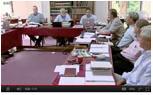
ESV Translation CommitteeTyndale House recently posted a page highlighting a video made by the BBC during one of the discussions of the ESV translation committee in Cambridge last year. It is only four minutes long but illustrates very nicely some of the complexities of translating terms from one language to another (in this case the term, ‘slave’).

What are the different terms for ‘slave’ in the Bible, and the connotations each had?

What are the connotations of the different ways we could translate these terms, especially when you consider the sociocultural, political and historical, and metaphorical associations of slavery? Should they be rendered ‘slave’, ‘servant’, ‘bondservant’, etc?

Slavery is the particular case study here but the same could be said about many other terms.

You can view the video by going to Tyndale House’s website