Biblical wisdom and christian engagement with modern culture

This was the title of an excellent conference I attended at the weekend at the Queen’s Foundation in Birmingham. It was organised by Knut Heim, tutor in Biblical Studies at Queen’s and David Spriggs, Bible and Church consultant at Bible Society. Bible Society very generously subsidised the gathering, which attracted about twenty participants ranging from biblical scholars, church ministers, students, and others.

The purpose of the conference was to explore ways in which the UK church could reengage with biblical wisdom, particularly (but not exclusively) the Old Testament books of Proverbs, Ecclesiastes and Job.

There was a fantastic range of presentations ranging from a survey of the treatment of the Wisdom Literature in Old Testament scholarship over the last century, to creative ways of engaging contemporary culture with wisdom using web 2.0. An eclectic mix, but this was precisely the point: scholarship and church should be united in understanding and creativity to engage with biblical wisdom for the sake of the world.

I gave a paper on ‘Wisdom, Church and the Mission of God’, which used Chris Wright’s discussion on the Wisdom Literature in his book, The Mission of God as a framework to explore some practical ways in which the church might engage with God’s mission in the world.

All the papers are due to be available in a few weeks time; I’ll let you know when that happens.

I was particularly impressed by the work, creativity and energy of Matt and Juls Hollidge from Kore, who describe their vision as ‘to explore the heart and roots of our faith and to discover what the Kingdom of God looks like in our world.’ Check out the Kore website, which has some excellent resources.
Bible and mission at the Baptist Assembly

This year’s Baptist Assembly will include two seminars on the theme of Bible and mission (thanks to my Redcliffe colleague Darrell Jackson for pointing this out to me). They are both on Saturday 1 May.

Here are the details…

Through different eyes: Reading the Bible in a global community
More and more Christians based in the UK are finding their experience of the Bible wonderfully enriched, as the eyes of readers around the world unlock fresh perspectives. Richard Kidd, Joe Kapolyo and Kumar Rajagopalan will tackle some familiar texts – expecting you never to hear them the same way again!
Arranged by the Baptist Union of Great Britain and Baptist Colleges

One God, one Bible, one mission: Reading scripture as the story of a missionary movement
What is the biblical basis for understanding the one mission to which we are called? Glen Marshall and Roger Standing will help open our eyes and hearts to God’s big story and encourage us to discover the ways in which we are being invited to take part.
Arranged by the Baptist Union of Great Britain and Baptist Colleges 

Excellent to see Bible and mission getting such good air time at these high profile events. If you are going to the Assembly, check it out and let me know what you thought.

Lausanne global conversation on Scripture in mission

The Lausanne Movement is calling on Christians from around the globle to engage in various conversations that will help the church to engage with the big issues of contemporary mission.

The Global Conversation covers the following categories and topics:

Truth: Bearing witness to the truth of Jesus Christ
– Marketplace Ministry
– Personal Witness
– Truth and Secularity

Reconciliation: Pursuing peace in our broken world
– Environment
– Ethnicity and Identity
– Poverty and Wealth
– Resource Stewardship

World Faiths: Loving our neighbours of other faiths/worldviews
– Diaspora
– Unreached People Groups
– World Faiths

New Missions Priorities: Discerning God’s priorities for the future
– Children
– Forming Leaders
– Orality
– Urban Mission

Authenticity and Integrity: Living a Christ-like lifestyle
– Prosperity Gospel
– Women and Men
– The Human Future

Partnerships: Serving together in love and humility
– Globalization
– Indigenous Leadership
– Partnership Development
– Scripture in Mission

Below I’ve put the general blurb about the conversation along with descriptions about two of the topics most closely aligned with the Bible and mission: orality and Scripture in mission. Do have a look and get involved: Join the global conversation

The Big Picture
We are living in a time of enormous challenge and amazing opportunity for the church. The life and witness of the church around the world is being assailed by external pressures while simultaneously being weakened by internal troubles. Yet the church also faces unprecedented global opportunities for the spread of the gospel and open doors for ministry in regions traditionally closed to the witness of Christ.
Unfortunately, a concerted and well-reasoned response to these global issues and opportunities has been difficult because the church, and evangelicalism in particular, is highly fragmented.
The Lausanne Global Conversation is one step towards bringing together the global church to engage with these important issues related to world evangelization.
We believe these global issues need global conversations.
So let’s talk, let’s strategize, let’s work together. Above all, let’s pray–with a sense of expectation and hope–for the Lord to bring wisdom through the counsel of many (Proverbs 11:14).
Your voice in the conversation is needed. Every Christian has unique experience and insight to offer the church.

Orality
Two thirds of the people in the world are oral communicators – who can’t, don’t, or won’t learn through literate means. Western Christianity has, since the time of the Gutenberg Bible “walked on literate feet” and has directly or indirectly required literacy of others, ignoring the vast majority of people who are oral communicators. Literate Christians must make significant changes in evangelism, discipleship, leadership training and church planting to reach the 4,000,000,000 oral communicators world-wide.

Scripture in Mission
The purpose of the Scriptures as Paul wrote to Timothy is to make us wise about the way of salvation through faith in Jesus Christ and to equip us for every good work as God’s people (2 Timothy 3:14-17). The Scriptures therefore are essential to evangelism and to Christ-like transformation. However, where the Scriptures are not available or where people cannot study and apply them, we find “Bible poverty.”
In this conversation we want to consider the issue of “Bible poverty.” Bible poverty exists when people find themselves in a context or setting that blocks them from hearing the truths of the Scriptures. This happens, for example, when they do not have access to the Scriptures in a language they understand well, or they are unable to engage with the Scriptures in a meaningful way, or they do not have the opportunity to apply them to their lives.
Contexts such as these can be called “barriers.” Some barriers are universal or nearly so while others differ according to context. We want to consider what barriers exist in urban contexts, in rural contexts, in contexts where other major religions dominate, and in contexts of the post-modern West.
As we consider barriers to the Scriptures, we also want to identify the bridges that would allow people to transcend and overcome these barriers. In some cases the bridges are easy to identify, but in other cases they will require searching together under the guidance of the Spirit of God to discern the way forward.

Direction journal

I recently discovered a new online journal with a number of helpful issues. Direction is ‘a Mennonite Brethren forum’; here’s how it describes its development:
Direction journal was begun in 1972 as a partnership among four Mennonite Brethren educational institutions in Canada and the U.S. Eventually two additional schools joined the group, and the U.S. and Canadian Mennonite Brethren Conferences also provide support. Delbert Wiens, editor, offered the first issue of Direction to laypersons and church leaders with an invitation “to listen to each other and to think prayerfully together.” Challenges cited by Wiens for the journal to address included theological issues, the church in theory and practice, sociological problems, and discipleship matters. Neither a purely academic journal nor a denominational magazine, Direction highlights the interdependence of Christian reflection and mission.

In 1972, Direction replaced two publications: The Voice (Canadian, since 1952) and the Journal of Church and Society (U.S., since 1965). It began as a quarterly publication but changed to semiannual in 1985. Five editors, apart from guest editors, have served during the journal’s life: Delbert Wiens (1972-75), Allen Guenther (1981-89), Elmer Martens (1976-81; 1989-95), Douglas Miller (1997-2007), and Victor Froese (2007 to the present). Kindred Productions began producing the journal with the 1996 issues. An overview of themes addressed by the journal may be obtained on the Back Issues page of this site.

The idea of a Direction Web site began in the late 1990s and was developed in the winter of 2000-2001. With the journal on the Web as well as in print, its articles now become much more accessible to interested readers.

After a quick look a few articles strike me as particularly interesting, but I’m sure there are more:

Genesis 1 as Critique of Japanese Culture by Hironori Minamino

Ezekiel’s Contribution to a Biblical Theology of Mission by Elmer A. Martens

Impulses to Global Mission in Isaiah by Elmer A. Martens

Calling all Bible and mission bloggers!

How many people out there are blogging on the Bible and mission? According to WordPress, they provide space for 290,188 bloggers and just today there has been the following activity on WordPress.com:

258,217 new posts
355,171 comments
60,395,829 words

A while ago I wrote about two of my favourite Bible and mission blogs, Brian Russell’s realmealministries and Eddie Arthur’s kouya chronicle. But how many others are there writing consistently on the dynamic interplay between the Bible and mission?

A further question: how might we define a blog as being ‘about Bible and mission’? Does it have to be exclusively looking at Bible and mission or should it just make regular contributions on the subject?

So what do you think? Drop me a line with any suggestions for Bible and mission blogs. Let’s broaden the conversation…

Marcus Honeysett on joy, mission and the Psalms

Marcus Honeysett of Living Leadership has a post on his blog on Joy in Missions.

Reflecting on the Psalms, he says that

The purpose of proclamation is to draw a worshipping people. And it is done by worshipping people. We don’t merely proclaim him among the nations, we praise him among the nations. We extol him and publicly exult in him. We find words and phrases that express our admiration, our adoration, our wonder and amazement. Like people stop open-mouthed in front of the Grand Canyon, when they finally find some words it is usually to turn to a friend and say “wow – just look at it!” That’s what we are doing for sake of the nations of the world.

This is a very helpful angle to consider. I’ve been thinking a lot about mission and the Psalms recently: we had the Psalms community day last term and I’m putting together our multilingual Psalms scroll (more on this when it’s done!); I’m preaching three times on the Psalms over the next few weeks; we have Gordon Wenham giving the annual lecture in Bible and Mission on the nations in the Psalms on 12 May; there is a student at Redcliffe doing a very interesting dissertation on a missional aspect of the Psalms; and the June 2010 issue of Encounters will be on mission and the Psalms.

I love the Psalms!

Exodus, Church and Mission

Exodus, Church and Mission is the title of an evening class mini-series we are running at Redcliffe College in May.
Here’s the blurb from Redcliffe’s website

Evening Classes: Exodus, Church and Mission
With Richard Johnson, Associate Lecturer in Biblical Studies

2 sessions:

Monday 17 and 24 May 2010, 7.30pm to 9.30pm

In partnership with the Centre for the Study of Bible and Mission

The book of Exodus is full of exciting stories and important teaching about God, his people, and their role in the world. This mini-series of two evening classes will help you to understand the big picture of Exodus, as well as how it applies to living as the people of God in the 21st century.

Monday 17 May – An Overview of the Book of Exodus
How does the book of Exodus fits together and how does it fit into the wider story of the Bible? As well as addressing these questions Richard will also deal practically with how we can get the most out of reading Exodus on our own or in small groups.

Monday 24 May – Themes for Church and Mission in the book of Exodus
Drawing on themes from the book of Exodus, Richard will suggest ways in which these apply to church life and mission in the 21st century.
Formerly Redcliffe’s Head of Biblical Studies, Richard Johnson is now an Associate Lecturer in Biblical Studies, runs a bookselling business, and has an itinerant teaching ministry. For more details about Richard please visit his website Qoheleth Resources.

Cost and booking
The mini-series costs £6 per session, which is payable on each night. Pre-registration is required. To book your place, contact events@redcliffe.org.

Directions: Please see our directions page for details on how to find us.

Bible, mission and migration

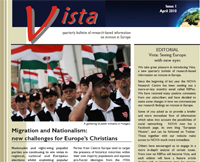
Nova Research Centre, an initiative located at Redcliffe that researches and publishes on mission in and for Europe, has just published their latest news bulletin. Vista is a quarterly bulletin of research-based information on mission in Europe. The theme this issue is migration.
Here’s a snippet that picks up on a biblical theme:

European churches and mission agencies are in the vanguard of those working with migrants and 2010 has been declared a year of European churches responding to migration. The experience of koinonia outlined in the New Testament will not permit social and ethnic diversity to become divisive and the most powerful testimony to a reconciling Gospel is to live that Gospel out within reconciled communities of the Kingdom. The experience of community should always move us beyond ourselves, however, to the vulnerable, needy and lost who can be found among migrants and refugees. It should also learn how it can best integrate the migrant experiences of vibrant and vital faith with its own experiences.

And, the challenge remains, as to how best address the challenges and questions posed by the nationalist and far-right populist parties. There are precious human rights and freedoms that the church must not allow to be trampled underfoot by such movements. New ways must be found to counter destructive, divisive, and racist policies that ignore the public value of key biblical and theological insights. The diversity of the early church is a powerful reminder and stimulus to better appreciating our own European diversity and framing a more adequate response in mission.

Read the whole issue of Vista

Biblical Interpretation for Church and World course

Brian Russell is teaching this course 26-30 July this year as part of the Doctor of Ministry programme of Asbury Theological Seminary (it will be taught at the Orlando campus).
This is how he describes the module, which also explains why I want to highlight and recommend it:

This course is part of the required core for the D.Min. degree, but more importantly it is my signature course for teaching biblical interpretation through the perspective of a missional hermeneutic of Scripture. The class focuses on reflecting critically on our reading practices and helping to shape interpreters into persons who read the Scriptures not merely for the Church but for our pre and post Christian culture.

For more details visit Brian’s blog

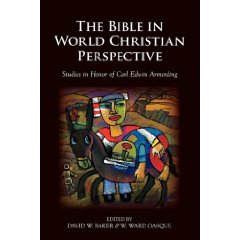
The Bible in World Christian Perspective

The Bible in World Christian Perspective is the title of a book of studies in honour of Carl Armerding, formerly of Schloss Mittersill Study Centre, Austria and Regent College, Vancouver. It is edited by David W. Baker and W. Ward Gasque (Vancouver: Regent College Publishing, 2009).

Here are the blurb and contents:

The Bible is by far the most widely translated and circulated book in the world, and Christianity is by far the most globally dispersed religion. The Christian faith can no longer be said to be a “Western” religion. The axis of influence in the world Christian movement is now in the South and the East. Africa is home to the largest number of Christians, and now China, where a generation ago prospects for the faith looked most unpromising, represents the locus where the church is growing most rapidly.

Theological education has also changed radically in recent years. As the church has grown throughout the world, new forms of equipping both clergy and laity for ministry have sprung up to meet changing needs and circumstances.

Carl E. Armerding has played a major role in re-shaping theological education. He was a founding member of the faculty of Regent College, Vancouver, Canada (1970–91), a globally influential school of theology, and served as its second President (1977–88). Having given leadership to the college during the period of its greatest growth and the development of its beautiful campus, he invested the next decade- and-a-half of his life in providing innovative Christian higher education to a wide range of international students, especially those from Central and Eastern Europe, as the Director of Schloss Mittersill Study Centre, Austria (1991–2006), and at the Oxford Centre for Mission Studies (1991–2002). He continues to teach and to advise students associated with these three institutions, along with others around the world. This collection of essays by colleagues, former students, and friends is an expression of appreciation for the leadership he has given to Christian higher education.

Table of contents:

1. The Bible in the World and the World of the Bible – David W. Baker
2. Exodus 22:1-4: A Case of Restitution vs. Retribution – Robin J. DeWitt Knauth
3. Eight Key Functions of Leadership – Soo-Inn Tan
4. Herodotus and Esther: A Second Look – Robert L. Hubbard, Jr.
5. Some Reflections on Paul’s Understanding of Christ as Lord – Gordon D. Fee
6. Petitionary Prayer and the Nature of God – Clark H. Pinnock
7. The Reforming Agency of a Psalm in the Later Middle Ages – James M. Houston
8. Becoming the People’s Book: A Brief History of the Bible in China – Glen G. Scorgie
9. What Evangelicals Can Learn from the Benedictines – Laurel Gasque and W. Ward Gasque
10. Apologetics Today: Learning from a Master – Michael Green
11. Old Testament Narrative and Christian Ethics – Jonathan R. Wilson
12. Turning a Blind Eye: Emmanuel Levinas, John 9, and the Blindness of Responsibility – Jeff Keuss
13. Mission as the Integrating Center of Theological Education – Jeffrey P. Greenman
14. Reading the Bible in the Global Marketplace – R. Paul Stevens
15. The Heart of Leadership is Asking the Right Questions – Peter Shaw CB
16. The Names Human and the Question of ‘Being’ Christlike – Darrell Cosden