Michael Kelly on Biblical Theology and Missional Hermeneutics

Eyes to See, Ears to Hear

Michael Kelly has written a thought-provoking essay entitled, ‘Biblical Theology and Missional Hermeneutics: A Match Made for Heaven… on Earth?’

He first gives a brief survey some themes in biblical theology and missional hermeneutics and then uses speech-act theory to bridge the two disciplines. I’ve not come across much, if anything, that has sought to relate speech-act theory to the Bible and mission conversation so this is a welcome exploration.

In case my description makes it sound like a rather dry prospect, here are a few quotes:

a good biblical-theological… reading of the OT text will be generative of mission in God’s world, sweeping up the readers and their communities in the great story of redemption being “told” by the ongoing application of the gospel of Jesus Christ to every corner of creation. A good reading will shape readers to align themselves with God’s mission. (p.62)

a missional hermeneutic will involve approaching Scripture-the whole story, including God’s intention for creation and humanity-with eyes to see how we might be drawn into this very real and visisble, bodily hope in our world. (p.71)

A missional hermeneutic engages self-consciously in this time of tension, and allows the interpreter full appreciation of the pain so often experienced in this world. A missional hermeneutic is not idealistic or triumphalistic, but brings real healing to places of real pain. (p.71)

Understanding Scripture as a divine speech act embedded in real historical human context, intended to change both the thinking of its readers and the actions of its readers, may indeed provide a helpful way to think about how Scripture functions as generative of mission… the overarching, divinely intended effect of the story to which biblical theology attends is that its readers align themselves with God’s mission in the world (p.73)

Christian missional obedience, then, goes beyond obedience to individual passages here or there (as vital as that obedience is when a passage is properly interpreted). The Bible, while offering real words of hope to a pilgrim community, also sends that pilgrim community into God’s world to be agents of blessing to every corner of the world. Christian missional obedience extends to actively aligning our story with the true story of the world as narrated by God through Scripture, as the Scripture comes to us and encourages, motivates, admonishes, comforts, warns, and promises. In other words, can we say that Scripture functions to shape its obedient readers toward God’s comprehensive mission in the world, to act in accord with this mission, a mission seen climactically embodied in the life, death, and resurrection of Jesus Christ? (p.74)

To put it simply: the mission of God seen through Jesus Christ was a mission of suffering and grief, in the hope and promise of restoration. Our Christotelic approach guards us from triumphalism, giving both a grief and a confidence to our being swept up into the mission of God. We understand the mission of God not simply in creational (or new creational) categories, but also in the categories of incarnation, humility, and sacrifice. The story of Jesus Christ, in both his death and resurrection, in pain and joy, shapes our living into God’s mission. (p.74)

So, well worth a read! The bibliographic details are: Kelly, M.B. ‘Biblical Theology and Missional Hermeneutics: A Match Made for Heaven… on Earth?‘ in P. Enns, D.J. Green and M.B. Kelly (eds) Eyes to See, Ears to Hear: Essays in Memory of J. Alan Groves (Phillipsburg: P&R Publishing, 2010), 61-76. (the link here goes to Amazon, which includes a preview of the book, though not of Kelly’s article).

Paul’s Missionary Methods – new book

Paul's Missionary Methods

A new book is due out in early 2013 that marks the centenary of the publication of Roland Allen’s Missionary Methods: Saint Paul’s or Ours? (Allen’s book is available for free at http://www.archive.org here: Missionary Methods: Saint Paul’s or Ours?). Here are the publisher details:   

Paul’s Missionary Methods: In His Time and Ours

Edited by Robert L. Plummer and John Mark Terry

What does Paul’s missions strategy mean for today?

A century ago Roland Allen published Missionary Methods: Saint Paul’s or Ours?, a missiological classic which tackled many important issues, including what biblically rooted missions looks like in light of the apostle Paul’s evangelistic efforts. Although Allen’s work is still valuable, new understandings have been gained regarding Paul’s milieu and missionary activity, and how his practices ought to inform missions in our ever-changing world.

Using the centennial anniversary of Allen’s work as a springboard for celebration and reflection, the contributors to Paul’s Missionary Methods have revisited Paul’s first-century missionary methods and their applicability today. This book examines Paul’s missionary efforts in two parts. First Paul is examined in his first-century context: what was his environment, missions strategy and teaching on particular issues? The second part addresses the implications of Paul’s example for missions today: is Paul’s model still relevant, and if so, what would it look like in modern contexts?

Experts in New Testament studies and missiology contribute fresh, key insights from their fields, analyzing Paul’s missionary methods in his time and pointing the way forward in ours.

Contents

Part One: Paul in the New Testament
1. Paul’s Religious and Historical Milieu – Michael F. Bird
2. Paul the Missionary – Eckhard J. Schnabel
3. Paul’s Gospel – Robert L. Plummer
4. Paul’s Ecclesiology – Benjamin L. Merkle
5. Paul’s Mission as the Mission of the Church – Christoph W. Stenschke
6. Paul’s Theology of Suffering – Don N. Howell, Jr.
7. Paul and Spiritual Warfare – Craig Keener

Part Two: Paul’s Influence on Missions
8. Paul’s Missions Strategy – David J. Hesselgrave
9. Paul’s Strategy: Determinative for Today? – Michael Pocock
10. Paul and Indigenous Missions – John Mark Terry
11. Paul and Church Planting – Ed Stetzer with Lizette Beard
12. Paul and Contextualization – M. David Sills
13. Paul and Leadership Development – Chuck Lawless

Postscript
14. Roland Allen’s Missionary Methods at One Hundred – J. D. Payne

Here’s a link to a sample: Paul’s Missionary Methods: In His Time and Ours

Reading the Bible missionally – getting into the authors – part 2

I recently posted about the module, ‘Reading the Bible Missionally’ on Redcliffe’s MA in Bible and Mission programme and how we are seeking to complement our reading of Chris Wright’s The Mission of God: Unlocking the Bible’s Grand Narrative by engaging with six other key authors on missional hermeneutics. I then gave links for three of them: Michael Goheen, Richard Bauckham and Dan Beeby to give a flavour of their writing (you can read that blog post here: Reading the Bible missionally – getting into the authors – part 1).

The other three writers we have been dealing with are Michael Barram, James Brownson and Darrell Guder. Here are some samples of their work:

Barram, M. ‘‘Located’ Questions for a Missional Hermeneutic‘, unpublished paper on GOCN website.

Brownson, J.V. Speaking the Truth in Love: New Testament Resources for a Missional Hermeneutic (Harrisburg: Trinity Press International, 1998).

Guder, D. ‘Missional Hermeneutics: The Missional Authority of Scripture‘, Mission Focus, Annual Review, 15 (2007), 106-121.

You can find more links to writing on missional hermeneutics and more general studies on the Bible and mission in our Bible and Mission books and articles page.

Free acces to new orality Journal from International Orality Network

ion journalOrality is one of the biggest and most exciting issues in Bible and mission today. I have blogged about it many times (see here for posts mentioning orality) and we have even developed a section for resources on the Bible and orality. Orality is also addressed in our teaching here at Redcliffe both at undergrad and postgrad levels (especially through the BA degree’s module, ‘Story, Song and Social Networks: Bible Engagement and Oral Culture’ and the MA module, ‘Bible Engagement in Intercultural Contexts’).

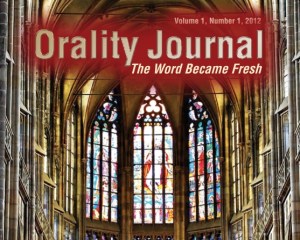
One of the key networks for Bible and orality is the International Orality Network. ION have recently announced the publication of the first issue of a new journal focusing on the theme of orality. You can find a link to the full issue pdf here: Orality Journal – volume 1 number 1.

No doubt this will be an indispensable journal. Here is the description of the journal and list of articles to the current issue:

Orality Journal is the journal of the International Orality Network.  It is published online semi-annually and aims to provide a platform for scholarly discourse on the issues of orality, discoveries of innovations in orality, and praxis of e!ectiveness across multiple domains in society.  This online journal is international and interdisciplinary, serving the interests of the orality movement through research articles, documentation, book reviews, and academic news.  Occasionally, print editions will be created. Submission of items that could contribute to the furtherance of the orality movement are welcomed.

Contents

Editor’s Notes – Samuel Chiang.

The Extent of Orality: 2012 Update – Grant Lovejoy. Using UN and OCED stats, the author shares how a credible analysis emerges concerning the size of oral preference learners in the world today.

The Worldwide Spread of Bible Storying: A Look at Where We’ve Been – J.O. Terry. An overview of the recent history and expansion of the Bible Storytelling movement.

The Two Journeys of Shanti and Jasmine – Tricia Stringer. This article covers insights and elucidation of the rippling effects when orality is practiced in hi-tech communities.

One Thousand Orphans Tell God’s Story – Marlene LeFever. The author shares what could happen when a ministry retools in realtime and includes orality principles and practices.

Mind the Gap: Bhutan as a Case Study – A. Steve Evans. A fresh look at using orality in Bhutan.

Wycliffe Bible Translators to move their training to Redcliffe College – a personal reflection

Wycliffe Bible Translators logoLast week Redcliffe College and Wycliffe Bible Translators announced that Wycliffe will be moving their training to Redcliffe. You can see the full press release on the websites of both organisations: Wycliffe / Redcliffe. Here is a snippet:

Eddie Arthur, the Executive Director of Wycliffe Bible Translators in the UK, says, ‘This is a wonderful opportunity for us and for people interested in worldwide mission. Redcliffe College already provides a fantastic portfolio of courses equipping people for mission and leadership roles. Drawing Wycliffe’s courses and experienced teaching staff into the mix can only serve to strengthen the quality of education and training offered at Redcliffe.’

Rob Hay, Principal of Redcliffe College, says, ‘This move will create fantastic opportunities for future students who are training to serve God around the world. There will be the chance to study cross-cultural mission, Biblical studies and linguistics all under one roof. There’s also potential for new courses in the future that formally combine the skills and expertise of the two organisations.’

Along with Bible Society, Wycliffe have been instrumental partners in the development and delivery of the MA in Bible and Mission here at Redcliffe and the wider initiative that is the Centre for the Study of Bible and Mission. For this and many other reasons the joining together of Redcliffe and Wycliffe’s training makes such a lot of joyful sense. Partnership works when it is driven by a shared commitment to the Kingdom; mutual trust and humility; an imagination for what could be; and a sense of what needs to happen to get there. The more I have worked with friends at Wycliffe the more humbled and inspired I am by the ministry and the people engaged in it. As I have learnt more about Bible Translation, Scripture Engagement, Orality, and the many other aspects of Wycliffe’s work I have found myself deeply challenged in my own engagement with the Bible and the complexities and joys of sharing it with others. I believe the experience has enriched my view of God, of his Word, of his Church and of his mission, and I hope this comes across in my teaching as well.

So it is with gratitude and excitement that I reflect on the past and consider the future. May God bless this strategic partnership for the service of his Kingdom. May we all learn from one another and may we be more equipped for our participation in God’s mission as a result.

Reading the Bible missionally – getting into the authors – part 1

The ‘Reading the Bible Missionally’ module on Redcliffe’s MA in Bible and Mission is now in full swing. Having surveyed the development of the approach, we have discussed George Hunsberger’s article , ’Proposals for a Missional Hermeneutic: Mapping a Conversation‘. We then spent last week getting to grips with Chris Wright’s methodology, as laid out in part one of his The Mission of God: Unlocking the Bible’s Grand Narrative. In later sessions we will follow the structure of Wright’s book as we unpack what a missional reading of the Bible will look like. However, it will be important for us to be drawing our discussions from a wider context and so this week and next students are coming prepared to present on and chew over the work of six other writers in the field of missional hermeneutics.

This week will be the turn of Michael Goheen, Richard Bauckham and Dan Beeby. As a sampler of what we are reading here is a link for each of them of articles or previews freely available on the web:

Goheen, M.W. ‘Continuing Steps Towards a Missional Hermeneutic’Fideles, Volume 3 (2008), pp.49-99.

Bauckham, R. ‘Mission as Hermeneutic for Scriptural Interpretation‘, Currents in World Christianity Position Paper, Number 106 (1999).

Beeby, H.D. Canon and Mission (Harrisburg: Trinity Press International, 1999).

Psalm 23 and mission – Jesus as shepherd, host, Emmanuel

I came across this quote in McCann’s NIB commentary on the Psalms while preparing for an undergad module on Missional Texts: Psalms & Genesis 1-11

In short, in NT terms, Jesus is shepherd, host, Emmanuel. When Psalm 23 is heard in the context of Psalm 22 and of Jesus Christ, its profoundly radical implications are even clearer: God is with us, but is not ours to own; the God who shepherds us to life also gives life to the world; the table at which we are hosted is one to which the whole world is invited.

Students Uncover the Gospel of Luke

Uncover projectWhen I was a student at Aston University in Birmingham we gave out Luke’s Gospels as part of a mission week. Christian Unions all over the UK were doing questionnaires, lunchtime evangelistic talks, big meetings, small groups Bible studies, and so on. That was back in 1994-5 and things have come full circle but in a digital media way.

Have a look at what UCCF have done to help people engage with the Gospel of Luke: Uncover website.

And here’s some info from UCCF’s own website about the project:

Uncover Gospel Project

Uncover is a national Christian Union campaign to give 50,000 students the opportunity to meet with Jesus in Luke’s gospel.

Would you pray for five friends, give them a gospel and invite them to read it with you? If every CU member did so, we’d reach 50,000 students. Want to take part in the biggest CU project in Great Britain? Order Uncover Seeker Bible Study guides, encourage your friends to ask their questions at uncover.org.uk and finally, if you’re a CU leader, order Uncover Gospels for your CU.

Missional hermeneutics – what are the actions?

Just a short post today inspired by my four-year-old daughter, who has just started school.

I jokingly asked her whether she wanted me to come to her school and teach them about missional hermeneutics. Her reply amused me at first and then caused me to reflect on the purpose of it all:

‘No, they won’t know the actions.’

Reading the Bible must lead to something: change, conversion, challenge, repentance, worship, etc. So where does a missional reading of the Bible lead us? Surely it should be to transformation, of the self, of communities, and of the world.

My daughter ‘spoke more than she knew’. She is quite right to expect that missional hermeneutics should involve action, as well as reflection. I also like the assumption that missional hermeneutics can be conceptualised as a song. But what are the actions?…

Bible Sunday 2012

ImageThe brilliant Bible Society are providing resources for Bible Sunday on 28 October here in the UK. Here’s some explanation from the Bible Society website:

28 October or any day you choose!


Welcome! We hope you will join Christians all over England and Wales as we celebrate the Bible.

Then join our campaign to Bless You by putting the Word into action with acts of biblically-based blessing.
 

Anyone can join the celebration

As an individual: Take time yourself on Bible Sunday to get deeper into the Bible. Share it on facebook.

As a group: Use our Bible Society resources for a fresh approach to the Bible in your home group and share the stories of people waiting for the Bible in their own language.

As a church: Hold a Bible Sunday service at your church, celebrating the importance of the Bible and raising money to see people all over the world receiving the Bible.
 

Celebrate the Bible

Bible Sunday is about celebrating the impact of the Bible in our lives, our churches and our communities. Share your story on facebook!