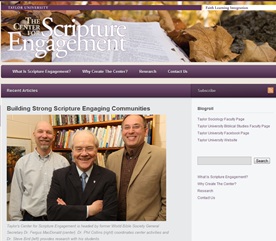
Taylor University launches Center for Scripture Engagement

Taylor University in the US has established an initiative to promote Scripture Engagement. You can view the website here: Center for Scripture Engagement

The home page gives a rationale for the existence of the center, focusing on three factors:

1) Because Scripture Engagement Is The Cutting Edge of Evangelism

2) Because Engaging With Scripture Is The Catalyst For Transformational Discipleship

3) Because A New Vision Of The Power of Scripture Is Urgently Needed


It is worth noting that the language of Scripture Engagement can be used in both broad and specific ways, so it is always helpful to know exactly what a particular author or organisation means by the term (or its related terms, Scripture Use, Bible Engagement, etc).

Taylor’s Center for Scripture Engagement understands SE as follows:

Scripture engagement is interaction with the biblical text in a way that provides sufficient opportunity for the text to speak for itself by the power of the Holy Spirit, enabling readers and listeners to hear the voice of God and discover for themselves the unique claim Jesus Christ is making upon them.

It then identifies distinct (though related) categories of SE:

Personal – interacting with Scripture during one’s private devotions.
Small Group – interacting with Scripture along with others.
Liturgical – the public recital of Scripture during acts of worship.
Rhetorical – public proclamation of the message of the Scriptures.
Didactic – instructional learning from Scripture in an educational context.

Finally, the Center suggests what SE enables us to do:

  • Discover God.  As we engage with the Holy Scriptures, God – Father, Son, and Spirit – mysteriously and graciously meets us, speaks to us, empowers us, and leads us into the next steps in our journey of faith.
  • Discover Our Mission with God.  The world urgently needs to hear the biblical story of God’s mission to rescue and reconcile the human race from its plight of insurgency, brokenness, and self-absorption.  By indwelling the biblical story and telling others about the story, we become an integral part of the very story we are invited to live and tell.
  • Discover Jesus Christ.  The Bible is the means through which Jesus exercises His Lordship over us.  The Scriptures testify to Jesus as the giver of eternal life (John 5:39; 6:68).  Engaging with these Scriptures is a vital feature of Christian discipleship.
  • Discover the Mission of the Church.  Scripture engagement transforms, inspires and enables the Church to express its life in vibrant ways and to accomplish its mission in the power of the Spirit.
  • Discover Values for Life.  Transformational Scripture engagement by the Christian community is the most effective driver in advocating the adoption of biblical values in public life.


We wish the new Center well and look forward to seeing how their research and other activities develop. Thanks to the ever-brilliant Scripture Engagement website for making us aware of this new initiative.

Free access to Thomas Schirrmacher’s World Mission book

The World Evangelical Alliance have made available Thomas Shcirrmacher’s collection of essays, World Mission: Heart of Christianity, which touches on a number of important Bible and Mission themes, as illustrated by the blurb: ‘One of the leading evangelical professors of mission and mission activist in Germany shows in a fascinating way, how the essence of God, of the Bible and of Christian faith is centered in World Mission.’

You can download the book as a pdf file here: World Mission: Heart of Christianity

Here is the contents

Romans as a Charter of World Mission: A Lesson in the Relation of Systematic Theology and Missiology (1993)

Paul: Theologian and missionary; The forgotten frame of Romans; Dogmatics and world Mission; World mission the fulfillment of the Old Testament; Reaching the unreached

‘Missio Dei’ – God, the First Missionary (1994)

Biblical Texts on Mission – Seven Lessons

Missions in the Old Testament Prophets; Missions in the Book of Jonah; Missions in Book of Joel; Missions in the Book of Daniel; Daniel as missionary to the Heathen; God’s worldwide kingdom is coming; Old Testament Arguments for New Testament Missions; Missions in the Gospel of John; Missions in the Gospel of Matthew

Biblical Reasons for Evangelical Missions: 31 Propositions

Part I: World Missions are an essential part of Christianity; Part II. Missions and Cultural Diversity; Part III. Conversion and Social Change

An Evangelical View of Missions – A Summary (1995)

Jesus as Master Educator

1. Teaching and Life; 2. The Training of the Twelve Apostles; 3. Paul and his COLLEAGUES; 4. Having a role model, being a role model

Social Responsibility in the New Testament Church according to Acts 6

The Trinity in the Old Testament and Dialogue with Jews and Muslims (1991)

1. The problem; 2. The Trinity in the Old Testament; 3. Ethics and trinitarian monotheism versus monistic monotheism

Postmillennialism and Missions

Great Missiologists

Gisbertus Voetius; Aurelius Augustinus; Theodor Christlieb; Missions in Martin Luthers Thinking; Martin Bucer – The German Who Gave England its Liturgy

Great Commission

The Great Commission as climax of the four Gospels; The Great Commission and the OT; The content; History; Bibliography

The Gospels as Evidence of the Necessity for Cultural Adaptation in the Missionary Proclamation (Together with Frank Koppelin)

Missions in light of cultural diversity; A Comparison with the Koran; The Recipients of the Four Gospels; The Gospel of Matthew


Thanks to LICC’s ever-informative Antony Billington who highlighted this.

Why we don’t ‘need’ so many versions of the Bible in English

We recently had an intensive Hebrew Week here at Redcliffe. There were two tracks: a group of beginners getting to grips with the language for the first time, and a group of intermediates who were wanting to consolidate and take on their prior learning.

I was struck once again as the week went on by the outrageous privilege we English speakers have when it comes to the resources we have at our disposal. If you don’t get on with one Hebrew Grammar book there are plenty of others to choose from. But it’s not just the abundance of textbooks that we enjoy.

Inevitably on a week like that the question comes up, ‘So why do we need so many versions of the Bible?’. My response of late is to say, ‘We don’t!!’ Of course I then qualify this by saying it is a wonderful privilege to have different versions appropriate for different types of reading (study, devotional, public reading, etc). It is really nice to have these but we don’t need them in the same way that a third of a billion people still need the Scriptures in their own languages.

The Jesus Film and new media

Thanks to Scripture Engagement for highlighting this story. The Jesus Film Project are working on how they can make the film available in ways that will engage users of mobile and digital technology.

As revolutionary as Bill Bright’s original vision was to reach the world through the university campus, so the new Digital Media app* could have just as much potential to transform the world. Tens of millions of people in closed nations will be able to see and hear the gospel on their smartphones or video tablets in their heart language─no matter where they live or how dangerous it may be for Christians there. And people can link anyone to the app through Facebook, a blog or a Tweet with Twitter.

The Jesus Film is not without its challenges (see some of the articles discussing the issue of the ‘visual predicament of the film in our Bible and Orality resources section) but, particularly in certain contexts, it is still a wonderful tool for the Gospel. It is great to see it being used in increasingly innovative ways.

SBL GOCN forum on missional hermeneutics part two – five questions for a missional reading framework

In my previous post on the GOCN forum on missional hermeneutics at SBL, I included the forum’s self description, which included their framework for a missional reading of Scripture.

I think the framework deserves a post in its own right. The discipline of missional hermeneutics is still in its infancy and many ‘missional’ questions could be asked of any text. So it is helpful that the group is providing a way forward on this by delineating several helpful (though not exhaustive) questions. I paraphrase the questions below (students take note!).

To really get where these questions are coming from it would be useful to read the background to the forum’s work which can be most usefully found in George Hunsberger’s 2009 paper, ’Proposals for a Missional Hermeneutic: Mapping a Conversation‘,Gospel and Our Culture Newsletter eSeries, 2 (January 2009). [Subsequently published as G. ‘Proposals for a Missional Hermeneutic: Mapping a Conversation’, Missiology, 39:3 (July 2011), 309-321.]

Anyway, here is there framework, which I have put in the form of questions. What do you think about them? What would you change or add?

(1) how does the biblical text renders the identity of the missio Dei, the God who is engaged in mission to the whole creation?;

(2) how has the biblical text been shaped for the purpose of forming a people of God who are called to participate in God’s mission to the creation?

(3) how does the biblical text evoke and challenge a missionally located community’s interpretive readings and questions?;

(4) how does biblical text relate the received tradition to a particular context in light of the good news of the reign of God in Jesus Christ?;

(5) how does the biblical text discloses its fullest meaning only when read together with the culturally and socially ‘other’?

SBL GOCN forum on missional hermeneutics part one – Reading Genesis 1-11 missionally

One of the main catalysts in the development of a missional reading of the Bible has been the annual gathering at the Society of Biblical Literature of the Gospel and Our Culture Network forum on missional hermeneutics.

This forum describes itself as exploring:

intersections of missiology, ecclesiology, and biblical interpretation, focusing on hermeneutical issues that arise in view of the Church’s missional character. In particular, presenters and participants at the Forum explore how faithful interpretation of Scripture needs to pay attention to a number of interlocking realities in the text: (1) the ways in which the biblical text renders the identity of the missio Dei, the God who is engaged in mission to the whole creation; (2) the ways in which the biblical text is shaped for the purpose of forming a people of God who are called to participate in God’s mission to the creation; (3) the ways in which the biblical text evokes and challenges a missionally located community’s interpretive readings and questions; (4) the ways in which the biblical text relates the received tradition to a particular context in light of the good news of the reign of God in Jesus Christ; and (5) the ways in which the biblical text discloses its fullest meaning only when read together with the culturally and socially ‘other.’

For this year’s forum the theme is ‘Reading Genesis 1-11 Missionally’. On this the forum states:

These foundational texts from Genesis disclose important truths about the nature of God and God’s mission to the world, and about the identity and vocation of the people of God, who are called to participate in this gracious mission. Proposals for papers are invited (in the form of one-page abstracts) which engage a specific passage or set of passages within Genesis 1-11—in view of the hermeneutical framework identified above—and which explore the extent to which such a missional approach to the biblical text illuminates important dimensions of the text.

It is great to see the forum tackling and OT text, especially one so foundational as Genesis 1-11. At Redliffe we have a 2nd year undergraduate module called, ‘Missional Texts: Psalms and Genesis 1-11’. I hope that the results of the forum will be published in one form or another so that we can benefit from reflections of this exciting group.

Free Access to Chris Wright on Christian Mission and the Old Testament Matrix or Mismatch

The Henry Martyn Centre in Cambridge has some fantastic resources available for the study of mission, including a number of papers related to the Bible and Mission.

One excellent example is Chris Wright’s 2000 paper on ‘Christian Mission and the Old Testament: Matrix or Mismatch’. Although he has written at more length and more recently on the subject it is helpful to have such resources freely available. Just as a taste, in his paper Wright responds the the paucity of reflection on mission in the OT (most famously by Bosch) by saying:

A more fully biblical understanding needs to show how the missionary mandate of the NT had its roots in the OT scriptures. This task requires careful attention to the rich texture of OT themes and texts that shaped, justified and motivated that NT mission through Israel’s self-understanding of their own mission as the elect people of God in the midst of the nations. What follows is a brief survey of some of the themes that might be included in such a task.

His survey works through several headings:

– The uniqueness and universality of Yahweh
– The purpose of Yahweh: blessing the nations
– Yahweh’s election of Israel for the purpose of blessing the nations
– The interaction of Israel and the nations, historically, culturally, religious
– The ethical dimension of Israel’s ‘visibility’
– Eschatological vision; ingathering of nations
– Models of ‘mission’ (key events, institutions, individuals)

No-one has done more to put the OT on the agenda of Bible and Mission scholarship than Wright. Although the paper will have been supeceded by his more recent and more substantial writings (see a list in our Bible and Mission books and articles section) it is great to have a record of the developing thinking of Wright as part of the wider conversation.

Brian Russell videos on The Bible as Mission Document

Asbury Seminary has a nicely produced series of videos called ‘Seven Minute Seminary‘ .

Two videos are presented by Brian Russell on the theme of ‘The Bible as Mission Document’. Check them out!

If you enjoy these check out Brian’s Catalyst journal article on What is a Missional Hermeneutic? as well as his blog as well.

EEA’s Biblical Guidelines on Civil Public Square Thinking

EEA websiteThe European Evangelical Alliance has just published a document entitled, ‘Biblical Guidelines on Civil Public Square Thinking’. You can find the full document, as well as a summary, on the EEA website.

Just as a taster, here is the intro to the summary, main headings and concluding statement.

EEA encourages all Christians to work for & in a civil public square with freedom, space for the Gospel to thrive, respectful co-existence of different kinds of people & peaceful resolution of conflicts. We believe this is a thoroughly biblical duty for the following reasons.

I-THE FOUNDATION: God’s blessings to his people have always been for the wider good

1-God´s own character. His goodness & mercy are great & for all. (Psalms 145: 9, 15-16, Psalm 103: 8, 11).
2-Jesus Christ: the visible image of God´s mercy for all (John 1: 9).
3-The Early Church & the apostolic teaching: example & evidences in everyday life (Romans 12: 18).

II-THE IMPLEMENTATION: God´s will in relating to mankind is to promote respect for difference, to respect freedom & demand responsibility

1-Promoting a genuine respect for difference (Romans 15: 7).
2-Respecting freedom and demanding responsibility (1 Samuel 8: 19-22).

III-A CHALLENGE: SOME PITFALLS TO AVOID

A narrow horizon: lack of a “wider embrace”.
The hidden lamp: lack of visibility.
The temptation to try to make people be like us: lack of love & grace.
Imposing versus proposing: lack of respect for difference.CONCLUSION

To have a prophetic impact, we must follow the example of the Servant of the Lord, who was a blessing for all (Isaiah:49: 6). This great challenge implies example, proclamation, invitation, defence & confrontation in the civil public square. Such a great task is impossible to accomplish with human resources. The freedom revolution that Jesus ushered in is so radical that, without a moral steer from the Holy Spirit, the Scriptures and much prayer, it literally cannot be handled. We pray earnestly for the Lord’s help.

What do you think?

Missional Bible Studies – some questions

Recently one of the students on our MA in Bible and Mission circulated an outline for people at his church of the kinds of questions a missional approach to the Bible would ask. How would reading the Bible through the lens of mission shape our preaching or Bible studies? Take a look via the link below.

Reading the Bible Missionally – Questions – final (shared with permission)